In a 2025 Salesforce CFO pulse study, 74% of finance leaders said they expect up to 20% cost savings and revenue uplift from agentic-AI programs over the next three years. The message is clear: agentic AI in finance isn’t coming—it’s here, it’s profitable, and it’s separating winners from the also-rans.
For financial institutions, the real advantage comes from rethinking how they work. Agentic AI changes decision-making, customer interactions, and day-to-day operations. To benefit fully, companies need to redesign workflows, adjust resource allocation, and rethink what gives them an edge in the market.
This article serves as a guide for C-level executives, innovation leaders, and decision-makers in the financial industry. It explains what agentic AI is and why it matters for finance, presenting a clear view of the opportunities it creates, the risks involved, and the practical steps leaders can take to move from exploration to implementation—supported by Neontri’s experience and recent market research.
Key takeaways:
- Agentic AI delivers measurable financial impact: 74% of finance leaders expect up to 20% cost savings and revenue uplift over three years, with institutions like JPMorgan saving over $144 million annually through AI-powered document processing.
- Success hinges on three strategic decisions: Financial institutions must choose their implementation path (build, buy, or partner), regulatory stance (aggressive, conservative, or strategic), and talent strategy (direct hiring at $3-5M annually, upskilling, or partnering).
- Compliance demands structured governance: Since 2008, banks have paid over €321 billion in fines for misconduct. Successful AI adoption requires navigating overlapping regulations like Basel III, GDPR, PSD2, and the EU AI Act while maintaining explainability and fairness.
- A clear adoption path separates leaders from laggards: institutions that pilot, build strong data foundations, and scale with oversight achieve major savings and stronger customer experiences. Delays risk customer loss and higher catch-up costs, making agentic AI essential for competitiveness.
What is agentic AI?
Agentic AI is a new class of artificial intelligence systems that can plan, decide, and execute complex tasks with minimal human input. Traditional AI systems and basic chatbots are typically limited to responding to user commands within fixed rules, while agentic AI can choose the best path to reach a goal on its own.
It combines large language models with real-time reasoning and the ability to coordinate external tools and data. These systems learn from experience, adapt to changing conditions, and adjust their strategies over time. They remain under human oversight but operate with a high degree of independence, making them versatile and proactive in supporting business objectives.
How does agentic AI differ from traditional AI in financial services?
Understanding the difference is crucial for grasping the real potential of these technologies in finance. It comes down to autonomy, adaptability, and operational scope, which make agentic AI a more proactive and dynamic solution.
| Feature | Agentic AI | Traditional AI |
|---|---|---|
| Autonomy | Independently plans and executes multi-step tasks | Carries out predefined tasks with human oversight |
| Adaptability | Self-learning, dynamically adapts to new data | Limited, requires manual updates |
| Decision-making | Proactive, makes strategic decisions autonomously | Reactive, based on fixed rules or prompts |
| Data handling | Processes both structured and unstructured data | Works mainly with structured data |
| Workflow integration | Coordinates across multiple systems and workflows | Works within siloed functions |
| Customer interaction | Personalized, adaptive, and anticipates needs | Basic, rule-based responses |
| Risk management | Continuously monitors risks in real time | Relies on historical data and reacts after the fact |
| Compliance | Autonomous monitoring and dynamic response | Supervised changes and periodic checks |
What role does agentic AI play in financial services?
Agentic AI is changing the way financial institutions work by making processes smarter and more flexible. It takes on complex tasks such as portfolio management, credit risk evaluation, and fraud detection, using data-driven decisions to act with minimal supervision.
Since it can learn and adjust in real time, agentic AI also supports personalized services like robo-advisors and dynamic financial planning tools. At the same time, it strengthens resilience by detecting risks early, streamlining responses, and ensuring compliance with regulations.
For financial firms, this means sharper, data-driven insights, improved customer experiences, and the ability to bring innovative products to market faster.
What are the main benefits of using agentic AI in financial services?
Its impact on financial services is seen in tangible benefits across operations and customer experience:
- Greater efficiency: By automating workflows like portfolio rebalancing, credit scoring, and fraud monitoring, agentic AI reduces manual oversight and repetitive tasks. This cuts costs and frees staff to focus on higher-value work. A 2025 Fenergo study found 26% of firms expect annual savings of over $4 million from AI-driven compliance automation alone.
- Smarter decision-making: Agentic AI processes vast data in real time, adapting instantly to market changes. This enables faster, more accurate forecasting and sharper decision cycles. McKinsey notes that firms using AI agents already outperform traditional methods.
- Stronger risk management: Autonomous agents continuously track risks and flag anomalies before escalation, reducing fraud losses and credit risks. Over a third (36%) of adopters prioritize fraud detection, underscoring AI’s role in safeguarding institutions and ensuring consistent regulatory compliance.
- Personalized services: Learning from customer behavior, agentic AI powers tailored advice, robo-advisory, and investment recommendations. This personalization boosts trust and satisfaction—fintechs using intelligent agents already save customers hundreds of dollars annually by avoiding overdraft fees.
- Faster innovation: By handling routine and complex workflows autonomously, agentic AI speeds up the rollout of new products—from buy-now-pay-later to adaptive pricing models—helping firms stay competitive. The global market is projected to soar from $2.1 billion in 2024 to $81 billion by 2034, highlighting its rapid adoption.
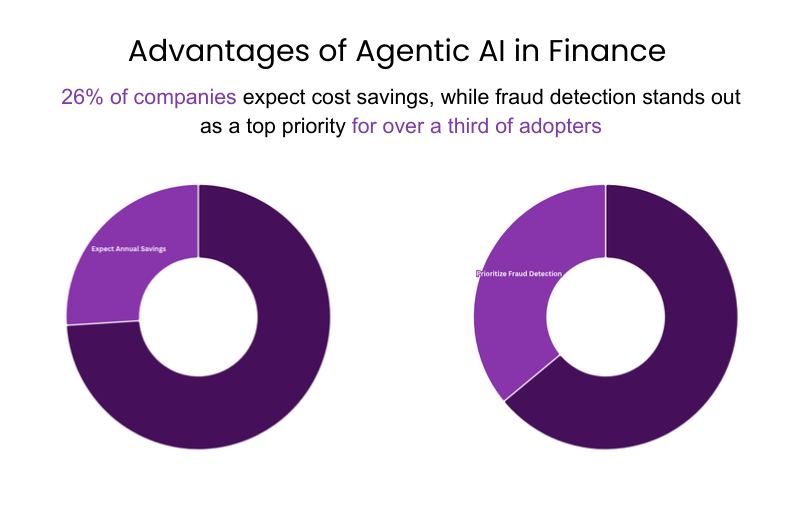
Taken together, these benefits highlight why agentic AI is becoming the new baseline in finance. Citigroup argues that its impact may even surpass the internet era—and by 2027, the industry will likely divide into two camps: the quick adopters reaping gains from efficiency, risk control, personalization, and innovation, and the laggards losing customers and market share. In short, agentic AI is not just an operational tool; it’s a survival strategy.
Applications of agentic AI in financial services
Agentic AI delivers real-time credit approvals and dynamic risk assessments by analyzing data instantly; similar principles can already be applied through automated lending decisioning platforms that combine scoring with end-to-end workflow orchestration.
Credit risk assessment and lending
Agentic AI delivers real-time credit approvals and dynamic risk assessments by analyzing data instantly. This speeds up loan processing while improving accuracy and fairness. It also helps expand financial services to markets that were previously underserved.
Example: JPMorgan Chase’s COIN (Contract Intelligence) platform processes legal documents and credit agreements in seconds, reducing what previously took 360,000 hours of lawyer time annually. This reduction equals more than 41 years of continuous work and translates into over $144 million in cost savings each year.
Fraud detection and prevention
By continuously monitoring transaction data, agentic AI can detect unusual patterns and emerging fraud tactics. These systems dynamically adapt to reduce false alarms and quickly flag high-risk activities. As a result, financial institutions can prevent losses and protect customers more effectively.
Example: Mastercard’s Decision Intelligence processes over 75 billion transactions a year, increasing fraud detection accuracy by 300% while minimizing false declines, which enhances customer experience and reduces losses.
Algorithmic trading and investment management
AI agents execute trades based on market conditions, news sentiment, and risk parameters without human intervention. These systems process vast amounts of financial data in milliseconds, adjusting investment strategies to optimize portfolio performance and at the same time maintaining specified risk levels.
Example: BlackRock’s Aladdin platform, which manages more than $21 trillion in assets, uses agentic AI to analyze market trends, news sentiment, and risk parameters. These insights power advanced risk analytics and portfolio management, enabling autonomous decision-making at scale across thousands of institutional clients.
Beyond optimizing these backend risk parameters, a comprehensive strategic framework for agentic AI in banking allows institutions to extend such efficiencies to consumer-facing interactions.
Customer service and support
Virtual assistants powered by agentic AI handle routine customer requests like balance inquiries, payments, and basic advice around the clock. This automation enhances service speed and availability, allowing human agents to focus on complex interactions and personalized support.
Example: Bank of America’s Erica is a virtual assistant that has handled over 1.5 billion client requests since 2018. It assists customers with tasks like transactions, bill payments, and financial insights 24/7. This AI support improves customer experience and reduces wait times.
Regulatory compliance and reporting
Compliance tasks can be automated by monitoring transactions in real time, checking them against regulatory lists, and producing audit-ready reports. Agentic AI also updates workflows as rules change, reducing manual work and helping institutions stay compliant.
Example: HSBC uses AI to track about 5 billion transactions each month for AML compliance. It automates suspicious activity reports and speeds up investigations by 20%. This makes it easier for the bank to meet regulatory standards.
Document processing and Know Your Customer (KYC)
AI-driven systems extract, validate, and process information from documents such as IDs and tax forms during customer onboarding. This speeds up verification, reduces errors, and ensures adherence to KYC regulations while enhancing the customer experience.
Example: Wells Fargo leverages AI to extract and validate data from income statements and tax forms during mortgage applications. This AI-powered document processing reduces review times from days to just hours, accelerating customer onboarding and improving accuracy.
Challenges and risks of agentic AI in finance industry
While adopting autonomous systems opens the door to greater efficiency, insight, and innovation, it also introduces new responsibilities for financial institutions. By understanding and addressing the following challenges, firms can manage risks and position themselves for long-term success.
Algorithmic bias and fairness
Agentic AI systems influence critical decisions such as loan approvals and fraud detection. If trained on biased or incomplete data, they can unintentionally reinforce harmful patterns and exclude vulnerable groups. To build trust, financial institutions need clear strategies to detect, minimize, and monitor bias, ensuring outcomes remain fair and transparent.
Data privacy and security
AI agents process highly sensitive financial and personal data, often across multiple systems and environments. This expands the potential attack surface and raises security concerns. Strong safeguards are required, including end-to-end encryption, role-based access controls, and zero-trust security frameworks to protect both data and customers.
Integration with legacy systems
Older financial infrastructures may not easily support autonomous AI, complicating smooth adoption and increasing costs. Companies should adopt modular integrations and APIs that enable gradual, scalable incorporation of agentic AI into existing systems.
Explainability and transparency
AI’s decision-making processes can be opaque, making it hard to justify outcomes to customers or regulators. This lack of clarity can lead to disputes—such as when a loan is denied without a clear explanation—and damage customer confidence. To address this, financial companies should implement algorithmic auditing and develop explainable AI models to provide clear, understandable decision rationales.
Complex regulatory landscape
Compliance is one of the toughest challenges when deploying agentic AI. Since 2008, global banks have paid more than €321 billion in fines for misconduct ranging from money laundering to sanctions breaches. To remain compliant, organizations must address multiple overlapping rules, such as:
- Basel III (effective 2027): Requires a minimum 8% capital ratio, incorporates AI system failures into operational risk, and mandates stress testing AI-driven decisions.
- GDPR vs. PSD2: PSD2 demands open access to financial data, while GDPR emphasizes data protection. Institutions must balance these by implementing consent management, audit logs, and strong customer authentication for AI-initiated transactions.
- Regional variations: The EU’s AI Act enforces explainability, the US (FINRA Rule 3110) requires supervisory oversight of AI communications, and the UK’s FCA Consumer Duty mandates evidence of fair customer outcomes.
Practical insight: Navigating the compliance maze requires advanced tools and proactive risk management. For example, Kodex AI’s platform automates regulatory workflows, processing complex requirements up to 12 times faster while ensuring compliance across Basel III/IV, MiFID II, GDPR, and DORA simultaneously.
Talent shortage and cost
Developing and managing agentic AI demands specialized skills that are currently scarce, leading to high expenses. A Deloitte report indicates 68% of executives face a moderate to extreme AI skill gap, with 27% citing it as a highly significant problem. Thus, organizations need to focus on strategic hiring, upskilling existing finance teams, and demonstrating clear ROI to justify investment.
Agentic AI in financial services: Adoption roadmap
Successfully adopting agentic AI requires both a structured rollout plan and a clear view of the strategic choices ahead. Institutions that move thoughtfully can capture value early while building resilience for long-term transformation.
Step #1: Align strategy and identify opportunities—Before starting, align AI initiatives with overall business goals and identify high-value use cases suited for agentic AI. Clear priorities ensure that resources are focused where AI can deliver the greatest impact.
Step #2: Start small, prove value—Begin with pilot projects in high-impact areas such as loan approvals, fraud detection, or compliance automation. Quick wins demonstrate business value and help secure leadership buy-in.
Step #3: Build the right foundation—Clean, connected data and flexible infrastructure are critical. Without this foundation, scaling AI across core banking systems becomes costly and inefficient.
Step #4: Prepare the workforce—A successful rollout depends on people as much as technology. So, foster a culture where employees see AI as a support tool, not a replacement, and provide training to build AI literacy.
Step #5: Scale with oversight—Expansion should be gradual, with human oversight and continuous feedback loops to refine models in real-world conditions. Strong governance and audit trails ensure AI remains transparent, fair, and compliant.
Step #6: Strengthen governance and ethics—As adoption grows, you need formal structures to oversee risk, ethics, and accountability. Clear guidelines, compliance monitoring, and transparency standards build trust among regulators, customers, and stakeholders.
Step #7: Foster partnerships and collaboration—Collaboration with technology vendors, regulators, and industry consortia can accelerate adoption and reduce risk. Partnerships provide specialized expertise and help institutions navigate complex regulatory and technical challenges.
Step #8: Commit to continuous improvement—AI adoption is not a one-time project. Businesses should regularly evaluate performance, security, and market needs while fostering a culture of learning and innovation to stay competitive as agentic AI evolves.
Scenarios of adopting agentic AI: Three defining decisions
Once the foundational elements for agentic AI are in place, financial institutions face three pivotal decisions that will shape the trajectory of their AI journey:
Decision 1: Build, buy, or partner?
Organizations must choose whether to develop AI capabilities internally, license existing platforms, or collaborate with specialized partners. Each option carries distinct trade-offs in investment, speed, and strategic flexibility:
| Path | Cost | Timeline | Control | Risk | Right for |
|---|---|---|---|---|---|
| Build (JPMorgan’s path) | Involves an upfront investment of $50-100 million | 18-24 months to production | Full control | High risk | Best suited for large banks with technology budgets exceeding $1 billion |
| Buy (regional bank reality) | Entails annual costs of $2-10 million | A quicker production timeline of 3-6 months | Limited control | Medium risk | Ideal for banks focused on core financial operations |
| Partner (hybrid approach) | Combines moderate upfront costs ($5-20 million plus revenue share) | A production timeline of 6-12 months | Shared control | Distributed risk | Suitable for firms seeking rapid deployment with flexibility |
Decision 2: Regulatory stance
How companies approach regulation will largely determine the pace and risk of agentic AI adoption. Three possible paths stand out:
| Path | Details | Upside | Risk | Best for |
|---|---|---|---|---|
| Aggressive | Deploy now, adjust later—move quickly, rolling out AI in revenue-generating areas and refining compliance measures along the way | First-mover advantage, faster learning cycles, and enhanced productivity | Higher exposure to regulatory scrutiny and potential compliance failures | Companies with strong risk management, embedded compliance teams, and high risk tolerance |
| Conservative | Wait for precedent—hold back until clear regulatory frameworks and industry standards are in place | Lower regulatory risk and more stable compliance structures | Slower adoption, loss of market position, and higher catch-up costs | Firms with limited risk appetite, heavy legacy constraints, or highly sensitive product lines |
| Strategic (recommended) | Roll out agentic AI gradually—focus first on lower-risk use cases and build a strong compliance framework | Balanced risk and reward, steady learning, and constructive engagement with regulators | Start with areas like back-office operations or customer-service copilots, expand once governance controls prove effective | Those aiming to innovate responsibly while maintaining regulatory trust |
Decision 3: Talent investment
Building in-house AI capabilities requires significant investment in specialized talent, whether through direct hiring, upskilling existing teams, or partnering with third-party experts:
- Direct hiring of a core AI team, totaling approximately $3-5 million annually, includes typical 2025 US market salaries:
- Head of AI: $400-600K
- AI engineers (5): $250-350K each
- Prompt engineers (3): $150-250K each
- AI risk manager: $300-400K
- AI ethics lead: $200-300K
- Training existing staff, which costs 20-30% less but calls for a 12-18 month ramp-up period.
- Partnering with third-party experts offers faster deployment with variable costs based on engagement scope and duration.


Looking for specialized expertise to deploy and scale agentic AI quickly?
Partner with Neontri to access specialized AI expertise without the overhead. We’ll help you deploy, scale, and optimize agentic AI—fast.
The right approach depends on strategic ambition, existing technical capabilities, and whether the organization seeks long-term platform ownership or prefers flexible partnerships
The future of agentic AI in finance industry
The role of agentic AI in finance is shifting from isolated use cases to institution-wide transformation. Its next phase will be shaped by several key trends that redefine how services are delivered and managed:
- Agent-to-agent systems: AI agents will work together across departments like risk and treasury, sharing information and acting automatically without constant human help. As a result, banks will be able to respond faster and more accurately.
- Real-time compliance checks: Regulations will be monitored continuously, with AI enforcing policies instantly to streamline audits and strengthen oversight.
- Hyper-personalization: Services and recommendations will adapt to each customer’s behavior and context in real time, making banking more relevant and engaging.
- Customer autonomy: AI will handle simple, low-risk decisions for customers, such as adjusting payments or optimizing savings, within bank-approved limits to enhance convenience without risk.
- Self-optimizing AI agents: AI systems will keep learning and improving on their own, reducing the need for constant human intervention.
- Collaborative human-AI workforce: People will work alongside AI assistants, training and supervising them to deliver faster, safer, and more accurate financial services.
Agentic AI is not here to replace people but to support them by speeding up processes, improving accuracy, and enhancing trust. For success, financial institutions must invest in clean, unified data, clear governance frameworks, and precise AI systems capable of executing tasks reliably.
The uncomfortable questions your board will ask (and how to answer)
Question: “What if the AI makes a catastrophic error?”
AI agents are designed with safeguards such as guardrails, kill switches, confidence thresholds, and escalation paths to humans. These mechanisms ensure that decisions can be reviewed and corrected when necessary. While autonomy raises questions about accountability, oversight remains central—and unlike human errors, AI mistakes are often easier to detect and fix.
Question: “How do we know it’s not hallucinating?”
Enterprise AI agents apply strong guardrails to prevent fabricated outputs. These controls are enabled by default, can be adjusted to institutional needs, and ensure that financial agents rely only on enterprise data. Each response is traceable to its source, giving decision-makers confidence in the results.
Question: “What about job losses?”
AI won’t replace auditors or risk professionals but will change the nature of their work. Routine, manual tasks give way to higher-value responsibilities such as robust oversight, analysis, and strategic decision-making. Institutions that invest in reskilling will retain talent, while those that delay risk losing skilled staff to more forward-looking competitors.
Question: “Can we trust vendor promises?”
No. Expecting instant and guaranteed ROI from agentic AI is as unrealistic as with any other technology. Demand proof-of-concept deliveries, penalty clauses, and staged deployments.
Conclusion
Agentic AI is transforming financial services with gains in operational efficiency, cost reduction, and customer experience. While it brings new challenges, institutions that adopt it responsibly can unlock its full potential and secure a lasting competitive edge. The future of banking will increasingly depend on how effectively firms combine human judgment with autonomous intelligence.
FAQ
What ethical challenges does autonomous agentic AI pose for finance?
Autonomous agentic AI raises concerns around transparency, accountability, and fairness. Because these intelligent systems often operate like “black boxes,” it’s difficult for institutions to explain decisions to customers or regulators, leading to trust and compliance issues. Bias in AI models can also cause unfair treatment, especially in credit decisioning, requiring ongoing monitoring and ethical safeguards.
How might agentic AI impact employment within financial institutions?
By automating routine tasks, agentic AI will redirect employees toward more strategic, analytical, and oversight roles. While some job functions may decline, new opportunities in AI management, data literacy, and ethical governance will grow, making upskilling and workforce adaptation essential.
How does agentic AI integrate with existing core banking systems?
In most cases, agentic AI connects with legacy core banking systems through APIs and middleware, enabling it to access real-time data and automate financial workflows without disrupting existing infrastructure. By plugging into these systems, AI agents can enhance core processes such as credit assessment, compliance, and customer service at scale.
What is the expected ROI of adopting agentic AI in financial services?
Financial institutions adopting agentic AI report operational cost reductions ranging from 20% to 30%, alongside improved decision speed and customer satisfaction. For example, Citi projects over $500 million in annual savings within a few years of full deployment, demonstrating significant return on investment.
Is agentic AI secure enough for sensitive financial data?
Security is a top priority when deploying agentic AI, with companies enforcing strict data encryption, access controls, and compliance with regulations like GDPR. While vulnerabilities exist, robust security frameworks and continuous monitoring help protect sensitive financial data from breaches and misuse.