

Core Banking Modernization Without Risking All Your Money

Migrate your core in phases, with full control at every step
We transfer ledgers, balances, and integrations in defined phases, reconciling data and verifying rollback procedures before each step goes live. Our engineers build and run Tier-1 core systems, from planning through production.
Visa Inc., PKO Bank Polski, and KIR trust us with this work – 18+ banking and fintech clients, 96% retention rate, 400+ projects across 4 continents.


What core banking modernization actually involves
Core banking modernization moves ledgers, accounts, balances, and transaction logic from legacy infrastructure to a cloud architecture, without disrupting daily operations.
It covers core migration, target architecture, API and microservice integration, data reconciliation, and a controlled cutover. Done well, it lowers the cost of future change and creates a stronger foundation for advanced analytics and AI. Handled poorly, it becomes one of the riskiest programs a bank can undertake.
The difference comes down to execution. Here is how we manage each stage of the program.

Why most core programs fail, and how we de-risk yours
Over the past decade, only around 30% of banks that undertook core transformations successfully migrated their ledgers and products to the new system. The same problems appear across programs, and each can be managed with the right controls.

Big-bang ambition, cost
overruns
Integration costs can exceed initial estimates by 50–100%, while decommissioning often takes longer than planned.
Our control:
We modernize in phases using a sidecar pattern and coexistence model,
so each stage delivers real value and can be rolled back before it puts
the program at risk.
Data that won’t reconcile on day
one
Migrations fail at the ledger. If even one balance or transaction history doesn’t reconcile at go-live, the regulator notices, and so do the customers.
Our control:
Neontri’s experts treat data migration as a dedicated workstream,
covering source mapping, a purpose-built conversion engine,
full dress rehearsals, and sign-off evidence ready before cutover.
A core that already drains the
budget
Banks can spend 15–20% of their total IT budget keeping the legacy core running, while hidden integration, maintenance, and compliance costs continue to erode value.
Our control:
We offload and relieve the core early, generating savings well before
the full migration is complete. That is the approach we used for
PKO Bank Polski.
Our phased modernization approach, tailored to your bank’s profile
The right path depends on asset size, product mix, and risk tolerance. We assess all three before recommending the modernization route.
Tier-1 or large bank |
Mid-market bank ($1–10B in assets) |
Neobank or digital bank |
|---|---|---|
|
We offload read traffic and high-risk lookups from the legacy core into a modern data layer, then replace core functions product by product using the Strangler Fig pattern. It’s the approach our teams used to co-develop the PKO Bank Polski Data Hub and keep it running today. |
We focus the sidecar program on the one or two domains driving the highest cost and risk. The build, buy, or integrate decision is made upfront, so it stays lean and avoids unnecessary engineering. At VeloBank, Neontri automated lending and deposit processes across branch and remote channels, reducing manual work and speeding up delivery. |
For greenfield programs, we build on a cloud-native foundation with the integration and compliance framework required by banks. About 89% of neobanks now launch fully cloud-based. When working with Aion Bank, acquired by UniCredit, our engineers delivered a secure, SCA-compliant mobile banking platform in five months. |
Neontri’s six-stage core modernization process


What you get:
Deliverables at every phase
System audit and readiness assessment
A clear view of your architecture, code health, risk areas, and modernization readiness.
Phased IT roadmap
Sequenced by what reduces risk and returns value fastest, not by vendor convenience.
Target architecture and build/buy/integrate recommendation
Vendor-neutral guidance on what to build, buy, or integrate, with trade-offs made explicit.
API integrations and microservice layer
The contracts, event streams, and idempotency patterns that enable the new core to connect cleanly across channels, payments, AML, risk, and data.
Data migration and reconciliation package
Source mapping, conversion engine, dress-rehearsal results, and day-1 reconciliation evidence.
Tested cutover and rollback plan
Parallel-run evidence and a fallback that has been fully rehearsed, so cutover is never irreversible.
Post-go-live support
Stabilization, knowledge transfer, and ongoing co-development where needed.
Proven on Tier-1 core systems


Data Hub
for PKO Bank Polski
- 70
-
million records
offloaded daily - 10,000
-
requests
per second - Zero
-
service
disruption
PKO Bank Polski needed to reduce pressure on its legacy core mainframe while keeping live banking services stable. Neontri built a Change Data Capture replication layer and an API facade that mirrored the existing interface, moving high-volume queries away from the core without forcing a full replacement.
PSD2 Open Banking Hub for KIR
- 300+
-
banks
connected - 18
-
months
to build - 6
-
months
ahead
of schedule
For Poland’s National Clearing House (KIR), our teams delivered a PSD2 Open Banking Hub connecting banks with EU fintechs. The platform was completed ahead of schedule, showing that regulated banking infrastructure can move quickly when delivery is tightly managed.
IKO mobile banking
for PKO Bank Polski
- 8
-
million
users - 2x
-
named the world’s No.1
banking app
As mobile banking became a primary customer channel, PKO Bank Polski had to deliver an experience capable of serving millions of users reliably at scale. Neontri developed the app layer behind IKO, its flagship mobile banking app, combining high performance with a seamless digital experience that has earned international recognition.
Data Hub
for PKO Bank Polski
- 70
-
million records
offloaded daily - 10,000
-
requests
per second - Zero
-
service
disruption
PKO Bank Polski needed to reduce pressure on its legacy core mainframe while keeping live banking services stable. Neontri built a Change Data Capture replication layer and an API facade that mirrored the existing interface, moving high-volume queries away from the core without forcing a full replacement.
PSD2 Open Banking Hub for KIR
- 300+
-
banks
connected - 18
-
months
to build - 6
-
months
ahead
of schedule
For Poland’s National Clearing House (KIR), our teams delivered a PSD2 Open Banking Hub connecting banks with EU fintechs. The platform was completed ahead of schedule, showing that regulated banking infrastructure can move quickly when delivery is tightly managed.
IKO mobile banking
for PKO Bank Polski
- 8
-
million
users - 2x
-
named the world’s No.1
banking app
As mobile banking became a primary customer channel, PKO Bank Polski had to deliver an experience capable of serving millions of users reliably at scale. Neontri developed the app layer behind IKO, its flagship mobile banking app, combining high performance with a seamless digital experience that has earned international recognition.
Why banks choose Neontri over platform vendors and pure advisors
Engineering, not just advice
We build and run mission-critical core infrastructure and remain involved after launch. The same long-term ownership is behind the PKO Data Hub, which our teams co-developed and have supported for years.

Vendor-neutral by design
Our role is to engineer the right setup for your bank. Since we don’t sell a core platform, our advice stays independent and supports multi-vendor delivery.

Integration-first delivery
Your core system needs to work cleanly with channels, payments, CRM, AML, risk, and data platforms. Our engineers connect those layers without adding integration debt.
One engineering partner
We cover core modernization, data platforms, payment processing, and AI-powered compliance within a single accountable engineering model.

Which approach fits you?
Dimension |
Sidecar/coexistence |
Phased/Strangler Fig |
Big-bang replacement |
|---|---|---|---|
Risk |
Lowest |
Moderate |
Highest |
Typical timeline |
18–36 months per domain |
18–36 months, multi-domain |
3–5 years |
Disruption |
Near-zero (parallel run) |
Low (incremental) |
High (single switchover) |
Cost predictability |
High (staged) |
Medium |
Low (50–100% overruns common) |
Best when |
Core is strained but stable; need fast relief |
Replacing product-by-product over time |
Legacy is end-of-life with no path forward |

Built for the 2026 supervisory bar
Our modernization approach aligns with DORA, NIS2, PSD2, GDPR, and relevant EBA guidance for EU banks. Each phase includes change governance, rollback testing, parallel-run evidence, and audit-ready documentation.
Neontri’s teams have delivered PSD2-enabled infrastructure in live banking environments, including the PKO Bank Polski Data Hub and the PSD2 Open Banking Hub for Poland’s National Clearing House.
Major releases undergo code review, automated SAST/DAST scans, and penetration testing. Encryption, NDAs, role-based access, and separated environments support secure delivery from development through production.
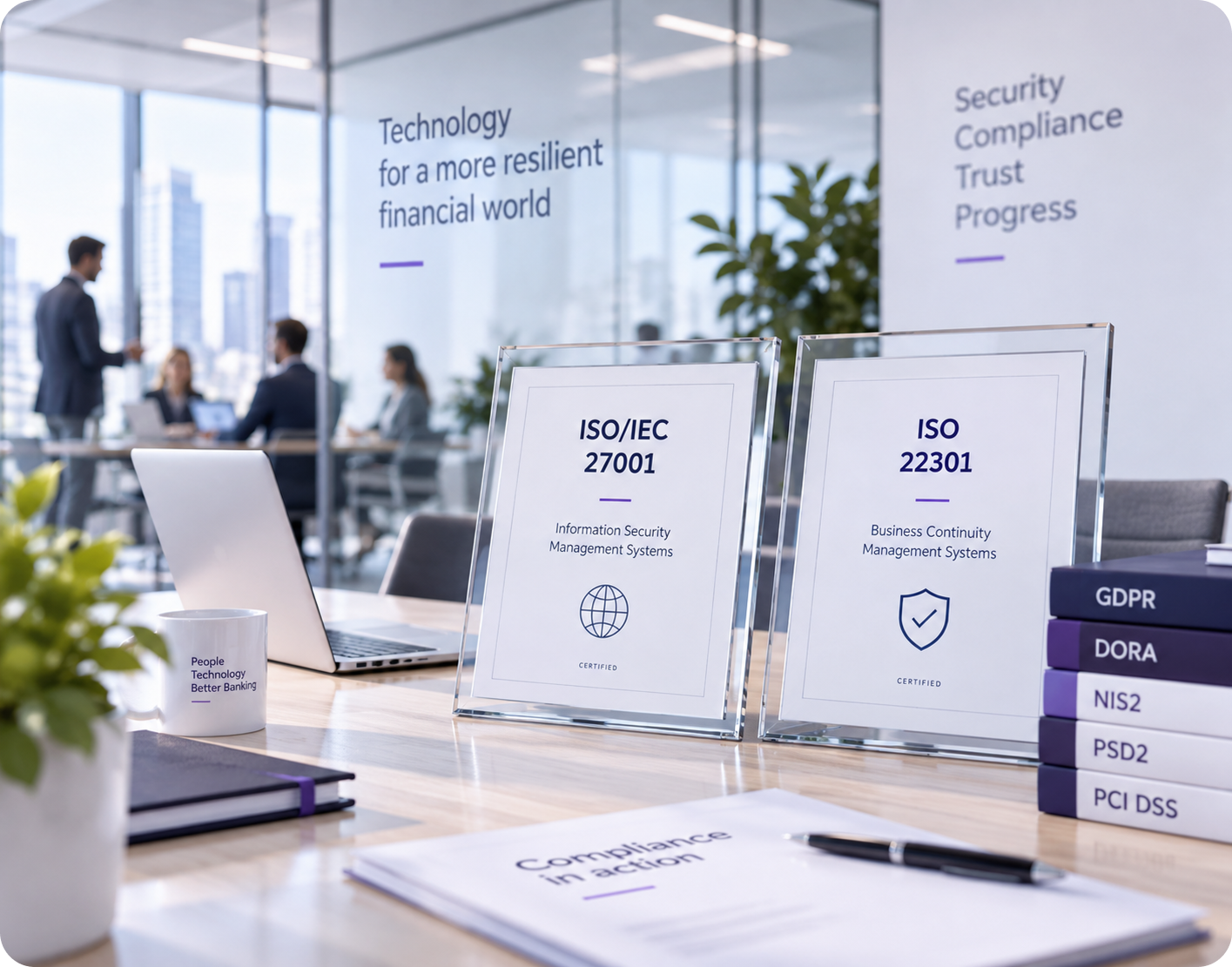
We are certified to ISO/IEC 27001 and ISO 22301 for the design, development, delivery, and operational support of custom software and IT outsourcing services. These certifications verify that our information security and business continuity management systems meet global standards for governance, risk management, security controls, and operational resilience. They also provide a well-established control framework that supports compliance with GDPR, DORA, NIS2, PSD2, and PCI DSS.



What to expect:
Timeline & engagement
01
Timeline
A targeted sidecar or phased program for a single domain usually takes 18–36 months. A full-platform migration can span 3–5 years. Decommissioning can become a major source of delay when it isn’t included in the plan from the start.

02
Cost drivers
The estimate depends mainly on asset base, product scope, integration complexity, and data quality. Data issues often affect the budget once delivery begins.

03
How we start
The first step is a paid assessment. It defines the roadmap and scope, so the estimate reflects your actual environment rather than a number designed to win the deal.

Our partners



Compliance: PCI DSS · PSD2 · DORA · GDPR · ISO/IEC 27001 · ISO 22301
Ready to modernize the core without betting the bank?