A $400,000 custom software project delivered a system nobody could use. The manufacturing company had spent 18 months building an inventory management platform that looked impressive in demos but failed catastrophically in production. Workers abandoned it within weeks, reverting to spreadsheets.
This scenario repeats across industries because the focus is on the benefits of custom software without understanding when those benefits actually materialize. The advantages of such a solution are real and substantial. Organizations report 150–300% ROI when implementations succeed. But success requires matching your specific business requirements to the right development approach.
According to McKinsey research, just one in every 200 IT projects meets all three measures of success: budget, timeline, and intended outcomes. The difference between success and expensive failure isn’t luck, it’s methodology.
This guide provides what competitor resources consistently miss, covering a quantified decision framework, actual ROI benchmarks by company size, hidden cost analysis, and a vendor evaluation scorecard.
Based on Neontri’s experience in custom software development services we will share how to determine if custom software delivers competitive advantage for your situation, calculate realistic investment beyond initial estimates, and select development partners who deliver results.
Key takeaways:
- Custom software delivers 150–300% ROI for mid-market companies within 24 months, but only when project complexity scores above 7 on a 10-point decision matrix. Initiatives scoring below this threshold achieve better outcomes with configured off-the-shelf solutions.
- Hidden costs can add 40–60% to initial custom development estimates, while annual maintenance typically runs at 15–20% of the original build spend, so these should be included in TCO calculations before committing.
- Organizations following structured vendor evaluation processes are significantly more likely to deliver projects on-time and on-budget (Standish Group research), yet most companies skip formal evaluation entirely.
- The build vs. buy decision hinges on three factors: competitive differentiation potential, integration complexity, and five-year total cost of ownership – not on feature lists or initial pricing.
- Healthcare, fintech, and manufacturing sectors show highest custom software ROI due to regulatory requirements and process specificity that off-the-shelf solutions can’t address without extensive modification.
The real cost of getting software decisions wrong: Enterprise-scale impact
The custom software development market reached $43.16 billion in 2024 and is expected to grow at a 22.6% CAGR to $146.18 billion by 2030 (Grand View Research). This trajectory signals a broader shift. As organizations digitize operations, generic platforms increasingly struggle to create lasting competitive advantage.
Yet rapid growth can hide substantial risk. Standish Group research suggests only 16.2% of IT projects are considered successful, meaning they are delivered on time, on budget, and with all promised functionality. Meanwhile, 52.7% run over budget, over schedule, and/or fall short on scope. McKinsey reports that budget blowouts average 75%, while delayed initiatives extend timelines by 46%.
These outcomes rarely come down to incompetent developers or broken technology. More often, they reflect misaligned choices. Companies build custom solutions when a proven product would suffice, or they adopt off-the-shelf software when real differentiation requires tailored development.
The key reframing is simple. Stop weighing feature lists and start measuring strategic outcomes. Custom software is not automatically better or worse than packaged options. It is a different tool for a different job.
The strategic outcomes framework: 4 questions that predict success
Before evaluating specific advantages, answer these questions honestly:
Q1. Does your process create competitive differentiation that customers pay premium prices for?
If operations mirror industry standard practices, custom software often introduces unnecessary complexity. But if the process is your product (as with logistics optimization or financial modeling) custom development protects and enhances the competitive moat.
Q2. Can off-the-shelf software adapt to your workflow, or must your workflow adapt to the software?
When packaged solutions force workflow changes that reduce efficiency or customer experience quality, the “savings” disappear. A mid-sized insurance company discovered its $200K annual SaaS subscription actually ran to $1.2M once workarounds, manual steps, and customer service issues caused by software limitations were included.
Q3. What’s your five-year technology trajectory?
Enterprises planning significant scaling, acquisitions, or market expansion often turn to enterprise software development services for the flexibility that packaged solutions can’t match. Building for tomorrow’s requirements today can also eliminate expensive migrations later.
Q4. Do you have internal capacity to manage custom development?
This requires ongoing decision-making, testing participation, and organizational change management. When weighing outsourcing vs. in-house development, companies without sufficient internal capacity often achieve better outcomes with vendor-managed packaged solutions.
The build vs. buy decision framework: 10-point weighted scorecard
Competitors provide vague advice like “consider your needs.” This framework provides actionable methodology. Score each criterion from 1–10, multiply by weight, then total.
| Criterion | Weight | Score (1–10) | Weighted |
|---|---|---|---|
| Process uniqueness (how different from industry standard) | 15% | ||
| Competitive differentiation dependency | 15% | ||
| Integration complexity (systems to connect) | 12% | ||
| Regulatory/compliance requirements | 12% | ||
| Scale requirements (5-year projection) | 10% | ||
| Data sensitivity level | 10% | ||
| Available Budget (relative to scope) | 8% | ||
| Internal technical capacity | 8% | ||
| Timeline flexibility | 5% | ||
| Change tolerance (organizational) | 5% | ||
| TOTAL | 100% |
Interpretation thresholds:
- Scores 70–100 indicate strong proprietary development fit. Your business requirements, competitive positioning, and organizational capacity align with purpose-built software benefits. Proceed to vendor evaluation.
- Scores 50–69 suggest a hybrid approach. Consider development for core differentiating functions while using off-the-shelf solutions for standard operations. Many successful implementations combine Salesforce or HubSpot with tailored integrations and proprietary modules.
- Scores below 50 favor off-the-shelf solutions. The situation doesn’t generate sufficient return on custom development investment. Focus on selecting and configuring the best packaged solution for your needs.
The core reframe applies here: custom software advantages only materialize when strategic conditions warrant the investment. Without those conditions, this type of development becomes expensive complexity. More detailed in the article: Build vs. Buy Software: A 3-Model Decision Framework
7 strategic advantages of custom software development: Quantified analysis
Generic benefit lists populate every competitor article. Here’s what they miss: quantified outcomes and the conditions required to achieve them.
Advantage #1: Competitive differentiation protection (ROI impact: 25–40% revenue premium)
Custom software supports workflows competitors can’t easily replicate. According to McKinsey research, enterprises with high-performing IT organizations have up to 35% higher revenue growth and 10% higher profit margins than their peers. When your software is your competitive advantage, building it yourself prevents commoditization.
A fintech company processing specialty lending built tailored underwriting algorithms that reduced approval time from 72 hours to 4 hours while maintaining default rates below industry average. Off-the-shelf lending platforms couldn’t accommodate their proprietary risk models. The custom platform enabled 340% growth over three years while competitors using standard platforms remained constrained by identical capabilities.
Condition for achieving this advantage: The process must create measurable customer value that off-the-shelf solutions can’t deliver.
Advantage #2: Integration flexibility (Efficiency gain with 15–35% time savings)
Enterprise environments typically run hundreds of software applications. Mordor Intelligence research says that large firms managed an average of 897 applications in 2024 with only 29% integrated. Custom software provides unlimited integration flexibility with existing systems (ERP, CRM, legacy databases, IoT devices) without the constraints of packaged solutions.
A manufacturing enterprise reduced order-to-ship time by 35% after building custom software that integrated their ERP, warehouse management, shipping carriers, and customer portal. The off-the-shelf WMS they evaluated required workarounds for 40% of their integration scope.
Key requirement to gain this advantage: Complex integration needs spanning more than five systems, legacy application modernization, or proprietary protocols.
Advantage #3: Security and sensitive data control (Risk reduction through significant attack surface decrease)
Off-the-shelf software represents known targets with documented vulnerabilities. IBM’s Cost of a Data Breach Report 2025 puts the average global breach cost at $4.44 million, while the U.S. average climbed to $10.22 million, a record high. Supply-chain compromise accounted for 15% of breaches, averaging $4.91 million, and third-party involvement rose sharply, from 15% to 30% in a single year.
In healthcare, organizations handling protected health information are increasingly building custom patient portals instead of relying on commercial platforms. The sector remained the most affected for the 14th consecutive year, with breaches averaging $7.42 million in the 2025 IBM report. One regional health system cut security incidents by 73% after moving from a vendor portal to a custom-built solution, using role-based access controls tailored to its care delivery model.
Condition for making this work: Handle sensitive data with regulatory requirements (HIPAA, PCI-DSS, GDPR) or face elevated threat profiles.
Advantage #4: Scalability without licensing constraints (Cost avoidance of $500K–$2M at enterprise scale)
SaaS pricing scales with usage, often exponentially. Purpose-built solutions eliminate fees tied to user seats, transaction volume, and record counts. Gartner has consistently pointed to strong SaaS growth and a market moving toward the $300B range, alongside rising enterprise software spend and higher IT cost expectations from CIOs. These signals suggest that licensing and consumption-based pricing remain a structural driver as organizations scale.
An e-commerce company processing 50,000 daily orders calculated their commercial OMS would run to $1.8M annually at scale. Their custom order management system required $600K to develop with $90K in annual maintenance, breaking even in 14 months with $1.5M+ savings over five years.
When this applies: Transaction volume, user count, or data volume projections indicate licensing fees exceeding $200K annually within 3 years.
Advantage #5: Intellectual property ownership (Asset value, 10–30% of company valuation)
When you build software, you own it. This creates tangible assets on your balance sheet and prevents vendor lock-in. For businesses pursuing acquisition or investment, proprietary technology platforms significantly impact valuation.
According to industry analysis, B2B software companies with proprietary platforms command 2–3x higher revenue multiples than those dependent on third-party infrastructure. A logistics technology firm implemented custom route optimization software that became their primary acquisition asset – valued at $40M during due diligence despite generating only $5M in annual cost savings internally.
Condition for achieving this advantage: Technology is core to your business model, or you anticipate exit events where IP contributes to valuation.
Advantage #6: Process-perfect fit (Productivity gain, 20–45% user efficiency)
Off-the-shelf software forces standardized workflows. Custom software molds to proven operations. As stated by McKinsey, workflow-optimized software implementations deliver 20–45% user productivity improvements compared to 5–15% for configured commercial solutions.
After a commercial platform failed to match its claims workflow, an insurance carrier turned to custom insurance software development. The resulting solution helped adjusters handle 40% more claims per day and contributed to a 22% increase in customer satisfaction.
This works best when: Operational processes are proven, optimized, and demonstrably superior to industry-standard approaches.
Advantage #7: Long-term cost efficiency (5-year TCO reduction of 30–50%)
Custom software usually costs more initially but less over time. It can deliver 30–50% lower five-year TCO than commercial alternatives for organizations that meet complexity thresholds (Forrester’s Total Economic Impact methodology).
| Cost category | Commercial SaaS (5-year) | Custom software (5-year) |
|---|---|---|
| Initial license/development | $50K–150K | $200K–600K |
| Annual licensing | $100K–400K × 5 | $0 |
| Customization/integration | $50K–200K | Included |
| Annual maintenance | $20K–50K × 5 | $30K–90K × 5 |
| Scaling costs | Variable (often exponential) | Fixed infrastructure |
| 5-year total | $750K–2.5M | $350K–1.05M |
Condition for achieving this advantage: Five-year projections indicate scale that triggers exponential SaaS pricing, AND you have organizational stability to benefit from long-term ownership.
The hidden costs nobody talks about: 15 budget categories beyond development
Custom software development benefits only materialize when budgeted accurately. Here’s the complete picture that transforms initial estimates into realistic budgets.
Phase #1: Pre-development costs (Add 10–15% to base estimate)
Discovery and requirements documentation: $15,000–50,000 depending on complexity. Thorough discovery prevents expensive mid-project changes. Organizations skipping this phase experience 2.5x higher change request costs.
Architecture and technical planning: $10,000–30,000 for comprehensive system design. This investment prevents expensive refactoring when scalability or integration requirements surface mid-development.
Vendor evaluation and selection: $5,000–15,000 in internal time investment. Structured evaluation processes require 40–80 hours of stakeholder time across RFP development, demonstrations, and reference checks.
Phase #2: Development-adjacent costs (Add 15–25% to base estimate)
Project management overhead:15–20% of the build budget for professional PM resources. PMI research shows initiatives without a dedicated PM run into 28% more delays.
Quality assurance and testing: 20–30% of hours for comprehensive testing. This includes unit testing, integration testing, UAT, security testing, and performance testing.
Infrastructure and environments: $5,000–20,000 for development, staging, and production environments before launch. Cloud infrastructure expenses continue post-launch.
Security audits and penetration testing: $10,000–40,000 for third-party security validation. Required for compliance-bound industries, recommended for all implementations.
Phase #3: Launch and adoption costs (Add 10–20% to base estimate)
Data migration: $20,000–100,000 depending on legacy system complexity and data quality. Budget 3–6x initial estimates for companies with poor data governance.
Training and documentation: $10,000–30,000 for user training materials, admin documentation, and training delivery. Under-investment here directly causes adoption failure.
Change management: $15,000–50,000 for organizational change support. This often-overlooked category determines whether users actually adopt the new system.
Parallel running period: 2–4 weeks of dual-system operation requires additional staffing and oversight.
Phase #4: Ongoing costs (Annual budget planning)
Maintenance and bug fixes: 15–20% of original development cost annually. This is the industry standard and should be contractually established before project start.
Feature enhancements: Variable based on the roadmap, but budget 10–30% of the original build cost each year for meaningful ongoing improvement.
Infrastructure and hosting: $500–5,000 monthly depending on scale and requirements. Includes compute, storage, networking, and security services.
Support and monitoring: $2,000–10,000 monthly for 24/7 monitoring and user support depending on criticality.
The realistic multiplier
Start with the initial development estimate. Apply 1.5–2.0x to reflect a realistic total project budget, and 2.5–3.0x to estimate three-year total ownership. Using these multipliers during evaluation supports better build-vs-buy decisions.
Learn more about the cost in the guide Custom Software Development Cost: Complete Pricing Framework
Industry playbooks: Custom software advantages by sector
Generic claims rarely resonate. Here’s how the value of tailored software shows up across industries, with quantified outcomes.
Healthcare: Compliance-driven custom development
Primary drivers include HIPAA compliance, EHR integration complexity, workflow specificity across care settings
A 12-hospital health system built custom patient scheduling software after three failed commercial implementations. This solution reduced patient no-show rates from 18% to 7% through integration with their specific care protocols, reminder sequences, and transportation coordination workflows. Annual value: $4.2M in recovered appointment revenue plus improved patient outcomes.
In IBM’s 2025 Cost of a Data Breach Report, healthcare remained the most expensive sector for breaches at $7.42 million per incident, reinforcing the case for security-focused tailored development.
Key metrics achieved:
- 61% no-show reduction
- 34% scheduling efficiency improvement
- 100% HIPAA compliance audit pass rate
Fintech: Competitive differentiation through proprietary platforms
Key drivers cover unique algorithm requirements, regulatory compliance, transaction speed demands
A specialty lending company developed an underwriting software processing 50,000 applications monthly with 4-hour average decision time versus 72-hour industry standard. Their proprietary risk models couldn’t operate within commercial lending platforms. Custom fintech development enabled market entry into underserved segments with $180M annual loan origination within 24 months.
Financial services organizations took an average of 168 days to identify and 51 days to contain a breach, making custom security architecture particularly valuable.
Key metrics achieved:
- 94% faster decisions
- 40% lower default rates than competitor
- $180M originated within 24 months
Manufacturing: IoT integration and process optimization
Primary drivers include legacy system integration, IoT data processing, production optimization
A precision manufacturing firm created custom MES (Manufacturing Execution System) software integrating 40+ CNC machines with their ERP and quality systems. Commercial MES solutions required $300K+ customization to deal with their specific QC protocols. Such development cost $400K total with 89% reduction in quality defects and 23% throughput improvement.
McKinsey research shows early AI programs achieving 40-50% acceleration in tech modernization timelines and 40% reduction in costs derived from technology debt.
Key metrics achieved:
- 89% defect reduction
- 23% throughput increase
- 4-month payback period
Logistics: Route optimization and real-time visibility
The challenge typically comes from multi-carrier complexity, real-time optimization needs, and customer visibility demands.
A regional distribution company rolled out a tailored TMS (Transportation Management System) after its commercial solution couldn’t manage its delivery density and vehicle mix. Custom routing algorithms reduced fuel costs 18% and improved on-time delivery from 87% to 96%. Customer satisfaction scores increased 34%.
Key metrics achieved:
- 18% fuel cost reduction
- 9-point on-time improvement
- $1.2M annual savings
E-commerce: Conversion optimization and inventory intelligence
The main contributors are personalization requirements, inventory complexity, omnichannel coordination
A specialty retailer investing in e commerce software development built custom inventory and recommendation systems after vendor platforms couldn’t handle their product complexity (50,000+ SKUs with extensive attributes). Tailored recommendation engines increased average order value by 28%, while inventory optimization reduced stockouts by 65%.
Key metrics achieved:
- 28% AOV increase
- 65% stockout reduction
- 340% ROI within 18 months
When NOT to build custom software: 8 red flags that predict failure
Here’s when off-the-shelf solutions deliver better outcomes, and the warning signs to recognize before committing.
Red flag #1: Commodity processes
If your process matches industry standard practice, commercial software has 15+ years of optimization built in. Custom building standardized HR, accounting, or CRM functionality rarely justifies the investment. You’re paying to recreate features that mainstream vendors have refined across thousands of implementations.
Red flag #2: Timeline pressure below 6 months
A purpose-built system generally requires 6–18 months to deliver to a high standard. Companies needing solutions in under six months should implement pre-built platforms and evaluate the development for future phases. Compressed timelines significantly contribute to project failures.
Red flag #3: Budget under $150,000
Quality custom software rarely costs less than $150K for meaningful business applications. Organizations with smaller budgets achieve better outcomes selecting and configuring commercial alternatives. Exception: highly specific single-function tools with limited scope.
Red flag #4: Unclear requirements
Tailored software demands clear problem definition. If stakeholders can’t articulate specific workflows, success criteria, and integration needs, commercial software’s structured approach provides guardrails that a bespoke build lacks.
Red flag #5: No internal technical capacity
Someone in your company must make ongoing technical decisions, validate deliverables, and manage vendor relationships competently. Those without internal technical leadership experience significantly higher project failure rates.
Red flag #6: Unstable business model
Firms undergoing significant business model changes should avoid custom development until their strategy stabilizes. This is particularly important when considering Custom software development for startups, as early-stage companies often refine their product, target audience, and revenue model through continuous market feedback. Building around assumptions that may soon change can create unnecessary costs and technical debt.
Red flag #7: Compliance requirements you don’t understand
Purpose-built applications shift compliance responsibility to you. Organizations without internal compliance expertise should leverage vendors who maintain certifications and handle regulatory updates.
Red flag #8: “Everyone else built custom”
Competitor decisions don’t validate your decisions. Evaluate your specific situation using the decision framework above. Some companies built custom software that became expensive technical debt – a cautionary tale, not a model to follow.
Selecting the right development partner: 10-point vendor evaluation scorecard
Those following structured provider evaluation processes achieve significantly more effective outcomes. Yet most companies skip formal evaluation entirely. Don’t be part of that statistic.
Vendor evaluation matrix
The strongest development partnerships begin with systematic assessment across capabilities that matter most to project success.
| Criterion | Weight | Questions to ask | Red flags |
|---|---|---|---|
| Domain expertise | 15% | “Show me 3 similar projects with references.” | Generic portfolio, no industry experience |
| Technical capability | 15% | “Walk me through your architecture for a similar scale.” | Can’t discuss specifics, outsources core work |
| Communication quality | 12% | “How do you handle requirement changes?” | Defensive responses, rigid workflows |
| Team stability | 12% | “What’s your developer turnover rate?” | High turnover, heavy contractor reliance |
| Process maturity | 10% | “Show me your project documentation examples.” | No standardized processes, missing artifacts |
| Pricing transparency | 10% | “Break down your estimate by phase and role.” | Lump-sum only, can’t explain assumptions |
| Reference quality | 10% | “Can I speak with 3 clients from similar initiatives?” | Limited references, all from years ago |
| Cultural fit | 8% | “How do you handle disagreements with clients?” | Our-way-or-highway attitude |
| Capacity availability | 5% | “When can you start, with whom?” | Vague timelines, unnamed resources |
| Contract flexibility | 3% | “What happens if scope changes significantly?” | Rigid contracts, heavy change fees |
Essential reference check questions
When contacting vendor references (and you must contact them), ask:
- “What surprised you most about working with them – positive or negative?”
- “If you could change one thing about the engagement, what would it be?”
- “Did the project come in on budget? If not, why not?”
- “Would you hire them again for a similar engagement?”
- “How responsive were they when problems arose?”
Reference checks can reveal what a proposal never will—but they’re only one part of choosing the right partner. See what else to evaluate before making the final decision. Read: Software Development Partner: How to Choose the Right One?
Contract clauses that protect you
Ensure your agreement includes:
- Code ownership clarity: All custom code becomes your intellectual property upon payment. No licenses, no restrictions.
- Source code escrow: Access to source code if vendor fails or relationship terminates.
- Performance warranties: Specific SLAs with financial penalties for non-compliance.
- Change order process: Defined procedure and pricing methodology for scope changes.
- Key personnel commitment: Named individuals assigned with replacement notification requirements.
- Exit provisions: Clear data export, transition support, and knowledge transfer obligations.
Technology stack decisions that impact your bottom line
Stack selection affects development cost, timeline, software scalability, and ongoing maintenance. Here’s practical guidance for non-technical decision makers.
Stack comparison for common project types
Different business requirements demand different technical foundations, each with distinct trade-offs in cost, speed, and long-term viability.
| Stack | Best for | Talent cost | Time-to-market | Scalability | |
|---|---|---|---|---|---|
| Node.js + React | Web applications, APIs, real-time features | $$ | Fast | High | Moderate |
| Python + Django | Data-heavy applications, ML integration | $$ | Moderate | Moderate | Low |
| .NET (C#) | Enterprise applications, Microsoft ecosystem | $$$ | Moderate | High | Low |
| Java/Spring | Large-scale enterprise, financial systems | $$$ | Slower | Very High | Moderate |
| Ruby on Rails | Rapid prototyping, startup MVPs | $$ | Very fast | Moderate | Higher |
Gartner states that 70% of new applications will use low-code or no-code technologies, up from less than 25% in 2020. Consider whether low-code platforms might address simpler use cases within your organization while reserving custom development for truly differentiated capabilities.
Questions to ask the development partner about stack selection
Technical decisions should reflect business realities, not just developer preferences or trending frameworks:
- “Why this stack for our specific requirements?” Answers should reference your use case, not generic preferences.
- “What’s the talent pool for this stack in our region?” If local expertise is limited, software outsourcing to Poland can provide access to a broader developer talent pool. Long-term maintenance depends on having the right specialists available.
- “How does this stack handle our projected scale?” Five-year projections should inform selection.
- “What are the licensing implications?” Some technologies have licensing costs at scale.
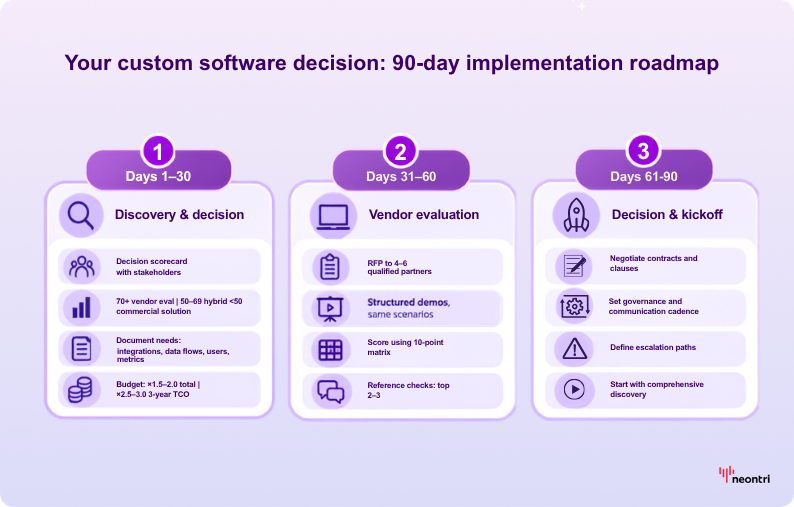
Your custom software decision: 90-day implementation roadmap
The core reframe for evaluating advantages of custom software: strategic alignment determines outcomes. Use this roadmap to move from evaluation to informed decision.
Days 1–30: Discovery and decision
Complete the Build vs. Buy Decision Scorecard with key stakeholders. Scores above 70 proceed to vendor evaluation, 50–69 trigger a review of hybrid approaches, and anything below 50 shifts the focus to commercial solution selection.
Document your specific needs including integrations, data flows, user types, and success metrics. This documentation serves both provider evaluation and implementation planning.
Establish a realistic budget using the multipliers discussed. Initial development estimate × 1.5–2.0 for project total, × 2.5–3.0 for three-year TCO.
Days 31–60: Vendor evaluation
Issue RFP to 4–6 qualified partners identified through referrals and research. Include your requirements documentation and evaluation criteria.
Conduct structured demonstrations using identical scenarios across vendors. Score consistently using the 10-point evaluation matrix.
Complete reference checks for your top 2–3 candidates. Ask the questions listed above and probe on projects similar to yours.
Days 61–90: Decision and kickoff
Negotiate contracts with your selected provider. Ensure all protective clauses are included and understand the change order process.
Establish governance structure including decision-making authority, communication cadence, and escalation paths.
Kick off with comprehensive discovery. Quality vendors insist on proper discovery before development begins. Those eager to skip discovery raise red flags.
Conclusion: Strategic decisions require strategic frameworks
Custom software can pay off when it solves a problem that packaged tools keep bending around, whether that’s a workflow that doesn’t fit, integrations that never quite hold, security requirements that are hard to enforce, or growth that turns licensing into a runaway cost. In those cases, teams see the upside in concrete terms, and ROI in the 150–300% range isn’t unusual.
That said, the outcome depends less on the code and more on the decision process. The teams that succeed pressure-test the build-vs-buy choice early, budget for the costs that show up after “version 1,” choose delivery partners in a structured way, and treat timelines as an investment plan rather than a hope. Next step: run the Build vs. Buy Decision Scorecard with the leadership team – 15 minutes of alignment can save months of rework and six-figure detours.