Eastern Europe is one of the top locations for software development outsourcing. Over the past eight years, its outsourcing market more than doubled, surpassing 7 billion euros. What attracts foreign companies to the region is a large pool of skilled tech professionals, affordable rates, and a healthy business climate.
Drawing on Neontri’s experience in delivering software projects for international clients, this article explains why Eastern Europe software development outsourcing remains a practical choice for global companies. We’ll also review the competitive advantages of the region’s major outsourcing destinations and show where to look for skilled technology teams for software development projects.
Key takeaways:
- Eastern Europe offers a vast talent pool of 1.5 million tech professionals and costs up to 3.5 times lower than in the US.
- Poland leads the region with the largest tech workforce at 430K+ professionals.
- Eastern European outsourcing provides significant advantages: strong STEM education, high English proficiency, and minimal time zone differences with Western Europe.
- When selecting an outsourcing destination in Eastern Europe, evaluate country-specific factors such as talent availability, economic stability, business climate, and tax incentives to find the optimal combination of quality and cost.
Why outsource software development to Eastern Europe
According to a survey by McKinsey, only 34% of companies cite lower costs as the main reason for going offshore, while 42% are driven by improved access to tech talent. With a talent pool of 1.5 million ICT professionals, Eastern Europe offers exceptional potential.
Why Eastern European developers cost less than US talent
The cost of living in Eastern European countries is 30% lower than in the US. This means that local software developers can live comfortably while charging much lower rates than their Western counterparts.
For example, American programmers earn an average of $161,000 a year while their Polish peers make around $45,000 with similar experience and qualifications. So, US companies outsourcing to this region will pay almost 3.5 times less than at home.
The table below shows average cost savings when hiring a tech team from the four largest outsourcing destinations in the region. Other countries in the region—Bulgaria, Moldova, and Slovakia—offer comparable figures.
| Role | No. of people | Average salary in the US | Average salary in Poland | Average salary in Romania | Average salary in the Czech Republic | Average salary in Hungary |
| Project manager | 1 | $136,000 | $41,000 | $24,000 | $32,000 | $29,000 |
| Front-end developer | 2 | $103,000 | $35,000 | $20,000 | $36,000 | $20,000 |
| Back-end developer | 2 | $115,000 | $35,000 | $24,000 | $37,000 | $24,000 |
| UI/UX designer | 1 | $121,000 | $24,000 | $20,000 | $29,000 | $20,000 |
| QA engineer | 1 | $109,000 | $30,000 | $20,000 | $20,000 | $20,000 |
| DevOps engineer | 1 | $142,000 | $44,000 | $36,000 | $43,000 | $41,000 |
| TOTAL | 8 | $944,000 | $279,000 | $188,000 | $270,000 | $198,000 |
*All salary estimates are provided by Glassdoor.
Eastern European outsourcing vendors typically use flexible engagement models and transparent pricing with no hidden costs. Thus, businesses can plan budgets confidently while tailoring the scope of services to their needs.
How Eastern Europe’s tax incentives attract tech investment
Countries in Eastern Europe offer tax incentives for IT and R&D projects. For example, Poland has established special economic zones offering tax exemptions that have attracted companies like Microsoft, Google, and IBM to open development centers there.
In Romania, software developers enjoy a significant tax advantage, with complete income tax exemption on salaries, benefits, and bonuses up to 10,000 lei, which has helped companies like Adobe and Oracle expand their presence.
Eastern Europe’s software developers: Skills, education, and global experience
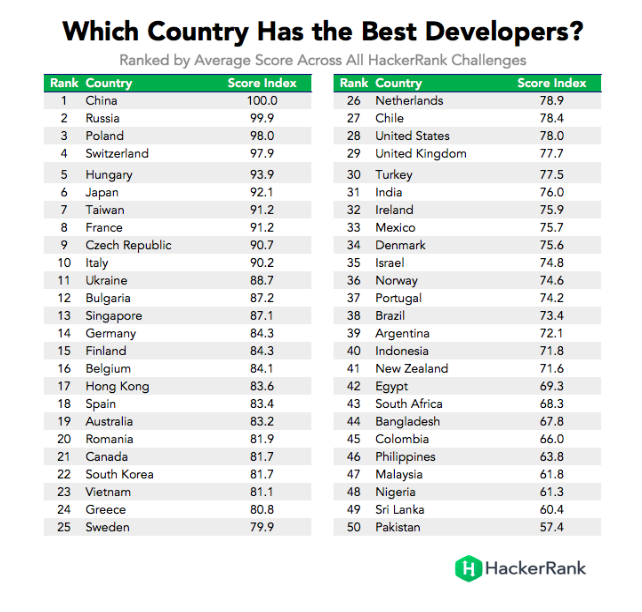
Eastern European developers rank high in global coding competitions on HackerRank and SkillValue. For instance, Poland ranks #3 in HackerRank’s country rating, while Hungary and the Czech Republic made it into the Top 10. The CEE region is home to renowned tech companies, such as UiPath (Romania), Avast (Czech Republic), and CD Projekt Red (Poland).
Such a high skill level comes from the region’s historically strong STEM education system. Self-education is also very common among Eastern European programmers. After getting their degrees, local software engineers continue to build their knowledge, stay updated with the latest technological advancements, and actively participate in coding communities.
What’s more, IT specialists in Eastern Europe gain diverse expertise from working on projects outsourced by companies worldwide. This international exposure allows them to gain valuable experience solving problems in various industries, such as finance, logistics, and retail.
GDPR compliance in Eastern Europe software outsourcing
As a part of the European Union (EU) most Eastern European countries are subject to the General Data Protection Regulation (GDPR). So, software development outsourcing vendors operate under some of the strictest data protection laws in the world.
Moreover, IT companies in Eastern Europe have implemented robust security protocols, including secure authentication methods, virtual private networks (VPNs), and data encryption. This way, client data is protected throughout the whole development process, from concept to delivery.
How Eastern European development teams Integrate with global companies
Companies can expect local software development teams to observe deadlines and follow high-quality service standards. Similar cultural values mean that an Eastern European team can easily integrate into the company culture of a North American or Western European organization.
What’s more, Eastern European developers have no problem challenging the status quo and coming up with non-conventional solutions to problems, or asking clarifying questions to fully understand the task.
How Eastern European teams maintain reliable delivery communication
Eastern European software development outsourcing companies value time as much as their Western counterparts, resolving issues promptly. This responsiveness isn’t just about following contractual obligations—it reflects the professional work ethic that’s deeply embedded in Eastern European business culture.
For companies based in Western Europe, communication is straightforward since they share similar working hours. Teams typically respond within one or two hours during the business day. For US companies, despite the greater time difference, there’s still a 3-4 hour overlap with Eastern European working hours. Any requests sent outside these overlapping hours are addressed first thing when the team returns to work the next day.
Main Eastern European software development outsourcing destinations
Popular outsourcing destinations in Eastern Europe differ in developer specialization, foreign language proficiency, and the country’s overall stability. These factors can substantially impact project success and should be carefully evaluated when choosing a software development company.
Software development outsourcing in Poland: Talent, skills, and stability
Poland boasts the largest talent pool of ICT professionals in Eastern Europe, with over 430,000 people. Moreover, thanks to its strategic location in the middle of the region, local dev outsourcing providers can easily access major European markets while maintaining optimal time zone compatibility with Western clients.

These factors make Poland one of the best choices for finding tech experts with traditional competencies like Python or Java and sought-after technical skills, such as data scientists, data analytics specialists, and programmers with expertise in emerging technologies like artificial intelligence (AI).
By partnering with an IT outsourcing provider like Neontri, international companies leverage the country’s deep tech talent pool to deliver innovative software development services while maintaining high quality standards.
Poland also ranks #6 on developer skills on TopCoder, the highest among CEE nations. The country’s major cities—Warsaw, Krakow, Wroclaw, and Gdansk—have become vibrant tech hubs with strong IT ecosystems. In addition to hosting numerous outsourcing providers, they are home to offshore development centers for tech giants like IBM, Microsoft, and Samsung.
Seamless communication with Western companies isn’t an issue. Poland is #15th in the global English proficiency ranking, so international companies won’t experience any language barriers.
Poland has a stable economic environment. With the country’s GDP projected to grow by 3.4% this year, it demonstrates resilience to global economic pressures. This stability translates into a reliable business environment for software development outsourcing.
Poland is a strong IT outsourcing destination for:
- Enterprises needing scalable engineering teams.
- Fintech companies requiring secure, compliant software.
- AI and data businesses looking for advanced tech expertise.
- Western European firms needing time zone alignment.
- US companies seeking mature European software development outsourcing.
Poland may not be the best outsourcing destination for:
- Companies seeking the lowest hourly rates above all else.
- Startups with very limited budgets and simple development needs.
- Companies looking for purely transactional outsourcing rather than long-term engineering partnerships.
- Projects where cost matters more than technical quality, security, or domain expertise.
Czech Republic as a software outsourcing destination
In the Czech Republic, 4.3% of the workforce is employed in the ICT sector, creating a talent pool of up to 130,000 tech experts. The presence of numerous universities with solid technical education ensures a steady influx of around 4,000 graduates into the country’s IT industry annually.

The abundance of people with strong software development skills and a well-developed IT infrastructure have made the Czech Republic an attractive destination for global investors like Skype, Cisco, and Oracle. That said, the country’s main tech specialization lies in the game development niche, with Brno, its second-largest city, serving as the primary hub.
Alongside high English proficiency (#25 in the global ranking), the Czech Republic has good business connections in Europe. The country’s geographic proximity to Western European markets has made it a popular outsourcing destination for companies looking for technical expertise and cultural alignment.
However, the cost of living in Czech cities is higher than in the neighbouring countries. Together with relatively high income taxes, it makes local outsourcing companies to charge higher rates.
The Czech Republic is a strong outsourcing option for:
- Companies seeking skilled European engineers with solid technical education.
- Game development companies looking for specialized talent.
- Companies that value English proficiency and smooth collaboration.
- Tech firms needing mature European delivery standards.
The Czech Republic may be less suitable for companies that prioritize the lowest outsourcing rates or need access to a very large engineering talent pool.
Cons:
- Higher outsourcing rates than many neighboring Eastern European markets.
- Smaller talent pool compared with Poland or Romania.
- Less suitable for simple projects where low cost is the main priority.
- Strong game development specialization may not fit every software project.
- Higher local living costs can increase development rates.
IT outsourcing in Romania: Strengths and limitations
Romania has the third-largest tech talent pool in the CEE region, with nearly 192,000 developers. Like Poland and the Czech Republic, Romania ranks high in English proficiency, which simplifies communication with US and Western European clients.

Yet, compared to other Eastern European countries, particularly Poland, Romania has a less developed IT ecosystem. 68% of its IT development capabilities and revenue are concentrated in the capital, Bucharest, with only a few business centers in other regions. Additionally, the country has been struggling with a brain drain for nearly a decade, with many tech experts seeking better opportunities abroad.
Romania is a relevant outsourcing destination for companies looking for a large developer base, strong English proficiency, and competitive access to CEE engineering talent.
Pros:
- Third-largest tech talent pool in the CEE region.
- Nearly 192,000 developers available on the market.
- Strong English proficiency for US and Western European collaboration.
- Competitive alternative to more expensive CEE outsourcing markets.
- Good fit for companies seeking scalable engineering support.
Cons:
- Less developed IT ecosystem compared with Poland.
- Most IT activity is concentrated in Bucharest.
- Fewer mature tech hubs outside the capital.
- Ongoing brain drain affects long-term talent availability.
- May offer less regional delivery depth than larger CEE markets.
Hungary as a software outsourcing destination
Hungarian tech talent pool brings together over 80,000 developers. The ICT sector is heavily export-oriented (13% of the country’s total exports), with 55% of local IT companies generating revenue by providing software development services to foreign clients.

One of Hungary’s key competencies is smart mobility. For example, NNG, a Budapest-based navigation software startup, achieved international success in the automotive industry. Additionally, the country’s digital transformation covered the implementation of intelligent transportation systems in several cities.
Hungary has a favorable business environment, with the EU’s lowest income tax (9%) and multiple government initiatives supporting the IT sector. Ranked #17 worldwide on English proficiency, the country is a good choice for international companies that value smooth communication.
However, the country’s cybersecurity ranking has slightly declined in recent years, which raises some concerns about its data protection and security capabilities.
Hungary is a suitable outsourcing destination for companies looking for export-experienced software teams, smart mobility expertise, and a business-friendly tax environment.
Pluses:
- Over 80,000 software developers.
- Strong experience working with foreign clients.
- Recognized expertise in smart mobility.
- Strong English proficiency for international collaboration.
Minuses:
- Smaller talent pool than Poland or Romania.
- Recent decline in cybersecurity rankings raises data protection concerns.
Is Bulgaria a good country for software development outsourcing?
Bulgaria is another place to consider for IT outsourcing in Eastern Europe. It boasts a talent pool of 70,000 tech professionals and an ICT market that has experienced a rapid growth of 300% over the past seven years. Currently, the country is home to approximately 10,000 tech companies, 70% of which are export only.

Bulgaria has the highest proportion of female software developers in the EU, 29% vs EU average of 19%. This gender ratio is a big plus for attracting diversity-conscious companies.
Another benefit of the nation’s IT sector is the competitive pricing of IT outsourcing services. With one of the lowest costs of living in Europe and a flat income tax of 10%, local teams can charge less than their counterparts in other EU countries.
However, compared to countries like Poland and the Czech Republic, which lead the region’s outsourcing landscape, Bulgaria’s IT market is still evolving. This may result in inconsistencies in service quality and talent availability.
Bulgaria works best for companies that want EU-based software delivery with leaner pricing, but can accept a market that is still building depth and consistency.
Pluses:
- Competitive development rates compared with many EU markets.
- Fast-growing ICT sector with strong export orientation.
- Around 70,000 tech professionals.
- Large number of IT companies serving foreign clients.
- Strong gender diversity among software developers.
- Low local tax burden supports more flexible pricing.
Minuses:
- Smaller talent pool than Poland or Romania.
- IT market is still maturing compared with regional leaders.
- Service quality may vary more between vendors.
- Talent availability can be less predictable for large-scale projects.
- Less suitable for companies needing highly mature delivery ecosystems.
Is Moldova a good option for hiring outsourced software developers?
Moldova boasts a talent pool of 24,000 ICT professionals, accounting for 1% of the population. On top of that, the country produces over 2,000 computing and tech graduates annually. Although 80% of the services provided by Moldovan software development companies are exported, the tech sector still lags behind other regional outsourcing destinations in Eastern Europe.
Moldova’s IT industry has strong governmental support, which includes the IT Park regime, which grants residents a flat 7% tax on monthly turnover. Over the past decade, the country’s ICT sector has even seen dynamic growth.
However, the country’s economic and political instability limits the sector’s potential. Many skilled tech professionals seek higher-paying jobs abroad, so it’s hard for local outsourcing providers to retain top talent.
Additionally, as a non-EU country, Moldova’s data protection laws are not fully aligned with EU standards such as GDPR. So, while outsourcing to Moldova allows companies to save costs, they must carefully weigh the associated risks.
Moldova fits companies looking for lean development costs and a small export-oriented tech market, but it requires closer attention to talent retention, political risk, and data compliance.
Pros:
- Lower development costs than many Eastern European markets.
- Export-focused IT sector with experience serving foreign clients.
- Suitable for cost-sensitive projects with manageable complexity.
Cons:
- Smaller talent pool than Poland, Romania, or Bulgaria.
- Less mature tech sector than leading Eastern European destinations.
- Political and economic instability may affect long-term planning.
- Brain drain makes senior talent harder to retain.
- Non-EU status creates additional GDPR and data protection considerations.
What makes Slovakia attractive for software development outsourcing?
Slovakia has a relatively small but highly skilled workforce in the ICT sector, with 50,000 tech professionals. The country benefits from a strong educational system—six universities with ICT faculties—producing around 3,000 specialists per year. The pmain IT hub is the capital, Bratislava, with smaller cities like Košice and Žilina expanding their tech ecosystems.

Slovakia enjoys a strategic geographical location with easy access to Western European markets. The country’s high English proficiency (#18 globally) further enhances its appeal to international companies. Drawn by Slovakia’s favorable business environment, global players like Accenture and IBM have already set up offices here.
But Slovakia also has its challenges as an outsourcing destination. Rising political tensions, like in Hungary, threaten its economic stability. High income tax rates (19–25% for individuals and 21% for companies) drive up labor costs and make IT outsourcing services more expensive.
Slovakia suits companies that want a compact, well-educated European engineering market, but it may be less attractive where budget pressure or large-scale hiring comes first.
Pros:
- Skilled ICT workforce with strong technical education.
- Bratislava is a mature IT hub, with Košice and Žilina growing.
- Strong English proficiency for international collaboration.
- Good access to Western European markets.
- Presence of global companies such as Accenture and IBM.
Cons:
- Smaller talent pool than larger CEE outsourcing markets.
- Higher income and corporate taxes can increase delivery costs.
- Less suitable for companies seeking the lowest outsourcing rates.
- Fewer large tech hubs compared with Poland or Romania.
| Destination | Best for | Key strengths | Main limitations |
| Poland | Enterprises, fintech, AI/data projects, and companies needing mature delivery capacity | Largest ICT talent pool in Eastern Europe, strong tech hubs, high developer skills, good English proficiency, stable business environment | Not the cheapest option; less suitable for companies focused only on lowest hourly rates |
| Czech Republic | Companies seeking skilled European engineers, game development expertise, and close Western European alignment | Strong technical education, mature IT infrastructure, good English proficiency, strong game development niche | Higher rates than many neighboring markets; smaller talent pool than Poland or Romania |
| Romania | Companies looking for a large developer base and competitive CEE engineering support | Third-largest tech talent pool in CEE, strong English proficiency, good fit for scalable engineering needs | IT activity is heavily concentrated in Bucharest; less developed ecosystem than Poland; brain drain risk |
| Hungary | Companies needing export-experienced teams and smart mobility expertise | Export-oriented ICT sector, low corporate tax, strong English proficiency, smart mobility specialization | Smaller talent pool; political tensions with the EU; cybersecurity concerns |
| Bulgaria | Companies seeking EU-based delivery with leaner pricing | Competitive rates, fast-growing ICT market, export-oriented IT companies, strong gender diversity in tech | Market is still maturing; service quality and talent availability may vary |
| Moldova | Cost-sensitive projects with manageable complexity | tax regime, export-focused software sector, government support | Small talent pool, political and economic instability, brain drain, non-EU data compliance considerations |
| Slovakia | Companies looking for a compact, well-educated European engineering market | Skilled ICT workforce, strong education system, high English proficiency, access to Western Europe | Smaller talent pool, higher taxes, rising political tensions, fewer large tech hubs |
How to outsource software development to Eastern Europe
The process of outsourcing software development to Eastern Europe requires careful planning and consideration to achieve optimal results. Here’s a brief overview of its key stages:
- Step #1: Choose the country. Narrow down options based on the factors most important to your business. For example, if you need a stable environment and a large tech talent pool, Poland is an excellent choice. If you are willing to save money and accept emerging market conditions, countries like Bulgaria and Romania provide good value propositions.
- Step #2: Outline requirements. With hundreds of vendors offering software development services in each destination, clearly define project goals, scope, and expected deliverables.
- Step #3: Choose the right outsourcing model. That’s no less important than outlining requirements. And should you want to delegate the entire project to an external team, go for classic IT outsourcing services.
- Step #4: Research vendor candidates. Carefully review their services, tech skills, and domain expertise. Look for a partner with a proven track record in your industry and one that aligns with company’s culture and workflow.
- Step #5: Schedule meetings with shortlisted IT companies. Engage with the vendors you’re considering. Prepare a list of key questions to evaluate their competencies, communication style, and work processes. During the meeting, assess the company’s values, cultural fit, and general understanding of your business needs.
- Step #6: Make the final decision. Carefully consider all the factors that matter most to the project before committing. The cheapest option may not always be the best if it compromises quality or reliability.
Grow your business with Neontri software development outsourcing services
Neontri has delivered outsourced software development projects across banking, fintech, payments, AI, and enterprise data systems:
- For Visa, Neontri supplied over 40 specialized payment experts through staff augmentation and recruitment process outsourcing, supporting a global finance leader with hard-to-find payment systems expertise.
- In fintech, Neontri built a cloud-native AI decisioning platform that was adopted by four end clients and reduced IT development costs for new features by 78% and maintenance costs by 80%.
Browse Neontri’s case studies to review the projects, technologies, and outcomes behind our work.
Final thoughts
Eastern Europe remains a top software development outsourcing destination for Western companies thanks to several key factors: a large pool of developers, exceptional technical expertise, high English proficiency, cultural proximity, and minimal time zone differences.
However, simply opting for IT outsourcing in Eastern Europe isn’t enough; you also need to select the right country. The differences in talent pools, tech ecosystems, and business environments across the region can significantly impact a software development project.
FAQ
How does the cultural affinity between Eastern Europe and Western countries impact outsourcing relationships?
Cultural proximity between Eastern and Western Europe significantly enhances outsourcing relationships by enabling smoother communication, shared work ethics, and aligned business values. These similarities reduce misunderstandings, foster trust, and allow Eastern European teams to integrate seamlessly with Western companies, ultimately leading to more successful project outcomes.