

Software development costs have become a critical consideration for organizations of all sizes, from startups to large enterprises. In response, businesses are adopting new operating models to reduce development expenses while improving project planning and budget allocation.
This article explains factors influencing the cost of building software, from hiring developers to maintaining the final product. It also shares practical guidance on calculating software development costs, drawing on Neontri’s experience building custom software products since 2013.
Key takeaways:
- The average software development cost is about 2.7x a developer’s base salary, factoring in benefits, IT setup and equipment, office space rent or home office stipends, employee retention programs, and other hidden costs.
- Developer rates vary by location, with US engineers typically earning 2x as much as comparable talent in Poland.
- The largest project expenses are usually direct costs, mainly salaries, and infrastructure such as cloud services, development tools, and third-party APIs.
Importance of understanding software development expenditures
Having a comprehensive understanding of development costs is essential for making strategic decisions, managing resources effectively, and ensuring project success from conception to deployment.
Proper cost analysis helps organizations with:
- Budget calculations. Accurate cost estimation prevents budget overruns and allows for realistic financial planning throughout the project lifecycle.
- Vendor selection. Understanding market rates and cost structures enables better evaluation of development partners and more effective contract negotiations.
- Feature prioritization. Cost awareness helps teams make informed decisions about which features to build first based on their development complexity and business value.
- Risk management. Anticipating potential cost escalations and hidden expenses helps organizations prepare contingency plans and avoid project delays.
Software development cost estimation approaches
Software development cost estimation approaches help organizations forecast project expenses and plan budgets effectively.
Building in-house
When building an internal team, a software development cost breakdown helps plan ahead the actual budget beyond just salaries. For example, with a team of three developers at $120K each, the actual annual cost will be closer to $970K when you factor in benefits, office space, equipment, and management overhead.
In this context, the build vs buy decision framework is an important step in determining whether investing in a full in-house capability is justified or whether adopting an existing solution can reduce upfront costs and accelerate time to market while still meeting core business requirements.
Outsourcing software development
This cost breakdown serve as a benchmark for comparing IT outsourcing quotes from different vendors. Companies can use it to identify the most suitable outsourcing partner while avoiding overpriced and suspiciously cheap offers.
Beyond just comparing quotes, a deeper understanding of effective application development outsourcing strategies can help businesses secure specialized expertise while actively minimizing hidden costs and project risks.
Team augmentation
Team augmentation provides a strategic approach to building distributed development teams. This cost assessment can help business leaders make informed decisions about which roles to keep onsite and which to distribute remotely.
For example, they can keep senior architects local for hands-on collaboration while engaging skilled remote developers for feature implementation. Smart role distribution across locations helps organizations scale their engineering capacity without the full overhead of local hiring.
Factors influencing software development costs
Accurately predicting software costs is challenging because every project is unique. A solution may range from a simple appointment-booking mobile app to a complex enterprise system processing millions of transactions. While both fall under the broad category of “software,” their costs vary significantly due to differences in design complexity, architecture, engineering effort, testing requirements, and ongoing maintenance.
Regardless of the type of solution, the final cost is driven by three key factors:
- How complex will the project be
- How many experts are needed on the team
- What tools and technologies will be used
The table below outlines the key factors determining the total cost of ownership in software development
| Category | Description | Impact on cost |
|---|---|---|
| Project complexity | The number of core features, complex business logic, additional security measures, and system integrations can increase development time and change the total cost of ownership framework. | High |
| Team composition | If the project requires specialized skills (e.g., security, DevOps) or a certain level of developer experience, that can significantly affect project costs. | High |
| Technology stack | Every technology choice adds to the bill, whether it’s paying for cloud servers, database systems, or third-party service licenses. | Medium-High |
| AI capabilities | Implementing AI features introduces additional costs for model development or fine-tuning, data preparation, infrastructure usage, and specialized AI/ML expertise. | Medium-High |
| Timeline | Rushed deadlines and frequent releases may require more resources, leading to higher development costs. | Medium-High |
| UI/UX | Complex designs, custom animations, or accessibility features require more development effort and additional QA. | Medium |
| Integrations | If a software project involves integrating third-party application programming interfaces (APIs), modernizing legacy systems, or migrating data, expect the final price to increase by 30-50% above the base cost estimate due to additional complexity. | High |
| Business requirements | Enterprise software development process requires specialized architectural designs to handle heavy usage, protect data, and comply with strict regulations. The costs add up quickly because these systems require additional security, backup systems, and audit controls. | Medium-High |
| Travel expenses | In the case of outsourcing, travel expenses become a hidden cost factor. Face-to-face meetings for project kickoffs, important milestones, and training sessions mean regular flights, hotel stays, and daily allowances for the teams. | Medium |
Key considerations when calculating the cost to develop software
Companies often struggle to calculate the full cost of developing software. Whether comparing outsourcing vs in-house development models, understanding fixed and variable costs in software development is crucial for successful project execution.
Direct software development costs: Why developer hourly rates exceed base pay
The most visible costs in software development are the ones companies directly pay for. Developer compensation typically makes up the lion’s share of these expenses.
However, the true cost of an employee goes well beyond base salary. Additional expenses quickly add up, including:
- Mandatory employment taxes
- Health and life insurance benefits
- Paid time off, such as vacation and sick leave
- Retirement and pension contributions
- Tuition reimbursement and professional development programs
- Dependent care and family support benefits
- Unemployment insurance and related contributions
So, the average software development cost per hour at this point is typically 1.25-1.4 times higher than the engineer’s base rate.
Indirect software development costs: Infrastructure, tools, and management overhead
Indirect costs are expenses that support the development process but aren’t necessarily a part of it.
One of the things that needs substantial investment is setting up development environments. Engineering services require 11-23 square meters per employee, including common areas. Basic office setup costs include furniture, computer equipment, and an internet connection. On top of that, there are costs associated with the software development process. This includes development tools, licensed software, version control systems, continuous integration/continuous deployment (CI/CD) pipelines, and testing frameworks.
Companies also have to invest in management personnel to oversee the team and factor in non-billable hours spent on technology development and research. When all these factors combine, the final cost of a fully functioning, managed employee in a software development business typically amounts to approximately 2.7 times their base salary.

Hidden software development costs most estimates miss
Hidden costs can account for up to 20% of the project budget. These software development expenses arise throughout the development process and can affect the final product’s price.
- Technical debt. Taking shortcuts during development to meet deadlines can lead to future maintenance problems, such as introducing hard-to-diagnose bugs and creating poorly documented code that slows feature development. On average, organizations waste 23% to 42% of their development time dealing with technical debt, making it one of the costliest yet least visible items in any project budget.
- Scaling. As software moves from development to production and its user base grows, infrastructure expenses for cloud resources, database storage, content delivery, and network bandwidth can run 2-5x above initial projections.
- Post-launch maintenance. Keeping software functional and competitive after release requires ongoing bug fixes, dependency updates, compatibility patches for new operating systems or browsers, and feature iterations based on user feedback. While frequently omitted from initial budgets, these recurring expenses add 15-20% of the initial build cost per year.
- Legal support. Software development is closely related to intellectual property rights, licensing agreements, and compliance requirements. Legal expertise helps navigate these complexities but adds to the overall project cost.
- Compliance audits and certification. Meeting industry standards such as ISO 27001, SOC 2, or GDPR requires periodic third-party audits, internal preparation time, and ongoing certification maintenance. These processes require dedicated staff hours, external auditor fees, and remediation work, which typically cost between $20,000 and $100,000+ per audit cycle.
- Recruitment fees. Hiring developers involves job advertising, internal recruiter time, interview hours from senior staff, and HR tooling costs. These expenses are rarely allocated to individual projects, but they typically add about 30% to the cost of each software developer hire beyond basic salary.
- Turnover and replacement costs. Developer attrition leads to vacancy gaps and productivity loss during ramp-up. Replacing an experienced engineer often costs about 150% of their annual salary before productivity fully recovers.
- Knowledge transfer. Maintaining comprehensive documentation, onboarding new team members, and ensuring smooth knowledge transfer might require at least 20 hours per month of tech leaders’ and project managers’ time.
Software development cost breakdown: Where the budget actually goes
Understanding the cost structure of building custom software is critical for accurate project planning and budgeting. From initial staffing decisions to ongoing operational expenses, each element plays a huge role in determining the total investment required.
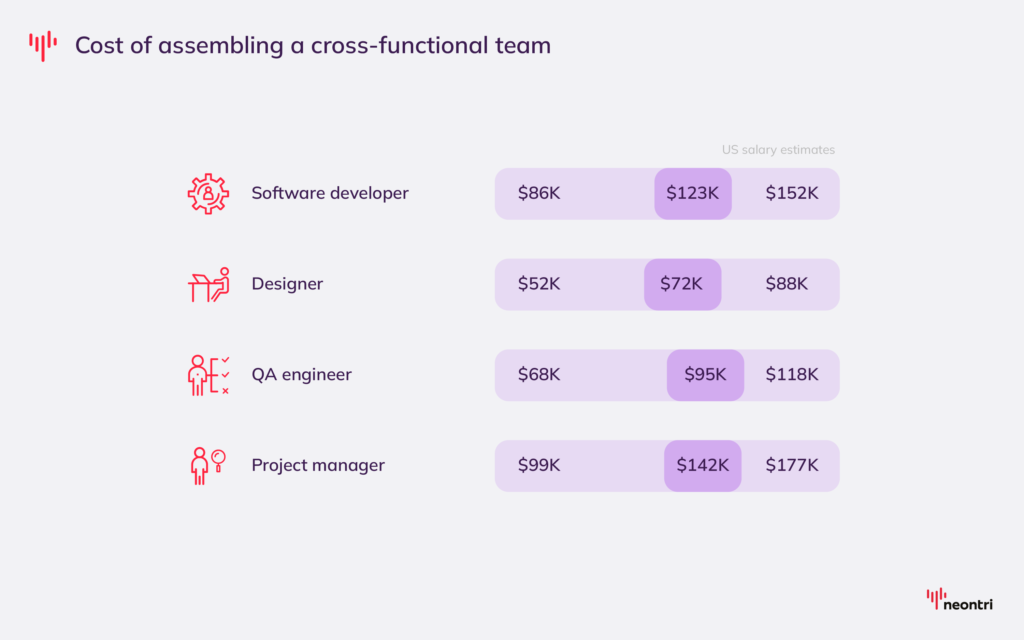
The development process typically starts with establishing the right team structure. To create a minimal viable product (MVP), you’ll need a balanced mix of expertise: two to three software engineers, a designer, a QA specialist, and a project manager.
Once your team is assembled, the overall budget is generally distributed across the following core categories:
| Category | % of total budget | What it covers |
|---|---|---|
| Development and engineering | 50-60% | Frontend and backend coding, API integrations, architecture setup, and core feature engineering |
| Product design (UI/UX) | 10-15% | User research, wireframing, prototyping, and final visual interface designs |
| Project management | 5-10% | Sprint planning, timeline tracking, and cross-team coordination |
| Quality assurance | 15-25% | Bug detection, automated and manual testing, security vulnerability checks, and performance audits |
| DevOps | 5-10% | Cloud environment setup (AWS/Azure/GCP), CI/CD pipeline automation, and basic database configuration |
| Tech infrastructure | 10-15% | Initial server costs, security/encryption tooling, CDN, and third-party service licenses |
Development and engineering
Software developers spend their time building basic functionality, performing code reviews, and conducting pair programming sessions. These responsibilities command hefty compensation across global markets. A comparison of developer rates by country highlights regional differences and helps organizations make informed sourcing and budgeting decisions.
According to SalaryExpert, software development costs in the United States are among the highest in the world, with average hourly rates ranging from $42 for junior specialists to $67 for senior engineers. The average hourly rates for software development in Western European countries are as follows: Germany – $51/hr, the United Kingdom – $45/hr, and the Netherlands – $45/hr.
Software developers in Poland, CEE’s most powerful IT outsourcing hub, earn an average of $30/hr, with junior specialists starting at $21/hr and senior engineers reaching $34/hr. In Romania, the average stands at $20/hr.
In Latin America, software engineer salaries – while still generally lower than in the U.S. – are higher than in some other offshore regions due to their geographical and cultural proximity to North American markets. Mexico’s average base pay for software developers sits around $17/hr, while Brazil’s full-stack developers average roughly $19/hr.
| Country | Junior hourly rate | Average hourly rate | Senior hourly rate |
|---|---|---|---|
| United States | $42 | $59 | $67 |
| Canada | $30 | $42 | $48 |
| Germany | $36 | $51 | $58 |
| Netherlands | $31 | $45 | $56 |
| United Kingdom | $31 | $45 | $51 |
| Poland | $21 | $30 | $34 |
| Romania | $14 | $20 | $23 |
| Mexico | $12 | $17 | $20 |
| Brazil | $14 | $19 | $24 |
Product design
Product design includes user research, persona development, wireframing, prototyping, and user interface design. Beyond that, designers’ time is also needed to create intuitive workflows, conduct usability testing, and iterate based on customer feedback.
Regular design reviews and accessibility compliance checking require additional resources and expertise. In addition, organizations must factor in substantial tooling costs for design platforms such as Figma and Adobe Creative Suite.
Quality assurance
The cost of quality in software development encompasses not only the salaries of QA engineers but also infrastructure costs for testing environments, automated testing applications, continuous integration tools, and device labs for cross-platform testing. When combined with the time required for test planning, execution, and defect management, QA can constitute 15-25% of the total project budget.
Project management
Effective project management calls for experienced professionals who coordinate teams, track deliverables, and maintain communication with stakeholders. Their time is mainly spent on planning meetings, sprint reviews, and status updates, but resource allocation, risk management, and timeline planning also demand a lot of attention.
Quality project management comes with a price. In major tech hubs, PMs typically earn between $99K and $177K annually. The costs of project management tools, collaboration platforms, and reporting software can add another $10K to $15K annually to operational expenses.
Technology infrastructure
Tech infrastructure includes both development and production environments. This includes cloud services, servers, databases, development tools, IDEs, and third-party services or APIs.
Licensing fees for commercial software, development frameworks, and security tools must also be accounted for. Also, remember that regular infrastructure scaling and maintenance costs increase as the project grows.
DevOps investment
DevOps is often misunderstood as a one-time setup cost, but it is actually an ongoing operational expense (OpEx) that scales with your software. Beyond the initial setup of deployment pipelines, continuous investment is required to maintain automated infrastructure, optimize cloud efficiency, and monitor system health. As the product evolves, DevOps engineers must continually update CI/CD workflows to accommodate new features, security compliance updates, and growing database needs.


Pricing models: Fixed price vs Time & Materials vs Dedicated team
Selecting the right pricing model can significantly impact software development costs, project flexibility, and risk management. The best approach depends on how clearly requirements are defined, the expected level of change, and the duration of the engagement. While no single model fits every project, understanding the trade-offs helps organizations align spending with business objectives.
| Model | When to use | Risk distribution | Typical premium/discount |
|---|---|---|---|
| Fixed price | Clearly defined scope, predictable requirements, and limited change tolerance | Vendor assumes most delivery risk | 10-20% premium to account for estimation uncertainty and contingency buffers |
| Time & Materials (T&M) | Evolving requirements, agile delivery, and iterative product development | Client assumes greater scope and budget risk | Baseline rates with no additional risk premium |
| Dedicated team | Long-term product development, scaling engineering capacity, or continuous improvement initiatives | Shared between client and vendor | 5-10% discount compared to ad hoc resource allocation due to longer commitments |
For most modern software initiatives, T&M and dedicated team models offer the best balance of flexibility, transparency, and cost control. Both approaches accommodate changing requirements, allowing teams to adapt priorities based on customer feedback, market shifts, and evolving business needs. By contrast, fixed-price software development is typically better suited to projects with a well-defined scope and a low likelihood of change, where predictability takes precedence over flexibility.
How to reduce software development costs: Best practices
Custom software development costs can have a significant impact on an organization’s bottom line. However, several proven approaches can help optimize spending. Below are the most effective cost-reduction strategies.
Outsource software development to optimize the budget

Choosing the outsourcing route is a powerful way to optimize operations and gain a financial advantage. By leveraging external expertise and tech talent, businesses can enjoy some great IT outsourcing benefits:
- Best price-quality ratio. Top outsourcing companies are continually honing their capabilities in high-end services such as GenAI implementation, third-party integrations, and data management. They achieve cost efficiency through optimized workflows, established development methodologies, and access to diverse talent pools across different regions.
- Easy team scaling. Outsourcing allows for flexible team structures, enabling organizations to quickly scale resources up or down based on evolving project needs.
- Reduced operational overhead. Companies can significantly cut down on costs related to office space, equipment, software licenses, and HR management since the outsourcing partner handles these responsibilities.
Reduce costs with open-source tools and frameworks
Organizations can substantially reduce software development costs by incorporating open-source solutions into their tech stack. Modern open-source programs are often as good as custom software in terms of quality. What’s even better, they don’t require any additional investments.
Software engineers can leverage extensive libraries, frameworks, and tools already tested by global dev communities.
Minimaze third-party integrations to prevent hidden overhead
Third-party integrations can decrease development time by introducing advanced features and powerful capabilities. However, they often carry baggage that is not visible at first glance, like hidden costs or extra complexities. Thus, business leaders should carefully evaluate the need for each potential integration and the impact it might have.
Tech companies should focus on external systems that provide clear value and avoid redundant or overlapping solutions. This selective approach reduces ongoing maintenance costs, minimizes potential points of failure, and simplifies the overall system architecture.
Mitigate development risk with Agile methodologies
Using Agile methodologies reduces development costs through improved efficiency and risk management. By breaking projects into smaller, manageable sprints and emphasizing iterative development, teams can identify and address issues early on when they’re least expensive to fix.
Regular sprint reviews and continuous feedback loops ensure that development efforts remain aligned with business needs. This will prevent the cost of rework in software development, feature bloat, and unnecessary scope creep that often plagues traditional development approaches.
Design simple interfaces to reduce development and maintenance costs
The design approach should prioritize clean, intuitive interfaces, with elements placed logically to ensure ease of use. Below are key principles to help achieve this.
- Standardized components. These reusable components can be applied across multiple areas of a cross-platform application, simplifying updates and enhancements. Changes can be implemented once and reflected consistently throughout the product, reducing development effort while saving time and cost.
- No unnecessary complexity. Simplicity doesn’t mean sacrificing functionality. It means implementing features in the most straightforward way possible. For example, instead of having five different ways to save a file, use a single, clear “Save” button that works consistently.
- Focus on UX. When users can quickly find what they need without confusion, satisfaction and productivity increase. Consistent, predictable interfaces enable smoother navigation, resulting in higher efficiency and improved customer satisfaction.
Real-world custom software development projects: Inside Neontri’s delivery experience
Neontri’s custom software development services enable organizations to turn complex technical requirements into secure, scalable, and commercially successful products. With over 400 completed projects, we have built deep expertise across banking, fintech, and retail. The case studies below offer a representative look at how that experience translates into real delivery.
- #1 AI-powered “Shop the Look” for fashion e-commerce
Scope: The platform centered on visual product discovery, covering image interpretation and multi-item detection, LLM-generated product descriptions and metadata, vector embeddings for similarity search, and a RAG pipeline combining vector search with product metadata retrieval to deliver context-aware outfit recommendations.
Team: Backend, mobile, integration, and API specialists across development and QA
Duration: 2023-2024
Delivery model: Fixed-price greenfield project
Scale: 20M+ customers, 10M+ mobile app users
Lessons: Shifting from text-based to visual discovery required rebuilding product metadata infrastructure from the ground up. Supporting real-time inventory accuracy across multiple brands and markets then added a further layer of integration complexity that extended into the later delivery stages.
- #2 Children’s mobile banking application for one of Poland’s leading banks
Scope: Full lifecycle product delivery across UX/UI design, iOS and Android development, backend engineering, payments integration, security, and open banking connectivity built as a standalone app within the broader bank’s ecosystem.
Team: Senior iOS, Android, and backend engineers embedded alongside bank’s internal teams, plus UX/UI designers and QA specialists
Duration: 2019-2023
Delivery model: Time and materials
Scale: 210,000+ active users, 4.5 App Store rating, 1,000+ man-days delivered
Lessons: Bootstrapping an in-house delivery capability alongside product delivery required embedding senior engineers early to establish architectural standards before scaling the team. Balancing an engaging child-facing experience with bank-grade security and compliance added significant design and testing overhead that compounded across each release cycle.
- #3 Cassandra data migration for digital identity platform
Scope: The engagement focused on stabilizing a petabyte-scale distributed data infrastructure on Google Cloud. This covered the design and implementation of a Flink-based migration framework, development of distributed pipelines with checkpointing, throttling, and failover mechanisms, and full execution of a live production migration strategy across multiple large client datasets without interrupting platform operations.
Team: Backend, data engineering, and integration specialists
Duration: 2024
Delivery model: Time and materials
Scale: 1TB+ datasets migrated per client, 20-25GB partitions optimized, 30M identity transactions processed monthly, 0% production downtime
Lessons: Performing schema changes on a live identity verification platform serving regulated enterprise clients left no margin for disruption. The key to achieving zero downtime was redirecting application writes to the new schema first, then migrating historical data in parallel – an orchestration approach that required detailed planning and thorough testing in isolated environments well before any production work began.
Conclusion
The tech world is changing fast, and so are the costs of building software, whether you’re doing it in-house or working with partners. Understanding what goes into the price of a software product is crucial to creating a seamless project roadmap.
Thorough planning, careful vendor selection, and the flexibility to adapt to changing requirements are the keys to cost-effective software development.
FAQ
How much does custom software development cost in 2026?
Custom software development typically ranges from $50,000 for a basic MVP to over $500,000 for a complex enterprise system. Team size, feature scope, and whether you hire web developers in-house or outsource are the primary cost drivers. Start by defining your core feature set before approaching vendors to avoid inflated estimates based on assumptions.
How is software development cost calculated?
Software development cost is calculated by combining team expenses with operational costs for building, deploying, and maintaining the application. Team salaries are typically the largest cost component, accounting for 50-60% of the total project budget. In the US, for a standard MVP team consisting of two to three software developers (at an average salary of $123K each), one project manager ($142K), one QA engineer ($95K), and one designer ($72K), annual staffing costs typically range from $430K to $550K. Beyond personnel expenses, organizations must also account for infrastructure, third-party software licenses, compliance requirements, and post-launch maintenance, which can collectively add another 30-50% to the total cost.
How long does it take to build custom software?
A functional MVP typically takes three to six months with a team of four to six people working full-time. More complex platforms with integrations, compliance requirements, or large user bases can take 12-18 months.
How do I estimate software development cost without a vendor quote?
Use a bottom-up estimation approach: break the project into features, assign hour ranges to each, and multiply by average blended rates, typically $30-$60/hour for offshore teams and $60-$100/hour for US-based developers. Cross-reference your estimate against comparable projects or public case studies in your industry. This gives you a defensible baseline before any vendor conversation begins.
How much does it cost to outsource software development?
Outsourcing to Eastern Europe typically costs $30-$60/hour, Latin America $25-$50/hour, and Southeast Asia $15-$40/hour. The final project budget is driven by the team’s seniority level, project complexity, and the chosen pricing model, such as a fixed-price agreement, time-and-materials structure, or a monthly dedicated team retainer.
How can I reduce software development costs without cutting quality?
The single highest-impact action is investing in a thorough discovery phase – teams that define requirements in detail before development begins reduce rework by up to 30%. Adopting an MVP-first approach, automating testing early, and limiting scope to validated user needs all reduce waste without compromising output quality.
What’s the difference between fixed-price and time-and-materials pricing?
Fixed-price contracts set a defined budget upfront in exchange for a fully scoped deliverable, making them predictable but not very flexible: any change in requirements typically triggers a formal change order and additional cost. Time-and-materials (T&M) contracts bill for actual hours worked and resources consumed, giving teams the flexibility to adapt scope as the project evolves, though final costs can exceed early estimates if the work expands.
What is the typical software maintenance cost as a percentage of build cost?
Industry benchmarks place annual maintenance costs at 15-20% of the original build cost, covering bug fixes, security updates, dependency management, and minor feature additions. A system that costs $200,000 to build should have a maintenance budget of $30,000-$50,000 per year. Factor this into your total cost of ownership before committing to a build, particularly for compliance-heavy or customer-facing products.