Despite significant tech layoffs over the past two years, IT talent remains in short supply. Recent data shows that 70% of technical workers received several job offers before accepting their current role, while 10% juggle multiple jobs. This makes it particularly challenging to quickly find skilled professionals, especially when seeking rare expertise.
Offshore IT staff augmentation services offer a practical solution to this issue. This model enables businesses to rapidly onboard skilled tech professionals without lengthy, costly recruitment.
This article will explore how offshore team augmentation works, when it’s most beneficial, and how to select a trustworthy outsourcing provider.
Key takeaways
- Offshore staff augmentation allows companies to significantly reduce costs by hiring skilled professionals from regions with lower salary expectations.
- The model provides access to a global talent pool, making it easier to find professionals with niche or highly specialized skills, such as AI.
- Offshore team augmentation simplifies human resources processes by handling recruitment, payroll, benefits, and legal compliance.
- By leveraging IT professionals across different time zones, companies can achieve near-continuous productivity.
Understanding offshore staff augmentation
Offshore IT staff augmentation is a flexible staffing model in which companies hire one or more IT specialists from an external company to augment their existing team, bringing the skills they need to the table.
Typically, these tech professionals will stay within the development unit until a specific job or task is completed. During that time, they will fully commit to the project, much like remote full-time employees, becoming a part of the team and reporting to the company’s managers.
Offshore staff augmentation services differ from traditional IT outsourcing services, where an entire project is handed over to an external offshore development team. In staff augmentation, the company maintains control over the project and executes it in-house while relying on qualified professionals provided by a vendor only to handle specific tasks or functions.
For companies specifically looking to build or scale software products, a strategic outsourcing SaaS development roadmap can deliver exceptional results.
The main benefits of offshore IT staff augmentation
Hiring experts through offshore staff augmentation provides numerous benefits. Whether you are launching custom solution development or need a specific skill set for an ongoing project, this model offers a flexible and efficient way to quickly access the expertise you require. Let’s zoom in on the key advantages.

Benefit #1: Reduce talent costs without compromising expertise
With IT salaries differing considerably across countries and regions, hiring offshore professionals can slash costs. For example, a software engineer in the US takes home an average of $122,000. In Poland, tech professionals with the same experience and qualifications earn a median salary of around $60,000.
Therefore, augmenting the team with a Polish developer can save around $62,000/year. For a team of five engineers for a project, multiply these savings by the number of people: $62,000 x 5 = $310,000/year. Thus, the cost of offshore staff augmentation vs in-house hiring demonstrates savings of more than 50%, making it a compelling financial advantage for growing businesses.
| Entry-level software developer salary | Average software developer salary | Senior-level software developer salary | |
|---|---|---|---|
| US | $88K | $122K | $144K |
| Germany | $74K | $105K | $120K |
| UK | $66K | $93K | $107K |
| Poland | $44K | $60K | $75K |
Benefit #2: Access specialized talent beyond local hiring markets
With offshore staff augmentation, the choice is no longer limited by the talent available in your country. Companies can hire skilled professionals from anywhere in the world. That is especially beneficial when they need highly in-demand or specialized skills, like GenAI implementation.
So often you can’t get enough talented developers in the onshore location, so an offshore team is valuable for their talent rather than any lower cost. – Martin Fowler, martinfowler.com
Benefit #3: Retain full control over delivery and team management
Companies might hesitate when considering offshore IT teams, worried about losing control over tech-related business operations. However, with staff augmentation, this concern isn’t relevant. Unlike working with an IT outsourcing company, which involves handing over all management, this cooperation model lets businesses stay in control of the entire development process.
The offshore employees and professionals joining the team will follow the existing methodologies and adhere to agreed quality standards. The dedicated offshore staff will work exclusively on the client’s project, report directly to the company’s managers, and follow its culture.
Benefit #4: Adaptive workforce capacity
In a complex, long-term project, the needs will likely change. However, hiring and firing in-house employees might not be an option because of labor shortages, the cost of severance packages, and the adverse effects of layoffs on team morale. With offshore staff augmentation, companies can avoid all these problems. New team members will stay with a company for as long as the company needs their input. After that, the staff augmentation provider will reallocate them to other projects.
Similarly, an offshore staff augmentation partner can deploy more professionals when needed. They can be sourced from the provider’s extensive network on short notice. For example, at Neontri, we have access to a vast talent pool of 350K qualified professionals, allowing us to find matching candidates within 24-72 hours.
Benefit #5: Specialized expertise and knowledge transfer
Software developers working for IT staff augmentation providers must continuously refine their skills and stay up to date on technological advancements as they work on various projects with unique challenges. This often translates into rare expertise, particularly in innovative solutions and cutting-edge technologies, which can be hard to find elsewhere.
When businesses hire these professionals through offshore IT staff augmentation, they can offer fresh approaches to tackling project challenges and share advanced practices with the in-house team, leading to productivity gains that extend beyond the project’s duration.
Businesses can add specialized AI offshore talent while maintaining control over architecture and delivery. This approach also supports flexible scaling, allowing organizations to strengthen critical competencies as project demands evolve.
Benefit #6: Accelerated development cycles
With offshore staff augmentation services, development cycles are likely to shorten. This doesn’t mean the project will be rushed. The acceleration happens because the company gains access to the expertise it needs. Additionally, professionals from staff augmentation providers often have diverse experience, allowing them to complete tasks more efficiently without compromising quality.
Benefit #7: Around-the-clock productivity
Time zone differences might sometimes be perceived as a challenge in offshore collaborations. However, this can also be a source of productivity gains. Think of a remote developer in Poland completing their tasks in their local daytime while it’s still night in the US. By 9:00 am New York time, the in-house team will have the portion of code to move further down the pipeline. Besides, the remote developer will be available during the overlapping hours to address any issues or jump on a quick call.
A team dispersed across time zones is technically working 24/7, delivering tasks at a speed that wouldn’t be possible otherwise. Even though this requires certain management efforts, it can give companies a competitive edge.
The transition to a larger engineering department typically relies on an effective strategy for scaling software teams to prevent organizational burnout as headcount increases.
Benefit #8: Streamlined HR processes
External professionals augmenting the staff are like your core team members, except you don’t have to handle their recruitment and payroll. Businesses simply pay the augmentation provider the agreed-upon amount, which usually includes the developers’ salaries plus the vendor’s fee. Alternatively, the arrangement may follow a time-and-materials model, in which companies pay for the actual hours worked by remote staff.
At an individual level, the offshore staff augmentation company manages employee pay, benefits, and taxes, relieving your in-house HR team of these responsibilities. This allows you to onboard as many IT specialists as needed without straining the recruitment or admin processes.
Benefit #9: Mitigated legal risks and compliance issues
Legal risks are much lower when companies work with offshore developers. That’s because the provider handles all legal and compliance requirements for the augmented professionals, such as employment contracts, taxes, and adherence to local labor laws.
Moreover, staff augmentation providers typically sign strict service and NDA agreements with their clients. Such agreements clearly outline roles, responsibilities, and liabilities, increasing transparency and mitigating the risk of disputes.
The key risks of offshore staff augmentation
Offshore staff augmentation can expand access to talent and reduce hiring constraints, but it also introduces operational risks. So before signing a contract, it’s worth looking at what can go wrong, and what a serious partner does to limit the damage.
Risk #1: Data security and IP exposure
Whenever offsite developers gain access to production systems, codebases, credentials, and core business logic, the potential for sensitive data leaks increases. Providers operating without clear NDAs or defined permission hierarchies add legal risks, leaving proprietary software exposed to IP disputes over code ownership.
Mitigating these issues calls for contractual safeguards paired with technical governance. Standard protocols should require enforceable NDAs alongside role-based access control (RBAC) systems that limit access on a need-to-know basis.
Beyond that, selecting a partner that already holds a verified compliance certification, such as ISO 27001 or SOC 2, is one of the clearest signals that external developers will meet a high standard of data protection from day one.
Risk #2: Rework from unclear specs
Offshore work needs sharper specifications from the start, since a developer eight time zones away can’t lean over and ask a quick clarifying question. A decision that takes minutes for a team working in the same office can take a full day to resolve asynchronously, and that lag compounds every time a task sits blocked waiting on an answer.
When project requirements aren’t documented enough, misunderstandings can travel through the pipeline before anyone catches them. Industry data reveal the price of poorly managed engagements: up to 30% of offshore projects require a complete or partial rewrite, while 40% experience severe quality issues that demand major rework. These delays not only drain engineering budgets, but they also severely compromise time-to-market.
To prevent this, establish strict governance before a single line of code is written. Clear, written acceptance criteria for each task, agreed before work starts, give both sides a shared definition of “done.” Furthermore, holding regular check-ins during the sprint catches drift while it’s still cheap to correct. Combining upfront requirements with continuous feedback guarantees that remote developers remain perfectly aligned with project goals from kickoff to launch.
Risk #3: Inconsistent quality across vendors
Not every staff augmentation company vets candidates to the same standard. Weak screening can result in mismatched skill levels and inconsistent code quality, which quietly erode the cost savings the model is meant to deliver.
One way to guard against this: a Try & Hire service arrangement, where a candidate works on a temporary basis before any permanent commitment. Such a short paid trial, reviewed against real project work rather than a portfolio alone, shows how a candidate actually performs. Plus, it puts the hiring risk on the provider’s side rather than the client’s, so a mismatch shows up in the first weeks of cooperation rather than six months into a project.
4 ideal scenarios for offshore IT staff augmentation
Offshore staff augmentation is a preferred engagement model for many businesses. However, there are situations when it’s particularly effective. Here are the four most common scenarios in which companies can benefit most from cooperation with offshore developers.

Scenario #1: Enhancing in-house capabilities
Offshore staff augmentation is a great option to enhance in-house development capabilities to complete an ambitious project. For example, you need IT skills that the existing team members don’t have. However, you can’t guarantee to have work for new people after the project’s completion. Hiring them as full-time in-house members only to fire them several months later feels morally wrong, let alone impractical and costly. In this scenario, IT staff augmentation provides a flexible, efficient, and ethically sound solution.
Scenario #2: Expanding a team rapidly for time-sensitive projects
Commissioning offshore staff augmentation services is also advantageous when additional team members are needed to meet tight project deadlines. With IT staff augmentation, companies can bypass the lengthy recruitment process and avoid spending months searching for qualified tech professionals.
An outstaffing vendor can quickly provide pre-vetted, skilled professionals who are prepared to dive into project tasks immediately after the agreement is signed. Moreover, experienced staff augmentation providers streamline the process by shortlisting only the most suitable candidates so you don’t waste time interviewing developers who are a poor fit for requirements. For example, 67% of the candidates we recommend to our clients are approved immediately.
Scenario #3: Acquiring niche or specialized skills
Staff augmentation is ideal when businesses need developers with specialized skills that are difficult to source domestically or are in high demand. Hiring such professionals in-house can be tricky—they are hard to find and rarely available. Plus, if you only need them for a specific project, full-time employment makes little sense and leads to unnecessary costs.
Offshore staff augmentation gives businesses access to a global pool of software engineers, enabling them to quickly find the right expert. Companies can bring them on board for just the duration of the project, avoiding the long-term commitment and the complexities of traditional hiring.
At Neontri, we enable companies from the US and Western Europe to find IT specialists who are difficult to recruit locally. Thanks to our extensive pool of high-quality professionals, we can provide matching candidates within 72 hours.
Scenario #4: Leveraging senior-level expertise cost-effectively
Projects often require senior-level expertise, but securing experienced tech professionals can involve navigating high salary requirements and intense market competition. This is where the IT staff augmentation model comes in.
By hiring senior tech experts from regions with a lower cost of living, companies can meet their salary expectations without breaking the budget. This approach allows them to access top-tier expertise at a fraction of the cost they would incur locally.
For example, senior developers in Poland earn 3-4 times less than their colleagues in the US. Thanks to the lower cost of living, they still enjoy a comfortable salary and a comparable quality of life. This makes offshore staff augmentation a true win-win solution: you gain access to top talent, and the IT professionals receive fair compensation for their skills.
Situations when offshore staff augmentation is not the best option
Just as some scenarios make offshore staff augmentation the obvious choice, others call for a different engagement model altogether. Recognizing these cases early saves time and money, since forcing a project into the wrong model usually shows up later as slipped deadlines or management overhead nobody budgeted for.
Situation #1: Requirements are still undefined
When a project’s scope or product-market fit hasn’t been settled, adding external specialists creates coordination overhead without a clear brief to work from. Developers need a defined problem to solve, and staff augmentation works best once that definition already exists.
A discovery phase or a fixed-scope engagement is usually the better starting point here.
Situation #2: The task is too small to justify onboarding
For work measured in days rather than months, such as a single bug fix or a small script, the ramp-up time of staff augmentation outweighs the benefit. Bringing a new person up to speed on a codebase, the company’s tools, and its internal processes takes real time, and for a task this size, that cost rarely pays for itself.
A freelancer or a fixed-price mini-project fits better in this case, since neither requires the same upfront investment before work can start.
Situation #3: The project needs full delivery accountability from one vendor
Some businesses want a single party responsible for outcomes, not augmenting their own team with individual contributors. In that case, staff augmentation falls short: accountability for deliverables stays with the client throughout the engagement.
In this case, it’s better to use IT project outsourcing where the vendor owns the delivery and the outcome, rather than simply supplying capacity to a client-led team.
Situation #4: On-site presence is a hard requirement
Some regulated or infrastructure-heavy projects require staff to work from a specific physical location, whether for security clearance or compliance reasons. Offshore staff augmentation is built around remote collaboration, so it won’t fit that constraint, regardless of how strong the vendor’s screening process is.
A local contractor or an on-site arrangement tends to work better than a fully remote model in these cases.
Offshore staff augmentation vs. dedicated team: Choosing the right model
Up to this point, we’ve mostly focused on scenarios where companies need one or a few experts for a project and how offshore staff augmentation can help. But what if the project requires a full-time offshore staff? In that case, businesses might consider the dedicated team model as an alternative.
Here’s how these options differ. IT staff augmentation involves adding specific talent or skills to the team, with companies retaining complete control over the project. A dedicated team, on the other hand, is about assembling an entire team with all the necessary skills to deliver a project.
In other words, staff augmentation assumes a company’s in-house team continues working on the project while getting support from external specialists. In the managed team model, businesses oversee the project execution, but the vendor assembles the team.
Like staff augmentation, dedicated team members work exclusively for one client at a time, becoming the remote department. To explore which model better fits your business goals, read our article Staff Augmentation vs Managed Services: A Strategic Decision Framework.
We summarized the key differences between these two options in the table below.
| Staff augmentation | Dedicated team | |
|---|---|---|
| Team composition | One or a few external professionals join the in-house team on a temporary basis. | The vendor provides a full team assembled to meet the project requirements. |
| Resource allocation | You decide on tasks and assign them to augmented staff. | You have high-level management control, but the team usually doesn’t need your involvement in day-to-day tasks. |
| Project ownership | You retain full responsibility for project execution. | You share responsibility for project execution with the vendor. |
| Ideal use case | For augmenting an in-house team with specific expertise on demand. | For projects that need a fully managed team for the long term. |
| Team integration | Augmented staff integrates with your existing in-house team. | The dedicated team works as a remote department of your company. |
Pricing models for offshore staff augmentation
Offshore providers typically offer three pricing structures, each suited to a different level of project certainty.
| Pricing model | How it works | Cost predictability | Best suited for | Trade-off |
|---|---|---|---|---|
| Time and materials | Billed hourly or monthly for hours actually worked | Lower: costs scale with hours logged. | Projects with evolving requirements or scope that isn’t fully locked | Total cost is harder to forecast upfront |
| Dedicated team | A fixed monthly fee for a committed team, regardless of hours logged | High: predictable monthly cost. | Long-term, ongoing product work | Requires enough steady work to keep the team fully utilized |
| Fixed price | A set price for a defined scope, agreed before work starts | Highest: total price is known upfront | Well-specified projects with a clear deliverable | Change requests usually mean renegotiating the contract |
Some engagements don’t fit neatly into any of these categories, particularly when part of the scope is settled, and part is still taking shape. A hybrid model addresses that by combining two structures within a single contract.
Typically, a fixed price or dedicated team covers the predictable core scope. A time and materials model then handles any work beyond that baseline, such as unexpected feature additions or temporary capacity spikes, ensuring total budget control without restricting team agility.
Selecting a reliable offshore staff augmentation partner: Critical factors
Not all IT staff augmentation companies offering offshore services can meet specific needs in terms of expertise availability and service quality. We’ve outlined the key factors to consider when making the choice:
- Factor #1: Robust security protocols and data protection measures. Ask service providers what actions they take to keep data safe and ensure employee compliance.
- Factor #2: Strategic geographical location. Look for companies located in a stable business, political, and legal environment. Explore the size of the local IT talent pool and learn about the cost of living and offshore developer salaries.
- Factor #3: Proven track record. Check the providers’ ratings and client testimonials on third-party platforms like Clutch. Explore their case studies or contact the provider’s past clients directly for feedback.
- Factor #4: Resource availability. Investigate the number of specialists in the provider’s talent pool, assessing the breadth of expertise and the range of seniority levels available. Also, check how quickly the vendor can provide the necessary talent for your project.
- Factor #5: Talent retention. Find out the outsourcing company’s employee turnover rate, as the augmented staff will work for you as long as they work for them.
- Factor #6: Infrastructure and facilities. Learn about the provider’s working conditions, including workstations, equipment, and network infrastructure.
- Factor #7: Flexible delivery models. Ask how flexible the potential vendor is if the project needs change and how quickly they can add talent if you want to expand further.
This checklist will help you evaluate potential IT staff augmentation providers and narrow down options. By methodically asking the right questions, create a complete profile for each potential vendor. For example, Neontri’s profile will look like this:
- The company fully complies with EU data protection regulations and holds ISO 27001 and ISO 22301:2019 certifications.
- It is located in Poland, which boasts the largest number of IT professionals in the CEE region, political stability, and strong contract enforcement. The country also gained 89.1 points for ease of doing business and ranks #15 out of 123 nations for English proficiency.
- Since 2013, Neontri has completed numerous successful projects across banking, retail, and fintech software development.
- The technology stack includes JavaScript, React, Angular, Vue.js, Bootstrap, Java, Python, Ruby on Rails, PHP, C#, Node.js, Swift, Objective-C, and Kotlin.
- 98% employee retention rate.
- Thanks to access to a talent pool of 550K+ qualified professionals, Neontri can quickly scale the team up or down as needed.
Building a software development team with Neontri: The process step by step
Knowing what to look for in a provider is only half the equation—it also helps to know what the engagement itself looks like from first contact to delivery. Here’s how the process unfolds with Neontri:
-
01
Requirement scoping
A quick discovery call establishes the required skill set, team seniority, and delivery timeline, enabling our recruitment team to source the right talent.
-
02
Candidate matching
Qualified professionals are shortlisted from a pool of 550K+ IT specialists, typically within 24 to 72 hours of the scoping call.
-
03
Client interviews
We present 2-3 best-matching candidates for each position. Based on the interview results, the client chooses who joins the team.
-
04
Team integration
Once approved, the new team member starts working as part of the in-house team, using the existing workflow and reporting to company managers.
-
05
Performance reviews
Dedicated account managers regularly review the progress of each specialist we’ve provided to maintain consistent quality throughout the engagement.
Best practices for maximizing offshore staff augmentation success
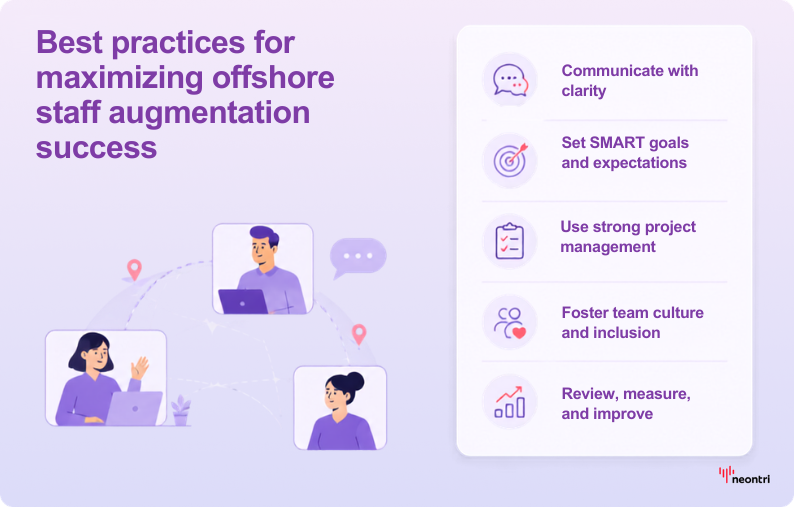
Offshore IT staff augmentation offers a powerful solution to bridge skill gaps, scale teams quickly, and stay ahead of the competition. However, there are a few steps to take to integrate augmented talent into your team successfully:
- Establish clear communication guidelines. Let the new team members know who to contact with any issues or questions about the project. Clarify the team’s preferred communication style and channels.
- Set SMART goals and KPIs. Establish specific, measurable, achievable, relevant, and time-bound (SMART) goals for the offshore team to monitor if everyone’s on track. Define KPIs to evaluate the team’s performance and communicate them to new team members.
- Implement project management tools and methodologies. Rely on project management and software development collaboration tools like Jira, Trello, or Asana to manage tasks, monitor deadlines, and track milestones. Leverage project management methodologies, such as Agile and Scrum, to further streamline the software development process.
- Foster a cohesive company culture. Set the same expectations for existing team members and the new employees. Introduce the augmented staff to internal policies and roles. Organize an onboarding meeting and invite them to your online team-building activities to create a sense of belonging.
- Implement regular performance reviews. Review the team’s progress to ensure it stays on track and introduce continuous feedback loops to make quick improvements.
Final thoughts: Leveraging offshore staff augmentation for competitive advantage
Offshore IT staff augmentation is a fast and cost-effective way to enhance IT capabilities. It gives companies access to a global IT talent pool, allowing them to quickly find the experts they need while maintaining full control over the development process.
Staff augmentation can significantly improve IT project efficiency, whether businesses are expanding their in-house team under tight deadlines, seeking rare tech expertise, or looking for senior professionals on a limited budget.
FAQ
How to ensure security with offshore staff?
To maximize security when working with offshore staff, implement comprehensive access controls, such as VPNs, encrypted communications, and role-based permissions, that limit the exposure of sensitive data. Establish robust legal protections through detailed NDAs, security training requirements, and regular compliance audits. Additionally, create clear data handling protocols and incident response procedures while maintaining continuous monitoring of all offshore team activities.
Is offshore staff augmentation safe for cybersecurity, fintech, or banking projects?
Yes, when proper security measures are in place. These include background checks, secure development environments, and compliance with international security standards like ISO 27001.
For fintech and banking projects specifically, look for providers with experience in PCI DSS, SOC 2, and GDPR-regulated environments, plus staff trained in secure coding practices for financial systems. Providers with a track record delivering for banks and fintechs, rather than general-purpose IT projects, typically have these controls built into their standard process.
Which is cheaper: Offshore vs nearshore?
Offshore talent offers the lowest hourly rates, making it more affordable for well-defined, maintenance-focused projects. However, nearshore talent frequently proves more cost-effective overall for complex, agile development. The overlap in working hours and shared cultural context drastically reduce management overhead, communication barriers, and costly rework. Ultimately, offshore wins on raw baseline cost, while nearshore minimizes total cost of ownership.
How can I evaluate the trustworthiness of an offshore staff augmentation provider for cybersecurity?
Conduct thorough due diligence that includes reviewing virtual security assessments, security certifications, client testimonials from similar industries, and data protection policies and incident response procedures.
Can offshore teams handle compliance-heavy sectors like banking or fintech?
Yes. Often, offshore providers have experience working with global financial institutions and therefore maintain even higher security standards than those typical of in-house teams.