
Despite $30-40 billion in enterprise investment into GenAI, a striking 95% of organizations are seeing no measurable return. Only a small fraction of integrated AI pilots are generating millions in value, while the majority remain stuck without a tangible impact.
The difference isn’t in the technology – it’s in the approach. Supply chain executives today face a perfect storm: rising network complexity, critical talent shortages, and urgent demands for resilient, responsive operations. Meanwhile, global disruptions have exposed the fragility of traditional models, demanding new levels of agility and intelligence.
Traditional automation has reached its limits, unable to keep pace with the speed, scale, and complexity of modern supply chains. Generative AI, however, offers a transformative solution that extends far beyond simple task automation. In supply chain operations, this technology serves as the foundation for autonomous, self-healing networks – capable of continuously analyzing data, predicting disruptions, and adapting in real-time to changing conditions – turning reactive operations into proactive, intelligent systems.
For this article, Neontri experts analyzed the top implementations across Fortune 500 companies and distilled proven strategies that separate successful deployments from costly failures. From industry-specific use cases to quantified ROI examples, this comprehensive guide equips leaders with the insights needed to plan, execute, and scale GenAI initiatives that deliver measurable business value.
Key takeaways
- Leading companies achieve 30%+ efficiency gains through strategic GenAI implementation.
- GenAI supply chain transformation is built on four foundational pillars: an enhanced data backbone, augmented analytics, a revolutionary user experience, and deep process automation.
- By 2030, autonomous supply chains will become the industry standard, so companies not investing in GenAI now face a permanent competitive disadvantage in the next decade.
Understanding GenAI’s supply chain revolution
Supply chain complexity has reached critical thresholds, with global networks averaging 15,000+ suppliers across 50+ countries, creating management challenges that exceed human cognitive capacity. Traditional planning approaches can not process the volume and variety of signals required for optimal decision-making in this environment.
The supply chain talent shortage crisis intensifies these challenges, with current performance metrics revealing the scope of the problem: forecast accuracy averages just 48%, on-time-in-full (OTIF) rates hover at 52%, and despite 63% of respondents claiming to have fully optimized operations, 55% still rely on Excel for critical planning tasks.
The generative AI in the supply chain market represents one of the fastest-growing segments in enterprise technology, with the global market size calculated at $640.04 million in 2024, growing to $932.02 million in 2025, and projected to reach $27.44 billion by 2034, expanding at a CAGR of 45.62%. This explosive growth is driven by urgent business needs and the convergence of technology maturity and operational demand.
GenAI can capture and codify institutional knowledge while democratizing access to advanced planning capabilities. It draws insights from diverse data sources to generate novel solutions and actionable insights that may not be present in historical records. Where traditional analytics relies on structured data and historical patterns, and machine learning refines predictions through training datasets, GenAI expands the frontier – offering dynamic problem-solving, adaptive scenario planning, and the ability to augment human decision-making.
GenAI brings three transformative capabilities that revolutionize how supply chains operate:
- Natural language processing allows supply chain professionals to interact with complex planning systems using conversational interfaces. Instead of requiring specialized training to navigate ERP systems or create complex queries, planners can simply ask “What would happen to our inventory levels if our primary supplier in Southeast Asia experiences a 3-week delay?” and receive comprehensive scenario analyses with actionable recommendations.
- Content generation capabilities enable GenAI to create comprehensive reports, supplier assessments, and risk analyses by synthesizing information from multiple unstructured sources. This approach extends beyond traditional analytics, which rely solely on transactional data, by incorporating supplier communications, market intelligence, regulatory updates, and external risk factors to provide coherent strategic insights.
- Scenario simulation allows real-time modeling of complex supply chain disruptions and their cascading effects across global networks. Traditional AI models require pre-defined parameters and historical patterns, while GenAI can generate novel scenarios by combining multiple variables and external factors, providing unprecedented visibility into potential future states.
Industry adoption rates show that while 97% of organizations are using some form of GenAI, only 33% are applying it to supply chain-specific use cases, highlighting massive untapped potential. Early adopters are already capturing significant value, with companies reporting an average return of $3.70 for every $1 spent. These quantified results demonstrate that GenAI in supply chain applications delivers measurable business impact beyond proof-of-concept demonstrations.
Global generative AI spending is expected to reach $644 billion in 2025, representing a 76.4% increase from 2024, creating a strong economic foundation for large-scale deployment. As supply chain organizations adopt these capabilities, the opportunity to transform operations and establish long-term competitive advantage has never been greater.


Ready to move from theory to impact?
Start building your GenAI supply chain transformation strategy today.
Foundational pillars of GenAI supply chain transformation
Generative AI is not just another technology upgrade – it represents a structural shift in how supply chains are designed, managed, and scaled. To move beyond pilots and unlock enterprise-wide value, organizations must build transformation on four foundational pillars that balance technical capabilities with business impact.
#1: Enhanced data backbone
The foundation of successful GenAI supply chain implementation rests on transforming disparate, often chaotic data landscapes into coherent, actionable intelligence. Enhanced data backbone capabilities address the fundamental challenge that 80% of supply chain data exists in unstructured formats – emails, PDFs, supplier communications, regulatory documents, and market intelligence reports that traditional systems cannot effectively process.
Master data cleaning and augmentation represents the first critical capability, where GenAI automatically identifies and resolves data quality issues across multiple enterprise applications. Instead of manual data stewardship processes that take weeks or months, the AI-powered system can standardize supplier names, harmonize product classifications, and validate address information in real-time, creating a unified foundation for advanced analytics.
Supplier knowledge base enhancement transforms static vendor databases into dynamic, intelligent repositories that continuously update based on news feeds, financial reports, regulatory filings, and performance data. This enables proactive risk assessment rather than reactive responses to supplier issues, with systems automatically flagging potential problems before they impact operations.
Real-time data integration capabilities enable GenAI to synthesize information from IoT sensors, transportation systems, weather forecasts, geopolitical developments, and market conditions into coherent operational insights. This holistic view supports dynamic decision-making that considers all the factors affecting supply chain performance.
#2: Augmented analytics
Traditional supply chain analytics rely on historical patterns and predefined models, which struggle to cope with the complexity and volatility of modern global networks. Augmented analytics, powered by GenAI, transforms this limitation into a competitive advantage by generating insights that emerge from the real-time synthesis of multiple data sources and scenario modeling.
Demand forecasting improvements achieve 20-35% accuracy gains by incorporating unstructured data sources, such as social media sentiment, economic indicators, competitor actions, and seasonal trend variations, that traditional systems cannot process. GenAI models can identify emerging demand patterns weeks or months in advance, enabling proactive inventory positioning and supplier capacity planning.
Scenario planning and disruption prediction capabilities enable supply chain teams to model complex “what-if” scenarios across multiple variables simultaneously. Companies implementing these capabilities have seen over 2-percentage-point increases in EBITDA by the second year, with threefold reductions in process cycle times.
#3: Revolutionary user experience
The third pillar addresses one of the biggest obstacles to the adoption of advanced analytics – the complexity of legacy planning systems, which require specialized expertise and lengthy training. Next-generation user experience capabilities break down these barriers by delivering intuitive, conversational interfaces that democratize access to advanced supply chain intelligence.
Natural language interfaces for planning systems enable logistics professionals to interact with complex ERP, forecasting, and optimization tools using everyday language. Managers can ask questions like “Which suppliers are at highest risk for delivery delays in Q3?” or “How would a 15% increase in transportation costs affect our profitability by product line?” and receive comprehensive analyses with visual representations and actionable recommendations. Democratization of advanced analytics empowers front-line employees with access to insights previously reserved for specialized analysts.
ChatGPT-like interactions for supply chain data transform routine operational tasks into efficient, intelligent conversations. Instead of navigating multiple screens and generating manual reports, users can request complex analyses, generate performance summaries, and create executive presentations through natural language commands that understand context and business objectives.
#4: Deep process automation
The fourth pillar represents the ultimate evolution of GenAI supply chain capabilities: independent systems that can execute end-to-end workflows with minimal human intervention. This shift goes beyond robotic process automation, enabling intelligent agents that understand business context, can make complex decisions, and adapt to changing conditions.
End-to-end workflow automation connects previously isolated systems and processes into seamless, dynamic operations. Cross-functional orchestration enables the GenAI system to coordinate activities across multiple departments, suppliers, and external partners based on real-time conditions and business priorities. When disruptions occur, it can simultaneously assess alternatives, communicate with stakeholders, and implement contingency plans while keeping human decision-makers informed and maintaining oversight controls.
Autonomous decision-making capabilities handle routine operational choices within predefined parameters, escalating only exceptions that require human judgment. This enables organizations to maintain 24/7 operations while ensuring that experienced professionals focus on strategic decisions rather than routine tasks.
Proven use cases of GenAI in supply chain management
The potential of GenAI is vast, but its true power lies in its practical applications. This section highlights concrete examples of how GenAI has been successfully deployed to address critical supply chain challenges and deliver measurable results.
Planning and forecasting
Demand planning represents one of the most mature and successful applications of GenAI in supply chain operations. It enables leading companies to achieve 15-30% improvements in forecast accuracy by intelligently incorporating external signals and market intelligence.
Amazon’s inventory optimization system is a perfect example of the potential scale of impact. It processes millions of products across global fulfillment networks to minimize stockouts while reducing inventory carrying costs. The system analyzes traditional demand signals alongside weather patterns, social media trends, economic indicators, competitor actions, and promotional activities to generate dynamic forecasts that adapt to changing market conditions. Amazon’s inventory turnover is among the highest in the industry, enabling the company to operate lean while still meeting customer expectations for fast delivery.
Supply planning optimization extends beyond demand forecasting to encompass supplier capacity modeling, transportation optimization, and inventory positioning across multi-tier supply networks. GenAI systems can optimize production schedules, supplier allocations, and distribution strategies, taking into account capacity constraints, cost structures, and service level requirements.
Risk planning capabilities provide early warning systems that identify potential disruptions weeks or months in advance. For example, Microsoft’s Supply Chain Center incorporates a news model that gathers supplier-related news that can potentially affect the logistics, such as natural disasters and geopolitical situations, enabling proactive response strategies.
Intelligent procurement
Procurement processes represent significant opportunities for GenAI optimization, with potential savings of 5-15%. Traditional sourcing relies on limited supplier databases and manual evaluation processes that cannot efficiently assess worldwide vendor ecosystems or identify emerging opportunities. Automated supplier identification and risk assessment capabilities scan global databases, regulatory filings, news sources, and industry reports to identify qualified suppliers while continuously monitoring risk factors that could impact performance.
RFP/RFQ process optimization reduces procurement cycle times by 40-60% through intelligent document generation, automated vendor communications, and comprehensive proposal analysis. GenAI systems can prepare detailed technical specifications, evaluate supplier responses against multiple criteria, and provide recommendations that consider the total cost of ownership rather than just initial pricing.
Contract analysis and compliance monitoring transform static legal documents into dynamic management tools that actively monitor performance against commitments, identify renewal opportunities, and flag potential compliance issues. This proactive approach reduces contract disputes while ensuring that organizations capture negotiated benefits and maintain supplier accountability.
Logistics optimization
Transportation optimization represents one of the most quantifiable applications of GenAI in supply chain operations. The impact of AI is estimated at roughly $190 billion in travel and logistics alone, demonstrating the substantial value creation potential.
Warehousing applications focus on intelligent labor planning, space optimization, and automated inventory management that responds to dynamic demand patterns. For one company, the implementation of virtual dispatcher agents has resulted in annual savings of $30-35 million. This was achieved through optimizing picking routes, automating inventory replenishment decisions, and coordinating inbound and outbound operations based on real-time conditions.
GenAI maturity journey: Mapping the path to autonomous supply chains
The path to GenAI-driven supply chain transformation is evolutionary, with organizations progressing through distinct maturity stages that build upon one another. Understanding these stages helps leaders plan investments, set realistic timelines, and prepare their supply chain for a future defined by intelligence, agility, and resilience.
Stage #1: Task-specific point solutions
Organizations typically begin their GenAI supply chain journey with applications that address specific operational pain points and require minimal integration with existing systems. Task-specific point solutions provide quick wins that demonstrate value and build organizational confidence in GenAI capabilities.
Chatbots for routine operational tasks represent the most common starting point, handling repetitive inquiries about order status, delivery schedules, supplier information, and inventory availability. Another common application is document analysis tools, which extract key details from contracts, invoices, and supplier communications – delivering immediate productivity gains while generating insights that guide future strategic decisions.
The investment requirements at this stage typically include software licensing, basic integration services, and initial training programs. Organizations can expect 6-12 month payback periods through productivity improvements and cost reductions, with success measured by user adoption rates, query resolution times, and operational efficiency metrics.
Stage #2: Process enhancements
The second stage focuses on integrating GenAI with existing planning and execution systems to strengthen decision-making and operational efficiency. These enhancements typically create measurable business value through greater planning accuracy and lower operational risks.
By embedding GenAI into current planning systems, organizations can augment human judgment with real-time analysis of diverse data sources and automatically generated scenario models. This approach preserves established workflows while delivering sharper insights, improved forecast precision, and shorter planning cycles.
Investment requirements include system integration services, data architecture enhancements, and expanded training programs that prepare teams to leverage enhanced capabilities. Organizations typically achieve 12-18 month payback periods through improved planning accuracy, reduced emergency procurement costs, and enhanced customer service levels.
Stage #3: Deep process transformation
The third maturity stage centers on the fundamental redesign of core supply chain processes to fully leverage GenAI for autonomous decision-making and workflow optimization. By automating master data management and rebuilding workflows, organizations can create intelligent systems that continuously ensure data quality, optimize process flows, and adapt to evolving business conditions. This transformation ensures processes operate on accurate, up-to-date information.
At the same time, human-in-the-loop oversight preserves strategic control by allowing GenAI systems to handle routine operational decisions within predefined parameters. This approach keeps the team’s judgment focused on complex, high-value strategic choices, while automating repetitive tasks that consume valuable professional time.
Investment levels reflect comprehensive system integration, process redesign, and change management requirements. Organizations typically achieve 18-36 month payback periods through operational cost reductions, improved customer service, and enhanced competitive positioning in their markets.
Stage #4: Cross-functional automation
The fourth and most advanced maturity stage creates autonomous agent networks that orchestrate end-to-end operations across multiple functions, suppliers, and external partners. These systems coordinate complex supply chain activities through intelligent communication and decision-making protocols that adapt to changing conditions while maintaining alignment with business objectives. They can manage supplier relationships, optimize inventory positions, and coordinate logistics operations with minimal human intervention.
Investment requirements include comprehensive technology infrastructure, advanced integration services, and extensive organizational transformation programs. Organizations typically achieve strategic ROI through market share gains, operational cost advantages, and enhanced customer loyalty that creates sustainable competitive differentiation.
Building a GenAI implementation strategy
Successful GenAI supply chain transformation requires a systematic approach that aligns technology capabilities with business objectives while managing organizational change and risk factors. The five-step implementation framework provides proven methodology for organizations at any maturity level to achieve successful outcomes.
Step 1: Set strategic goals
Define the organization’s strategic ambition and align GenAI initiatives with broader business objectives and competitive positioning. Establish clear success metrics, governance structures, and secure executive sponsorship to ensure the long-term success of the transformation. This foundational step prevents technology-driven initiatives that fail to deliver tangible business value.
Step 2: Map critical decision points
Identify key areas across the supply chain where GenAI can have the greatest impact. Consider data availability, current pain points, and potential ROI to prioritize implementation efforts. Successful organizations typically focus on 15–25 high-impact decision points as the foundation of their GenAI strategy.
Step 3: Prioritize high-impact, low-complexity use cases
Select initiatives that can demonstrate value quickly while building organizational capabilities and confidence. Quick wins help fund larger initiatives and develop internal expertise needed for more complex implementations.
Step 4: Redesign end-to-end workflows
Rethink workflows to optimize human-AI collaboration rather than merely automating existing processes. Analyze task allocation, decision authority, and performance measurement to ensure GenAI enhances human capabilities where strategic oversight is required.
Step 5: Build an ecosystem of partners
Develop a network of technology and implementation providers with specialized expertise, proven methodologies, and ongoing support for complex transformation initiatives. Evaluate potential partners based on industry experience, technology capabilities, cultural fit, and long-term strategic alignment rather than just cost considerations.
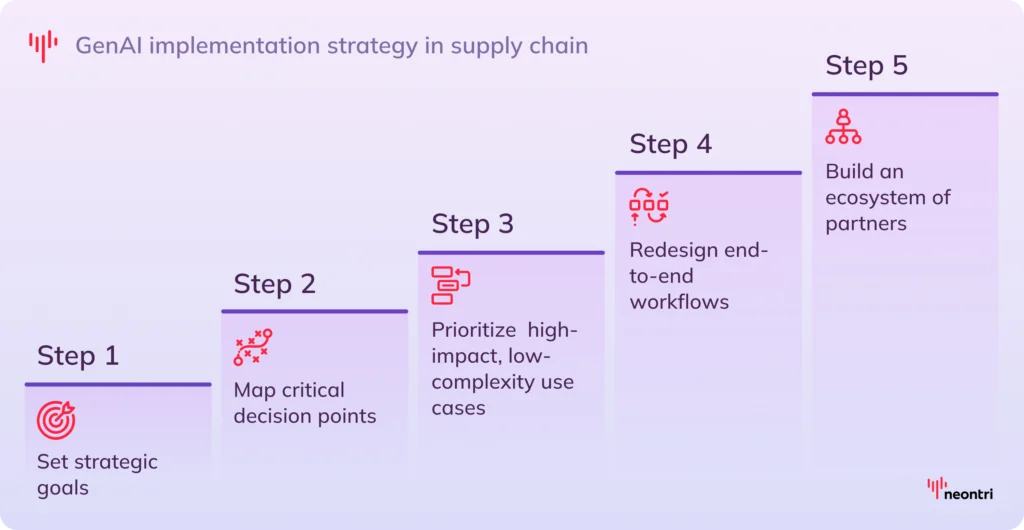
With this structured framework in place, organizations gain both the clarity and confidence to move from strategy to execution. The next step is translating these principles into tailored approaches that reflect the unique dynamics, priorities, and challenges of specific industries.
Manufacturing
Manufacturing organizations face unique challenges, including complex bill-of-materials structures, multi-tier supplier networks, and tight integration between production planning and supply chain operations. GenAI implementations in manufacturing are focused on production planning optimization, quality control, and supplier network risk management – solutions tailored to address these specific requirements.
- AI-driven production optimization leverages GenAI to generate dynamic production schedules that simultaneously consider demand forecasts, supplier capacity, and machine availability. This holistic approach improves asset utilization, reduces inventory levels, and enhances customer service.
- Quality control applications use GenAI to analyze inspection data, supplier certifications, and process parameters to predict potential issues before they occur. By proactively identifying risks, manufacturers can reduce scrap rates, warranty costs, and customer complaints while improving overall operational efficiency.
- Supplier network risk management is critical in environments where single-source components can halt entire production lines. GenAI systems continuously monitor supplier financial health, capacity utilization, and external risk factors, providing early warnings and actionable mitigation strategies to prevent disruptions.
Retail and consumer goods
Retail organizations operate in fast-moving environments with seasonal demand patterns, promotions, and complex omnichannel fulfillment requirements. GenAI implementations in this sector focus on three areas: Retail leaders applying retail-specific GenAI use cases unlock $240-390 billion in sector value through operational gains and customer experience improvements.
- Demand sensing capabilities incorporate social media trends, weather patterns, economic indicators, and competitor activities into dynamic demand models that adapt to changing market conditions. This enables retailers to position their inventory effectively, minimizing stockouts and markdowns.
- Omnichannel fulfillment strategies optimize inventory allocation and order fulfillment across stores, distribution centers, drop-ship suppliers, and third-party providers. GenAI dynamically balances inventory availability, transportation costs, delivery requirements, and customer preferences to streamline operations.
- Promotional planning and pricing optimization leverages GenAI to model complex interactions between campaigns, competitive responses, and demand patterns, helping retailers maximize margins while maintaining inventory and sales targets.
Logistics and transportation
Logistics providers operate in highly competitive environments where operational efficiency directly impacts profitability and customer satisfaction. GenAI implementations focus on route optimization, fleet management, warehouse automation, and last-mile delivery innovation that create sustainable competitive advantages.
- Route optimization and fleet management go beyond traditional vehicle routing by incorporating dynamic rescheduling, driver preferences, customer requirements, and real-time traffic conditions. These capabilities reduce costs while improving service levels and driver satisfaction.
- Warehouse automation and labor planning use GenAI to optimize picking routes, storage locations, and staffing levels based on real-time demand and operational constraints, boosting productivity, reducing labor costs, and enhancing worker safety.
- Last-mile delivery innovation targets the most expensive component of logistics operations. GenAI optimizes delivery schedules, explores alternative delivery options, and enhances customer communication, providing accurate delivery estimates and flexible fulfillment options.
Integration challenges and how to overcome them
Deploying GenAI in supply chain operations presents a complex set of challenges that span data quality, technical implementation, and organizational change. Success depends not only on advanced models but also on reliable, harmonized data, scalable and secure infrastructure, and a workforce prepared to embrace new ways of working. By proactively addressing these challenges, organizations can unlock the full potential of GenAI, turning insights into actionable decisions, optimizing operations, and driving measurable business value across the enterprise.
Data quality
High-quality, reliable data is the lifeblood of effective GenAI in supply chains, yet organizations often struggle with inconsistent, incomplete, or siloed information. Addressing these data quality challenges is critical to ensure accurate insights, actionable recommendations, and successful AI-driven decision-making.
| Challenge | Description | Solution |
|---|---|---|
| Multi-source data harmonization | Organizations often operate multiple ERP systems, planning tools, and external data sources with varying formats, definitions, and update cycles, creating significant complexity for GenAI supply chain implementations. | Implement comprehensive data governance frameworks that standardize definitions while maintaining flexibility for diverse business needs. |
| Data governance | Effective GenAI operations require addressing master data management, quality monitoring, and access controls, while also supporting real-time data sharing across systems. | Establish data stewardship roles, deploy automated quality monitoring, and define clear escalation procedures for data issues that could affect AI performance. |
| Real-time data processing | Traditional batch-oriented architectures cannot support the dynamic decision-making that GenAI requires. | Invest in streaming data platforms, event-driven architectures, and real-time integration capabilities to enable GenAI systems to operate on current, rather than historical, information. |
| Data security and privacy | GenAI systems process sensitive supplier information, customer data, and proprietary business intelligence, increasing the complexity of security and privacy requirements. | Implement comprehensive security frameworks covering access controls, data encryption, audit trails, and regulatory compliance, while ensuring necessary accessibility for effective AI operations. |
Technical implementation hurdles
Building an AI factory architecture is crucial for achieving production-grade GenAI in supply chains, but it presents significant technical challenges. This architecture must address data management, model training and deployment, integration requirements, and security considerations while maintaining performance and scalability for enterprise operations.
The AI factory approach centralizes core capabilities, including data pipelines, model management, deployment automation, and monitoring systems, while providing APIs and interfaces that support a diverse range of business applications.
However, turning this vision into reality exposes organizations to multiple technical hurdles that must be carefully managed to ensure successful adoption:
- High infrastructure costs: GPU costs and computational requirements represent significant infrastructure investments that vary by model complexity, data volumes, and real-time processing needs.
- Cloud strategy risks: Cloud platforms can reduce costs and provide access to specialized AI hardware and services that would be prohibitively expensive for individual organizations. However, cloud implementations must address data security, network latency, and vendor lock-in concerns while ensuring reliable performance for critical supply chain operations.
- Model training complexity: Fine-tuning general-purpose GenAI models for supply chain applications demands specialized expertise and significant compute power. Organizations should consider partnerships with technology providers or consulting firms that have developed supply chain-specific models and implementation methodologies.
- Legacy system integration: Organizations often operate on established ERP platforms, planning systems, and operational databases that were not designed for AI integration. Therefore, implementations typically require middleware solutions, API development, and careful change management to minimize disruption to existing operations.
Organizational change resistance
The skills gap and training requirements present significant challenges, as organizations need professionals who understand both supply chain operations and GenAI capabilities. Training programs must address technical system operation, strategic decision-making with AI support, and collaborative working approaches that leverage both human and artificial intelligence.
Cultural adoption strategies must address employee concerns about job security, system reliability, and changing work responsibilities while building confidence in GenAI capabilities. Successful adoption requires transparent communication, gradual implementation approaches, and recognition systems that reward effective human-AI collaboration.
Performance measurement and incentive alignment ensure that success metrics and compensation structures support rather than undermine GenAI adoption. Organizations should revise job descriptions, performance metrics, and incentive structures to reward effective utilization of AI capabilities rather than traditional task-oriented activities.
Change management programs should provide comprehensive support for employees throughout the transformation process, including training, coaching, and psychological support that addresses concerns about changing roles and responsibilities in AI-augmented work environments.


Turn complexity into clarity with Neontri
Every challenge in GenAI implementation comes with a proven path forward. Let’s design a tailored roadmap that accelerates adoption while minimizing risk.
Measuring GenAI success in the supply chain
The true value of GenAI in supply chains emerges only when organizations can quantify its contribution across cost, revenue, and resilience dimensions. Beyond efficiency gains, the right measurement framework reveals how GenAI reshapes decision-making speed, workforce productivity, and long-term competitiveness.
Financial impact metrics
Cost reduction examples demonstrate the quantifiable benefits that organizations achieve through GenAI supply chain implementations. Leading companies report 10-20% logistics coordination savings through intelligent route optimization, automated freight negotiations, and dynamic capacity utilization that reduces transportation costs while improving service levels.
Inventory optimization typically delivers 15-25% reductions in carrying costs through improved demand forecasting, dynamic safety stock calculations, and intelligent inventory positioning across global networks. These savings compound over time as organizations develop more sophisticated optimization capabilities and expand implementations across product categories.
Revenue impact through improved customer service, reduced stockouts, and faster order fulfillment typically generates 5-15% revenue increases that complement cost reduction benefits.
Operational performance indicators
Decision-making speed improvements of 30%+ faster response times enable supply chain organizations to capture opportunities and mitigate risks more effectively than competitors using traditional approaches. Faster decision-making becomes particularly valuable during market disruptions, when rapid responses determine competitive outcomes.
User adoption and satisfaction metrics indicate the effectiveness of change management programs and system design decisions. Successful implementations typically achieve 60%+ user adoption rates within 12 months, with satisfaction scores indicating that employees find GenAI systems helpful rather than burdensome.
Process efficiency gains of 50%+ reductions in administrative tasks free experienced professionals to focus on strategic activities that create competitive advantage. These efficiency improvements enable organizations to handle growth without proportional increases in staffing, while also improving job satisfaction by eliminating routine tasks.
Planning accuracy improvements of 15-30% in demand forecasting, supplier performance prediction, and risk assessment create cascading benefits throughout supply chain operations. Improved accuracy reduces safety stock requirements, enables more efficient capacity utilization, and enhances customer service through better delivery promises.
Strategic value creation
Competitive advantage and market positioning benefits extend beyond immediate operational improvements to create sustainable strategic differentiation. Organizations that achieve autonomous supply chain capabilities can offer service levels, cost structures, and flexibility that competitors cannot match using traditional approaches.
Innovation acceleration and time-to-market improvements enable organizations to respond more quickly to changing customer requirements, market opportunities, and competitive threats. GenAI systems can rapidly model new scenarios, assess risks, and implement changes that would require months using traditional planning approaches.
Long-term strategic value creation includes improved supplier relationships, enhanced customer loyalty, and organizational capabilities that support future growth and market expansion. These intangible benefits often exceed immediate cost savings in their impact on organizational success and competitive positioning.
Getting started: Your GenAI action plan
Successfully implementing GenAI in supply chain operations requires more than just the right technology – it demands a structured roadmap that balances quick wins with long-term transformation. At Neontri, we’ve guided enterprises through complex technology shifts for over a decade, building deep expertise in data management, AI implementation, and enterprise system innovation.
Drawing on this experience, our team has developed a practical action plan that helps organizations move from exploration to full-scale deployment with confidence. The roadmap is structured across three horizons – 30 days, 90 days, and 12 months – giving business leaders a clear path to capture early value, build organizational capabilities, and achieve sustainable transformation at scale.
Immediate next steps (30 days)
The first 30 days should focus on establishing a clear understanding of the organization’s current state and laying the groundwork for GenAI adoption. This begins with a comprehensive readiness assessment of existing systems, data quality, organizational capabilities, and strategic priorities that will shape implementation success. Honest evaluations of digital maturity, change management capacity, and available investment resources are critical at this stage.
From this assessment, organizations can identify pain points, quantify potential benefits, and measure readiness for AI transformation. This analysis provides the foundation for realistic timeline planning, resource allocation, and success metrics that guide implementation decisions.
Next, attention should shift to use case prioritization and business case development. Focusing on 3-5 high-value applications with strong ROI potential, available data, and manageable complexity allows organizations to demonstrate tangible results within 6-12 months while building internal confidence and momentum.
Finally, vendor evaluation and partner selection should be initiated. This requires careful consideration of solution capabilities, industry expertise, implementation methodologies, and long-term strategic alignment. Beyond functionality, organizations must assess the total cost of ownership, scalability, and seamless integration with existing systems to ensure sustainable success.
Quick wins (90 days)
Next, organizations should shift from assessment to action by launching pilot projects. These projects should focus on contained use cases that deliver measurable value while minimizing operational risk. Successful pilots typically address specific pain points like routine inquiry automation, document analysis, or basic scenario planning that provide immediate value while building practical implementation experience.
Each pilot must be designed with clear success metrics, defined timelines, and escalation procedures to ensure learning objectives are met regardless of tech outcomes. The primary goal at this stage is not only to prove the feasibility of GenAI but also to build organizational capability and confidence.
In parallel, team formation and training should begin by identifying project sponsors, technical resources, and business stakeholders who will champion GenAI adoption. Training programs should combine technical skills development with new collaboration approaches that help maximize GenAI’s value across functions.
Scaling and transformation roadmap (12 months)
During the next stage, implementation across priority use cases extends successful pilot projects into broader organizational applications, with a focus on achieving measurable business impact. Effective scaling requires disciplined change management, seamless system integration, and continuous performance monitoring to ensure consistent value delivery.
Over a 12-month horizon, organizations can expect improvements of 15–30% in targeted operational areas. As adoption deepens, organizations should pursue advanced capability development, including tighter integration with planning systems, the creation of industry-specific models, and the deployment of sophisticated automation capabilities that generate sustainable competitive advantages. While these capabilities require longer development cycles, they deliver transformational impact across the supply chain.
To safeguard value creation, ROI measurement and continuous improvement programs must be embedded into the transformation journey. Regular review processes, benchmarking, and strategic planning cycles ensure that GenAI investments deliver on their promise while uncovering new opportunities for optimization and expansion.
Ultimately, the 12-month roadmap must balance ambitious goals with realistic implementation timelines. By committing to continuous learning, adaptation, and strategic investment, organizations can make meaningful progress toward the long-term vision of an autonomous, GenAI-powered supply chain – securing a durable competitive edge for the decade ahead.
Conclusion
The supply chain industry stands at a transformational inflection point, where generative AI will separate market leaders from followers over the next decade. Organizations that begin their GenAI journey now will develop autonomous capabilities that create sustainable competitive advantages, while companies that delay implementation will face increasingly difficult catch-up challenges as the technology becomes ubiquitous.
The path forward is clear: early action creates momentum, capability, and market differentiation. Now is the time to take the first step. Partner with Neontri to translate GenAI’s potential into measurable business value and secure your position as a leader in the next era of supply chain transformation.