

Generative AI applications are gaining recognition across banking, cybersecurity, software development, retail, marketing, and other industries. This popularity stems from the measurable results they deliver, such as reduced costs, faster workflows, and higher engagement.
According to McKinsey, 71% of organizations now use generative AI in at least one business function. The study estimates the technology could unlock between $2.6 trillion and $4.4 trillion in annual economic value across 63 use cases.
In this article, we’ll examine generative AI application examples – from banks using GenAI copilots for insight extraction, to retailers simplifying search with intent-based shopping, and beauty brands optimizing content through AI-generated visuals.
Key takeaways
- Generative AI helps financial institutions, including JPMorgan, Citi, and UBS, summarize regulatory content, speed up research, and assist sales teams with client-specific outreach, saving thousands of hours annually.
- GenAI supports faster recovery and response by generating incident playbooks, executive reports, and phishing simulations.
- GitHub Copilot, Amazon Q Developer, and custom tools like DevGen.AI are streamlining code generation, test creation, and legacy system upgrades, cutting development time and boosting engineer satisfaction.
- Retailers are using GenAI to improve content quality, customer support, and personalized shopping, as shown by Alibaba’s seller-side content tools, ASOS’s conversational shopping assistant, and Best Buy’s virtual support agents.
- Brands like Clorox, Unilever, and L’Oréal are applying GenAI to accelerate content production, generate new product ideas, and deliver localized assets at scale.
Generative AI applications in banking and finance
Financial institutions are rapidly moving beyond experimentation, embedding generative AI into core operations to streamline processes, empower research teams, strengthen compliance, and elevate client communications. A practical example is using Claude in finance workflows for financial analysis, reporting, compliance support, and research.
Application #1: Automating financial research and reporting
Generative AI support analysts by condensing long financial documents into quick summaries. For instance, Deutsche Bank’s DB Lumina, built on Google Cloud, creates one-page reports from extensive research materials, helping teams save time when reviewing market insights.
At UBS, a new approach combines OpenAI and Synthesia to generate short AI-generated content in the form of avatar videos presenting research highlights. UBS launched the initiative in early 2025 with a goal of producing 5,000 such videos per year to make insights more accessible to clients (although they later lowered this target).
Application #2: Document summarization and compliance
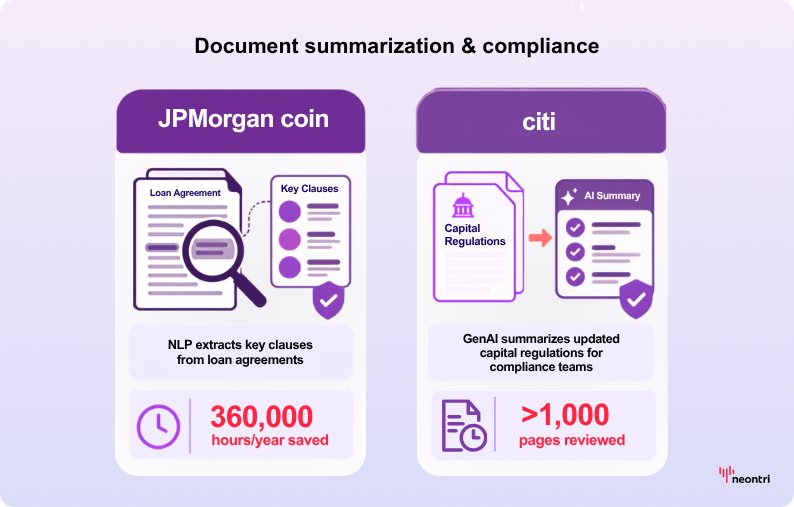
Regulatory documents are often hundreds of pages long and packed with technical details. Therefore, JPMorgan’s COIN platform uses natural language processing to identify and extract key clauses from loan agreements. This reduces manual review time by an estimated 360,000 hours per year.
Similarly, faced with over 1,000 pages of updated capital regulations, Citigroup used GenAI to generate summaries for its compliance teams, speeding up internal review and interpretation.
Support teams are also benefiting from document summarization tools. Citi Stylus uses generative AI to summarize policy and onboarding materials for employees across multiple regions.
Application #3: Fraud detection
Some financial institutions, like Mastercard, are also exploring GenAI’s role in fraud-related operations. The company has applied generative AI solutions to help detect compromised cards and high-risk merchants more quickly, doubling detection speeds and reducing false positives by around 200%.
Application #4: Sales optimization
Financial institutions also use GenAI to generate client-specific recommendations that support corporate sales teams. The Japanese Mitsubishi UFJ Financial Group (MUFG) works with AWS and Amazon Bedrock to provide account managers with tailored outreach suggestions. According to the bank, this has helped increase conversion rates by approximately 30%.
Application #5: Internal productivity and AI copilots
Several institutions are using GenAI tools to support knowledge workers in day-to-day tasks. Morgan Stanley’s AskResearchGPT assists financial advisers by answering questions based on internal research reports.
At the same time, Barclays Bank PLC is scaling up its GenAI strategy by rolling out Microsoft 365 Copilot to 100,000 employees worldwide. The bank is integrating the generative AI assistant with its internal productivity tools to create a unified AI agent that can extract insights, automate tasks, and make internal knowledge bases more accessible.
Generative AI applications in cybersecurity
Unlike traditional AI models designed to detect threats or predict anomalies, generative AI applications in cybersecurity concentrate on text generation and content creation. Their value lies in producing clear, actionable textual, scripted, or structured outputs that enable security teams to respond faster and operate more effectively.
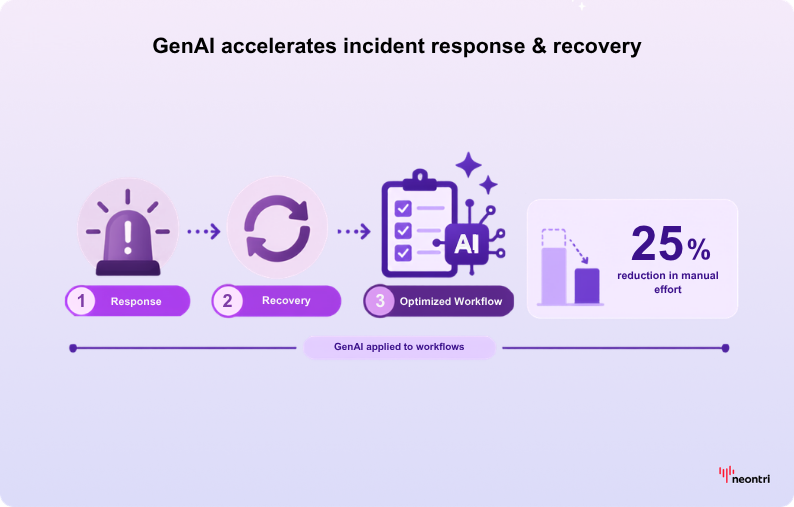
A 2024 NTT DATA study found that applying GenAI to response and recovery workflows reduced manual effort by approximately 25%. In secure environments such as Azure OpenAI or Vertex AI, teams can combine internal and external data sources to generate accurate, context-aware guidance tailored to each incident.
Generative AI demonstrates its capabilities in the following areas of cybersecurity:
- Area #1: Drafting incident response playbooks. Generative AI can produce step-by-step response procedures tailored to detected threats, helping reduce time to resolution.
- Area #2: Summarizing large volumes of incident-related data. It can digest internal logs, threat intelligence feeds, and manuals to deliver actionable summaries.
- Area #3: Supporting analysts. By generating recommendations based on documented past incidents, GenAI helps newer team members effectively take action.
- Area #4: Generating red-team scenarios. GenAI tools can craft realistic images and emails for training and testing.
- Area #5: Creating decoys. AI can fabricate credible fake files, credentials, or domains to mislead attackers and trigger alerts.
Mitsui & Co. offers a good example of how generative AI can enhance cybersecurity operations and incident response. The global trading and investment company uses Microsoft Security Copilot to process large volumes of alerts, retrieve logs, and extract insights in Japanese. The tool also supports internal fraud investigations, enabling compliance teams to efficiently access and analyze communication records across business units worldwide.
Speaking of Microsoft, Nationwide Building Society partnered with the tech giant and Accenture to modernize its cybersecurity infrastructure, leveraging generative AI to support a large-scale migration to Microsoft Sentinel. By accelerating the transfer of hundreds of terabytes of security data, GenAI improved threat detection and reduced the operational burden on the teams, allowing greater focus on broader, long-term security improvements.
Generative AI applications in software development
In software development, generative AI applications help teams write, refactor, test, and document code more efficiently. GenAI is also used for version upgrades, debugging, and summarizing legacy systems, saving time and reducing manual effort.
Application #1: Code generation and autocompletion
GitHub Copilot is increasingly used to accelerate large-scale software development. By assisting with routine coding tasks and reducing context switching, it enables teams to move faster while maintaining code quality, making it especially valuable in complex enterprise environments.
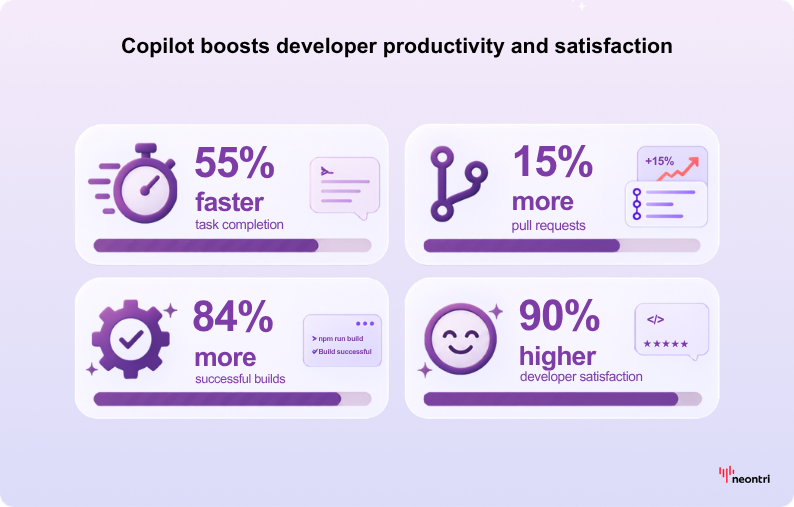
A randomized trial conducted by Accenture showed that Copilot helped teams complete tasks 55% faster, merge 15% more pull requests, and produce 84% more successful builds. Beyond productivity gains, 90% of developers reported higher satisfaction.
ZoomInfo is one of the organizations adopting GitHub Copilot to scale and accelerate enterprise software development. The company rolled it out to more than 400 engineers, achieving a 33% code suggestion acceptance rate and 72% developer satisfaction.
ANZ Bank also used GitHub Copilot at scale, with around 1,000 engineers participating in trials. The results showed meaningful gains in both productivity and code quality.
Application #2: Refactoring and legacy code modernization
Amazon Q is increasingly used to tackle complex refactoring and legacy modernization efforts that are often delayed due to time and resource constraints. By combining code generation with automated testing, debugging, and multi-step reasoning, the tool can safely transform existing applications while reducing manual effort.
National Australia Bank (NAB), BT Group, Novacomp, and Amazon’s internal teams are using it to automate repetitive tasks and accelerate modernization efforts. At NAB, developers accepted 50% of Q’s AI-generated responses, while BT Group reported a 37% acceptance rate.
At Novacomp, Amazon Q was used to upgrade a Java 8 project with more than 10,000 lines of code to Java 17. The transformation was completed in minutes, replacing what would typically require more than two weeks of manual work by an expert developer. Moreover, broader adoption of the tool across the organization has contributed to a 60% reduction in average technical debt.
Amazon applied the same capabilities internally, upgrading more than 1,000 Java applications to version 17 in just two days. This reduced the typical upgrade time per application to under 10 minutes and delivered time savings measured in months.


Modernize legacy systems without slowing down
Reduce technical debt and unlock modern technologies with Neontri’s proven enterprise modernization expertise
Application #3: Test generation and quality assurance
Meta deployed an LLM-based tool, TestGen-LLM, to automatically improve existing human-written tests during large-scale Instagram and Facebook test-a-thons. The system applies a set of verification filters to ensure that each generated test class delivers a measurable improvement over the original suite, effectively reducing the risk of hallucinations.
In production evaluations on Instagram’s Reels and Stories, 75% of test cases it generated were built correctly, 57% ran reliably, and 25% increased test coverage. Overall, TestGen-LLM improved 11.5% of the classes it was applied to, with Meta engineers accepting 73% of its recommendations for production deployment – demonstrating one of the first industrial-scale uses of LLM-generated code with built-in quality assurances.
Generative AI applications in retail
Generative AI in retail now supports a wide range of AI applications, from creating product descriptions and marketing assets to generating personalized content creation, optimizing inventory, and automating customer support.
Application #1: Intelligent seller support
Alibaba, the global e-commerce giant, is using generative AI tools to support over 500,000 sellers. Built on their proprietary model, these tools help small merchants create marketing content, translate product listings, negotiate refunds, and resolve disputes with customers and banks. Alibaba reports a 30% increase in orders after launching these GenAI-based tools and a 37% boost in product exposure.
Application #2: Conversational shopping
ASOS, the UK-based fashion retailer, has developed a generative AI-powered shopping assistant using Azure OpenAI Service and Azure AI prompt flow. Built in just a few weeks, the AI system engages customers in natural language, curates looks based on individual preferences, and analyzes trend data in real time from designers and the broader fashion ecosystem. Internal testing with 150 employees and early customers showed strong engagement and zero safety concerns.
Application #3: Customer support and shopping assistance
In 2024, Best Buy partnered with Google Cloud and Accenture to launch a generative AI-powered virtual assistant designed to streamline customer service and support, both online and in-store. This solution helps customers troubleshoot product issues, manage memberships, and reschedule deliveries through natural, conversational language.
The company is also rolling out internal GenAI tools to assist customer care agents by summarizing support calls, analyzing tone, and offering real-time response suggestions.
Application #5: Intent-based product discovery
Walmart is using generative AI to enhance the online shopping experience by making search more intuitive. The GenAI-powered search engine allows customers to type natural language queries and instantly receive curated product bundles.
The system was built on fine-tuned training data from decades of Walmart retail operations and integrated with OpenAI. The company is also experimenting with AI image generation and review summaries to help customers make confident purchasing decisions more quickly.
Discover more use cases in Generative AI Use Cases in Retail: From Hype to Impact
Generative AI marketing applications
Generative AI is reshaping how brands design, execute, and optimize marketing strategies. By automating content creation and enabling real-time personalization at scale, it allows teams to move faster, experiment more freely, and deliver more relevant experiences across channels. As a result, brands can scale creativity, foster deeper customer engagement, and build more effective, data-driven marketing campaigns without proportionally increasing time or cost.
Application #1: Creative ideation
Clorox is embedding generative AI into its marketing, R&D, and consumer insight processes as part of a $580 million digital transformation initiative. The company’s advertising teams use GenAI to produce early-stage visuals and creative concepts before refining them through human oversight. Additionally, GenAI is used to analyze thousands of customer reviews, uncovering insights that have directly informed product decisions.
Application #2: AI-powered digital twins
Unilever is using generative AI alongside digital twin technology to reinvent marketing content creation across brands such as Dove, TRESemmé, and Vaseline. By applying AI-powered 3D modeling, the company produces hyper-realistic digital replicas of its packaging, which are seamlessly embedded into creative workflows. This approach allows marketing teams to rapidly adapt visuals for social media, e-commerce, and other channels without repeated physical production.
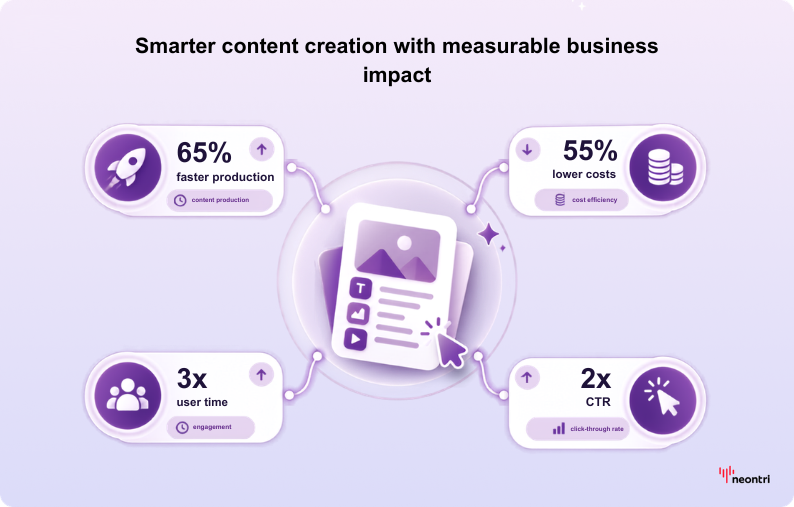
The approach has already yielded results: content production has accelerated by up to 65% and costs have dropped by 55%. Engagement metrics have also improved, with some assets tripling user time and doubling click-through rates.
Application #3: AI visuals for scalable content creation
L’Oréal Groupe is integrating generative AI into its marketing workflows through its internal GenAI platform, CREAITECH. Powered by Google’s Imagen 3 and Veo 2 models, the platform accelerates video editing, packaging design, and visual testing.
By using generative AI, teams can transform simple prompts into high-quality visuals without traditional studio shoots. This approach has reduced concept development time from weeks to days, lowered production costs, and accelerated market testing.
Final thoughts
As organizations accelerate generative AI adoption and embed it into core business processes, the focus is clearly shifting from experimentation to measurable impact.
However, sustained success depends on more than access to powerful models or tools. Strong governance frameworks, responsible usage policies, and domain-specific customization are essential to scaling generative AI effectively and safely. Organizations that align these foundations with a clear understanding of where AI systems create the greatest value will be best positioned to lead.
Turn these principles into measurable business outcomes with GenAI services tailored to your needs. Contact us to discuss practical, scalable solutions for your organization.
FAQ
What are generative AI applications in business?
Generative AI applications in business use AI models to create content, automate workflows, and enhance decision-making. Examples include generating reports, writing code, summarizing documents, and building dashboards to help teams work faster, reduce costs, and improve productivity across marketing, HR, finance, IT, and more.
What are generative AI applications in customer service?
Generative AI in customer service can help automate responses, draft personalized messages, summarize customer interactions, and support agents with real-time suggestions. Companies like Klarna and Vodafone use GenAI to handle millions of inquiries, reduce resolution times, and improve customer satisfaction through faster, more consistent service.
What are generative AI applications in manufacturing?
Generative AI applications in manufacturing include generating optimized product designs, simulating production scenarios, drafting maintenance procedures, and automating documentation. It can also assist in supply chain modeling, production scheduling, and quality control reporting, reducing time-to-market and improving operational efficiency throughout the production lifecycle.
What are generative AI applications in HR?
Generative AI applications in HR include drafting job descriptions, generating personalized onboarding materials, automating candidate outreach messages, and summarizing resumes. Additionally, it helps with creating employee training content, simulating interview questions, and producing performance review summaries.
What are generative AI applications in accounting?
Generative AI in accounting is used to draft financial reports, automate invoice and expense summaries, generate tax documentation templates, and assist in audit preparation. It can also explain complex financial statements in plain language, simulate budget scenarios, and produce internal compliance reports.
What are generative AI applications in engineering?
Generative AI applications in engineering include generating design alternatives, creating simulation inputs, and proposing improvements to existing systems. In addition, it automates CAD modeling tasks and summarizes sensor or testing data.