Gone are the days of one-size-fits-all recommendations and bland product descriptions. Today’s retail business landscape (encompassing both online retailers and brick-and-mortar stores) is undergoing a revolution fueled by artificial intelligence (AI).
With the global AI in retail market size projected to hit a staggering $45.74 billion by 2032, it’s clear that AI and the retail industry are evolving together.
In this article, you’ll discover how AI is transforming retail through real-world use cases, explore emerging technology trends reshaping the industry, and learn about the practical challenges retailers face when implementing AI solutions.
Key takeaways:
- AI adoption is accelerating rapidly: Around 90% of retailers now use AI in at least one business area, with investments continuing to grow.
- Personalization drives measurable results: AI-powered recommendations, dynamic pricing, and tailored loyalty programs boost conversion rates and customer lifetime value.
- AI improves operational efficiency: From inventory forecasting and warehouse automation to fraud detection and smart shelving, AI reduces costs and streamlines processes.
- Emerging trends expand AI’s impact: Technologies like visual search, voice commerce, multi-agent fulfillment systems, and shelf analytics are reshaping how customers shop and how retailers operate.
- Implementation comes with real challenges: Talent shortages, data quality issues, system integration complexity, and ethical concerns around privacy and bias require careful planning and governance.
The role of AI in retail industry
Artificial intelligence, including GenAI, remains in its early but fast-growing phase in the retail industry. Recent data shows that around 90% of retailers are using AI in at least one business area, and plan to increase their investments this year. This scale of adoption points to a clear choice for retail companies. AI can improve productivity, optimize supply chains, support personalization, and guide customers both online and in-store. These priorities match common GenAI retail use cases such as customer support, product discovery, and operations.
Consumer interest is equally strong. 87% of shoppers who have tried GenAI tools report a positive impact on their shopping experience, 73% are open to AI chatbots for e-commerce to handle customer service, and 60% have used voice assistants to make purchases. Interest and adoption continue to rise. Retailers are using AI for inventory, pricing, fraud detection, and CRM, and are also exploring robotics to reduce shrinkage and multi-agent systems.
AI in the retail industry: Use cases
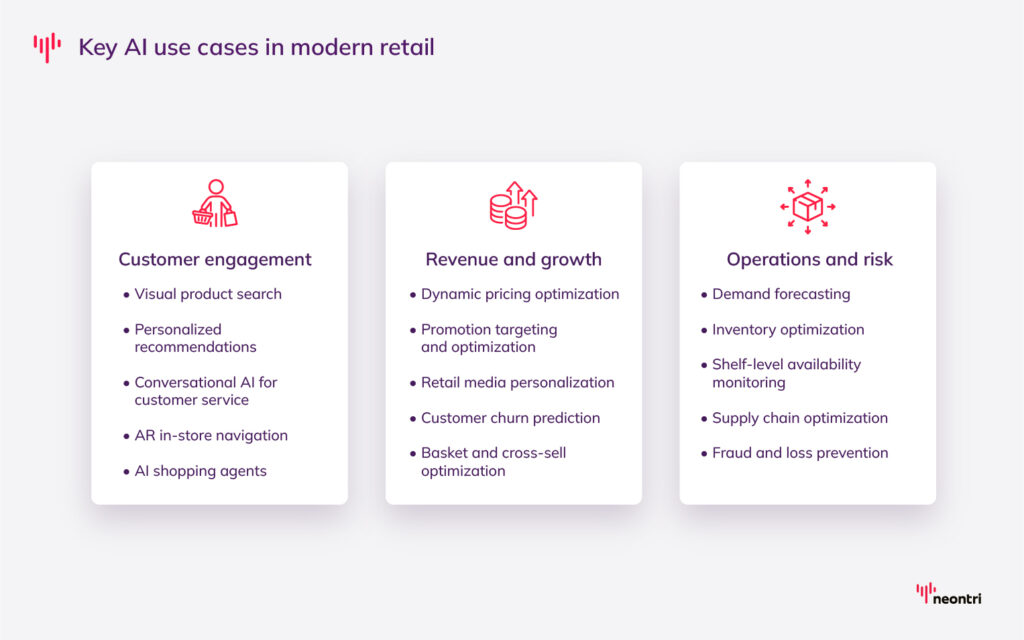
Artificial intelligence brings a wide range of opportunities to the retail industry that extends far beyond improving customer experience and generating content. The technology optimizes retail operations and enables retail stores to maintain a competitive edge. Take a look at some noteworthy AI applications in the retail industry below.
How is AI used to deliver personalized product recommendations in retail?
Artificial intelligence in the retail industry allows retail stores to analyze large amounts of customer data such as:
- Browsing and purchase history
- Items added to a cart
- Demographics
This level of advanced analytics and analysis means that brands can offer product recommendations tailored to customer’s tastes and preferences (e.g. paired with print on demand, sellers can list thousands of product variations without holding inventory and surface the right options based on each shopper’s preferences).
Examples:
- “You may also like” suggestions recommend similar or complementary items based on browsing and buying patterns.
- Personalized search and category ranking reorder results so the most relevant products appear first for each shopper.
- Triggered recommendations show timely suggestions after key actions, such as cart additions, wishlists, or abandoned carts.
AI retail use case: AMAZON (Virtual try-ons)
 Amazon stands as one of the best examples of using GenAI to create personalized recommendations. As an omnichannel retailer, it customizes its homepage for each customer using AI advanced analytics to collect transaction and historical sales data, information on their purchasing behavior, preferences, wishlists, and items in their cart.
By analyzing historical and real-time data, Amazon gains valuable insights into its customers’ preferences. This allows the company to analyze transaction patterns and create highly personalized marketing campaigns that enhance the overall customer experience and satisfaction levels. According to McKinsey, personalized recommendations drive 35% of purchases on Amazon.
How is AI used to power virtual try-ons in retail?
One of the common challenges customers often face when shopping online for clothes and other wearables is ensuring the perfect fit.
With the help of virtual try-ons powered by artificial intelligence and augmented reality (AR) technologies, customers can visualize how clothes, accessories, makeup products, and even furniture items will look or fit them and their spaces. The outcome is the reduced product return rates, increased customer satisfaction and brand loyalty.
AI retail use case: WARBY PARKER

Warby Parker offers a virtual try-on experience for glasses and sunglasses, available both on their website and through the mobile app. Their system combines AI and augmented reality (AR) technologies to analyze customers’ facial features and virtually overlay eyewear frames.
Using the customer’s device camera, the tool creates a 3D map of their face to ensure accurate placement and size comparison. This allows shoppers to try on various styles and colors of frames in real-time, with the system providing instant rendering. As customers tilt, turn, and move their heads, the virtual frames adjust dynamically, mimicking natural movement and light reflection.


Unlock Shop the Look for smarter product discovery
Convert browsing into buying with AI visual search that helps customers find the right products faster and increases sales.

What role does AI play in intelligent product search?
One of the main reasons shoppers leave is that they can’t find the products they are looking for. These abandoned shopping trips add up quickly. In the United States alone, search-related problems are estimated to cost retailers more than $300 billion every year. AI addresses this problem by improving search accuracy, relevance, and personalization.
AI-powered site search understand context and intent, so shoppers use natural keywords and still get precise, relevant results. As the artificial intelligence processes extensive data in retail and learns from each shopper’s behavior and preferences, results become more personalized over time.
Retail AI implementation: ZALANDO

Zalando applies complex AI algorithms to analyze vast amounts of valuable customer data: past purchases, browsing behavior, and saved items. This allows the platform to personalize search results for each customer and display more products that are most likely to interest them based on their unique preferences.
Zalando uses dynamic filters which evolve based on customer behaviors. For example, if a user consistently applies size or color filters, these options may be pre-selected or highlighted in future searches. There’s also a search bar that understands natural language (NL) queries beyond just keywords. Customers can describe desired styles, materials, or even occasions (e.g., “black ankle boots for winter”), and the AI interprets the intent, delivering relevant product suggestions.
How does AI create a better visual shopping experience?
Visual search technology employs image recognition and AI algorithms to enable users to search for products using images instead of text. For those who might not be familiar with specific search terms or type the wrong search terms into the search bar, this makes it easier and faster to find relevant products.
AI retail use case: ASOS

Asos offers a Style Match feature, which employs visual search technology on its app. With Style Match, customers can snap a photo of an item or upload an image from their library to initiate the search process. Ecommerce image optimization plays a key role here by ensuring that both user-submitted and catalog images are properly formatted and tagged. ASOS’ machine learning (ML) and AI algorithms analyze visual information like color and patterns to find a match and provide personalized recommendations to customers.
Hands-free shopping through voice search
AI in the retail industry brings yet another opportunity to retail stores – voice search, often powered by an AI voice agent, which enables consumers to browse products and make purchases without lifting a finger. They can do it by using voice commands via smart speakers like Google Assistant, Apple’s Siri, Amazon’s Alexa, or other voice-activated platforms. Retailers are also developing their own voice-enabled shopping experiences directly integrated with their apps or websites.
AI retail application: WALMART

Walmart has also tapped into the potential of voice commerce, thereby enhancing the shopping journey for its customers. Through Google Assistant or Siri, they can effortlessly add items to their Walmart online shopping carts, create shopping lists, and even initiate the checkout process using voice commands.
What sets Walmart apart is its focus on user convenience. Shoppers can easily access information about their previous purchases and preferences, which enables quick reorders and reduces the need for repetitive tasks. What’s more, Walmart’s voice commerce platform integrates with its brick-and-mortar stores, offering the option of in-store pickup or delivery.
What makes AI descriptions better?
The greater the number of products retail stores have to sell, the longer it might take to write unique descriptions for each one. While not being professional copywriters, the technology might quickly generate unique, compelling, and SEO-optimized product descriptions, capturing details important to customers. When combined with a strong SaaS SEO strategy, these AI-generated descriptions can be further optimized to improve search rankings, drive organic traffic, and enhance overall product visibility online.
AI retail use case: H&M

H&M, a well-known fashion retailer, has implemented an AI software called “Cherry” to create product descriptions for its online store. This system analyzes images of clothing items and uses natural language processing to generate descriptions. These descriptions are then reviewed and edited by human editors. The approach has helped H&M streamline its content creation process and provide consistent and accurate product descriptions for its customers.
Dynamic pricing and targeted promotions
When it comes to retail business, price is a key determinant of purchase decisions, which makes effective pricing decisions essential. Surveys reveal that 90% of shoppers plan to switch brands, look for lower prices, and cut spending when costs are high. More than half are already doing so.
AI pricing engines continuously optimize prices using sales data, algorithms, and feedback loops, enabling effective pricing strategies. As a result, by using AI retailers are able to adjust prices based on their promotional activities, historical trends, product range, etc. Not just by chain, region, or retail physical stores but by the individual.
AI retail use case: AMAZON (Price Optimizer)

Amazon employs a dynamic pricing tool called Amazon Price Optimizer to enhance price optimization by adjusting product prices several times a day. The technology takes into account factors like customer demand, competitor pricing, sales volume, and product availability. By implementing the solution, Amazon remains competitive while maximizing profits. According to reports, this solution has led to a 5% increase in sales and 2% improvement in profits for Amazon.
Personalized customer experience with AI-powered loyalty programs
Consumers crave connections with brands, and 80% of them are more likely to stick with a retail store that offers a loyalty program. Thus, offering rewards tailored to their individual needs builds trust, strengthens relationships and brand loyalty. And those retailers who deliver tailored loyalty programs that win their clients’ hearts (and wallets).
This approach translates to higher sales, increased customer satisfaction and retention, repeated purchases, and higher lifetime value. Imagine a world where a favorite store remembers their customers about their preferences, suggests items they love, and rewards them for loyalty.
AI in retail business and STARBUCKS

Starbucks can be a good example of how a customer loyalty program makes a tremendous difference for the business. The brand uses artificial intelligence to study customers’ historical purchases, individual preferences, and even the time of day they visit the place. The technology helps the Starbucks Rewards program offer personalized rewards like discounts on favorite drinks or exclusive deals.
This personal touch makes customers more loyal and encourages them to spend and visit more often. It turns out that Starbucks rewarded members are five times more likely to visit a Starbucks every day. As for the company, the loyalty program brought a 15% year-on-year increase in active membership in the US in 2023, reaching nearly 31 million active members. These loyalty members, on the other hand, account for 41% of Starbucks’ sales in the USA.


Real success. Real stories.
Explore how we did it
Streamlined customer service with AI chatbots
AI chatbots and virtual assistants are changing the way customer service works in retail. By using chatbots, retail stores can react to messages quickly, improving customer engagement and satisfaction. They also capture real-time customer feedback, which helps retailers refine their offerings and better meet shopper needs.
Retail AI implementation: EBAY

One excellent example of chatbots in online shopping is eBay ShopBot. This virtual assistant quickly responds to shoppers’ questions, provides instant replies. No more tedious scrolling through eBay or ticking boxes; ShopBot offers friendly conversations and direct links to products customers are interested in.
How does AI improve security and fraud detection?
As customers shift from physical stores to online purchasing, fraudulent activities in transactions, orders, and deliveries are on the rise.
To tackle this issue, retailers are applying AI solutions for fraud detection and prevention. Brands process data to detect suspicious transactions and amoralities’ by spotting suspicious behaviors and inconsistencies.
AI retail use case: PAYPAL

PayPal relies on an AI-powered system called Deep Learning Fraud Detection to identify and prevent fraud in financial transactions. The solution studies user behavior, transaction patterns, and other parameters related to identification and credit card information, including address verification.
It also examines patterns to spot individuals with multiple accounts or those trying to exploit proxy servers for purchases. Through machine learning (ML), the solution continuously adapts and improves its fraud detection capabilities. PayPal reports that this solution has helped them reduce losses from fraud by 25%.
How does AI support inventory management and forecasting?
Keeping the right balance of stock to meet customer demand, both in-store and online, is crucial.
By analyzing customer purchase history and past sales data, preferences, and market trends, AI helps retailers in smart decision making, improving operational efficiency and lowering costs. Retailers scaling these AI capabilities rely on cloud-based inventory platforms to process massive datasets across locations without infrastructure bottlenecks.
In addition, tools and solutions like cameras, digital sensors or smart shelves enable real-time monitoring of inventory levels. This optimizes supply chain management, helps retailers avoid the dreaded “Out of Stock” status, and improves operational efficiency.
AI and robotics in retail warehouse automation
Smart technologies like AI-driven systems and automated machines are reshaping warehouse operations in retail. Robots can pick, pack, and move products quickly, while AI systems coordinate their tasks to make the whole process run smoothly.
These solutions can also predict when items need restocking, plan the best storage layouts, and adjust tasks on the go. As a result, retailers can respond quickly to changes in demand and make sure orders are delivered on time and in good condition.
AI for retail stores: LOWE’S

Lowe’s, the American home improvement retailer, leverages AI in retail stores to revolutionize inventory management and enhance the shopping experience. The brand uses small cameras strategically positioned on shelves in key areas of the store, like the light bulb section.
This smart shelves solution keeps an eye on stock levels in real-time. When a gap on the shelf is detected, it sends a quick alert to the store’s devices, ensuring that staff know when to restock at the right time. By using AI in this way, Lowes ensures that customers always find what they need and makes shopping more efficient and enjoyable.
Artificial intelligence in retail for lead generation
Artificial intelligence helps retailers attract and engage high-potential customers by analyzing online behavior and preferences. The technology identifies visitors who are likely to become clients, so retailers can tailor their outreach and marketing efforts effectively.
AI retail use case: Sephora
Sephora uses AI to analyze customer browsing patterns and preferences on its website and app. Through personalized suggestions and interactive quizzes, Sephora’s AI-driven lead generation tools encourage potential customers to engage, helping the brand gather valuable leads for future marketing and sales efforts.
Every great solution starts with a simple message
Make that step
AI retail technology trends
Retailers are adopting several AI trends to strengthen product discovery, operations, and customer experience:
| AI retail trend | Benefit |
|---|---|
| Generative AI product recommendations | Personalizes suggestions using context and behavior. Case studies often report 10–25% gains in conversion or engagement, depending on data quality and rollout scope. |
| Shelf analytics with computer vision | Detects out-of-stock items and shelf issues faster. Retail pilots often show 20–40% quicker identification, with fewer manual checks. |
| Predictive customer churn prevention | Identifies early churn signals and supports targeted retention actions. Programs commonly report single- to low double-digit churn reduction over time. |
| AI-driven visual search | Matches products from image-based queries, which can speed up discovery in visual categories. |
| Voice commerce optimization | Enables hands-free shopping and repeat orders through voice-enabled assistants. |
| Multi-agent systems for fulfillment | Coordinates picking, packing, and routing tasks to streamline fulfillment. |
| Real-time dynamic assortment | Adjusts product selection based on demand, availability, and store context. |
| AI-powered in-store navigation | Guides shoppers with personalized in-store directions and routes. |
AI in retail companies: Challenges
AI can create real value in retail, but companies that adopt it often face practical obstacles that can slow delivery or reduce impact. Common challenges include:
- Lack of AI skills: Demand for AI talent is high, and some retailers struggle to hire or retain the right experts.
- Poor quality or insufficient data: For systems to work efficiently, accessible and high-quality data is needed. Otherwise, the business insights might be flawed and incomplete.
- Integration with existing systems: Connecting AI tools to legacy platforms, POS systems, ERPs, and e-commerce stacks can be complex and time-consuming.
- Operational readiness: AI changes workflows across teams. Without clear ownership, training, and process updates, adoption can stall after the pilot stage.
Ethical considerations and future risks
Beyond delivery and integration, AI introduces governance questions that affect compliance, fairness, and customer trust.
- Privacy concerns: Retail AI systems rely on collecting and linking large amounts of customer and behavioral data, which can lead to over-collection, unclear consent, or unwanted tracking.
- Data security exposure: Storing and processing more customer data increases the potential impact of breaches, leaks, or misuse by third parties.
- Bias and unfair outcomes: If training data or decision rules are skewed, AI can disadvantage certain customer groups or regions, and it can also affect hiring, credit-style decisions, pricing, or fraud flags in unintended ways.
- Limited transparency: AI-driven decisions can be hard to explain, which can reduce trust and make it difficult to justify actions such as rejected returns, flagged transactions, or customer service decisions.
- Pricing and competition concerns: Dynamic pricing and automated promotions can raise fairness questions and may attract regulatory scrutiny if they result in discriminatory or misleading outcomes.
- Over-reliance on automation: Heavy automation in customer service, fraud, or inventory decisions can reduce human oversight and make errors harder to catch, especially during unusual demand spikes or disruptions.
- Manipulative targeting: Personalization and ad targeting can cross the line into pressure tactics, nudging impulse purchases or prioritizing margin over relevance.
Partner with Neontri to support an AI-driven retail strategy
At Neontri, we turn innovative ideas into digital products built for real business impact. Our experts combine AI engineering and delivery experience to take initiatives from concept to production, with a strong focus on data readiness and system integration.
Neontri also assisted a global sporting goods market leader with an omnichannel payment solution that integrated seamlessly with the Polish mobile payment service BLIK and has processed thousands of orders across retail locations.
If you are looking for a trusted partner to help raise customer experience and support growth, reach out and let’s talk.
FAQ
What are the trends of artificial intelligence in the retail industry?
Current trends include the rise of generative AI for content creation and marketing automation, greater use of real-time data to personalize customer service, and advanced predictive analytics for demand forecasting. Retailers are also investing in AI-powered visual recognition tools to improve product search, and using this technology to streamline supply chains with faster, more accurate decision-making. As AI matures, its role in dynamic pricing, customer behavior prediction, and immersive shopping (like AR/VR) is expected to grow.
What are the benefits of AI in the retail industry?
It can improve customer satisfaction by delivering more personalized recommendations and more consistent service. It also supports better stock management and supply chain optimization, which can increase sales and reduce waste. In addition, automation can lower operating costs by handling routine tasks and reducing errors. With AI and predictive analytics, retailers can gain deeper customer insights and make better, faster decisions.
Is AI safe for retail businesses?
Yes, artificial intelligence can be safe for retail businesses when it is used responsibly and with the right controls in place, especially around data privacy, security, and bias. In the EU, this becomes even more important because the EU AI Act starts applying in a broader, enforceable way from 2 August 2026, which means many AI systems will need documented governance and compliance steps depending on their risk category.
Who are the major players in AI retail technology?
Leading vendors in retail AI include companies like: a) Amazon which uses artificial intelligence for inventory management and personalized recommendations; b) Google that offers AI-driven analytics; c) IBM, known for its AI solutions like Watson for retail insights. Other significant contributors are: a) Microsoft with its cloud services and analytics tools; b) Salesforce, providing AI-enhanced customer relationship management.
How can AI help reduce product loss in retail stores?
Artificial intelligence can instantly identify suspicious activities or possible theft in brick-and-mortar stores by analyzing sensor and video data in real time. The technology also makes it easier to optimize inventory by predicting future customer demand or informing staff about out of stock items.
How AI improves retail supply chain efficiency?
By predicting demand more accurately, AI helps retailers run more efficient supply chains, keeping inventory levels in check, and improving logistics and order fulfillment. With real-time insights, retail businesses can react quickly to changes, reduce stockouts, and deliver orders on time. AI automation also makes supplier management and route planning faster and more cost-effective. The result is less waste, more agility, and happier customers.