Understanding and meeting customer demand can make or break a business. A strong forecasting strategy, especially one that uses AI, gives companies a clear advantage. That’s why AI demand forecasting is becoming critical in today’s dynamic and unpredictable business environment, where traditional planning methods often fall short.
Overstocking, stockouts, supplier delays, rising logistics costs, and disconnected data—these are just a few issues companies face these days. They don’t just impact margins; they affect customer satisfaction and long-term resilience.
AI-powered demand forecasting helps overcome these challenges, replacing time-consuming manual work with faster, more accurate predictions. According to McKinsey, organizations using this approach see 30–50% fewer errors, up to 15% better inventory management, and a 20–30% boost in accuracy.
In this article, we’ll look at how AI is reshaping the way companies manage supply and demand, focusing on key benefits, real-world examples, practical steps for implementation, and solutions to common roadblocks, drawn from Neontri’s experience supporting businesses in building smarter, more flexible supply chains.
Key takeaways:
- AI-powered demand forecasting uses machine learning to process historical and real-time data, making predictions faster and more precise than traditional and manual methods.
- From retail and fashion to manufacturing and logistics, AI helps reduce errors, lower costs, and improve product availability and customer experience.
- Companies implementing AI in demand forecasting should follow a few key steps: start small, unify data, choose the right model, and scale gradually for lasting results.
- Poor data quality, integration issues or cost concerns might be a challenge, but with the strategic business planning and support, they can all be addressed effectively.
The definition of AI demand forecasting
AI demand forecasting uses machine learning to better determine and predict future demand for products or services, streamline supply chain management, and adjust production to match market needs. For this, it processes large volumes of structured and unstructured data, such as:
- Historical sales data
- Real-time market trends
- External variables like weather, social media sentiment or economic indicators
As AI models learn and improve over time, their predictions become more accurate and adaptable, even when market conditions change. Gartner reveals that 45% of companies have already implemented machine learning into their forecasting processes, with this number only expected to grow.
AI-driven forecasting marks a major shift from reactive to predictive supply chain planning. Unlike traditional methods that rely mainly on past sales and simple statistical models, AI leverages multiple machine learning techniques to deliver greater accuracy and responsiveness.
Core technologies include:
- Neural networks (LSTM/GRU): Ideal for analyzing time-series data, capturing complex demand patterns across different time horizons.
- Ensemble methods: Combine models like Random Forest, Gradient Boosting, and Prophet to improve forecast accuracy and reduce overfitting.
- Transformer models: Detect subtle relationships between seemingly unrelated factors, such as weather or online sentiment, to refine predictions.
- Reinforcement learning: Continuously fine-tunes model performance by learning from previous forecasting results.
How does AI for demand forecasting work?
Incorporating artificial intelligence into demand forecasting modernizes traditional methods by using advanced models, including large language models (LLMs), to work with vast amounts of information. This improves data analysis, uncovers deeper insights, and leads to more responsive forecasts. If you’re ready to bring this level of intelligence to your forecasting, explore our custom Gen-AI solutions.
Here’s how the whole process looks like:

Traditional vs AI-driven demand forecasting
As technology has advanced, prediction techniques have come a long way. Let’s take a closer look at the key differences between traditional forecasting methods and AI-powered approaches:
| Aspect | Traditional forecasting | AI-driven forecasting |
| Data sources | Heavily relies on historical sales data | Combines past, real-time, and external sources, such as customer sentiment, competitor pricing or weather data |
| Accuracy | Moderate, less responsive to changing trends or economic shifts; depends on manual updates | High accuracy with continuous learning; adapts automatically using diverse data sources |
| Flexibility and scalability | Rigid and slow to respond; scaling requires hands-on effort and is prone to errors | Highly flexible and scalable; handles vast datasets in seconds for instant insights; ideal for businesses with diverse product lines or markets |
| Speed | Slow and time-consuming; may take days or weeks to produce forecasts | Fast and efficient; processes data and delivers predictions in real time for quicker decisions |
| Cost efficiency | May seem cost-effective upfront, but slow processes and mistakes might make it more expensive over time | Might need higher initial investment, but lowers ongoing costs by reducing errors and limiting manual effort |
| Usability and learning curve | Requires statistical expertise; onboarding is slow and data interpretation can be difficult | User-friendly, intuitive dashboards with visual insights; easier to adopt and use with minimal technical skills |
While traditional forecasting has been a reliable tool in the past, now it struggles to cope with fast-moving, complex data environments. AI offers a smarter alternative. With machine learning, it delivers accurate, real-time forecasts with minimal human expertise and intervention. This is why machine learning for production optimization is also critical for streamlining manufacturing processes and accelerating operational efficiency.
Its flexibility and speed make it the demand planning of the future.
Benefits of AI demand forecasting
Businesses that implement AI for forecasting and planning can see numerous advantages, including:
- Up to 50% better accuracy: Thanks to AI algorithms that analyze large amounts of historical and actual time data, understand market trends, and adjust predictions based on current conditions, companies are able to predict future demand with higher precision than traditional methods. This reduces the risk of running out of products or overordering, helping keep stock levels balanced.
- Improved decision-making: Demand planning with AI gives organizations valuable insights into consumer preferences, markets, and competitors. So, they can make faster, more informed decisions and respond quickly to changes, staying one step ahead of the competition.
- Enhanced customer experience: Artificial intelligence paves the way for highly accurate demand predictions that ensure the right products are available when customers actually need them. This lowers the chance of losing sales and not being able to adapt to changing consumer and market demands. In fact, AI-driven forecasting can cut the number of unavailable products by up to 65%, making customers more satisfied, engaged, and loyal.
- Up to 20% lower operational costs: Overstocking costs businesses around $1.1 trillion each year. AI-powered demand planning reduces errors, helping companies avoid the costs of excess inventory, stockouts, and urgent shipments. It also streamlines supply chain operations and improves resource allocation, all contributing to significant cost savings.
- Faster response to disruptions: AI models learn as new data comes in, helping companies quickly adjust forecasts to market shifts, supply chain disruptions, and customer behavior changes. As a result, organizations can stay on track, even when things don’t go as planned.
These benefits apply across most businesses; however, the impact of AI demand forecasting can look different depending on the industry. Let’s take a closer look at how it works in specific sectors.
| Industry | Benefits of AI demand forecasting |
| Retail and e-commerce | Enables accurate sales forecasts and dynamic inventory restocking, helping retailers avoid stockouts and overstocking. Supports better promotion planning and pricing strategies, which leads to improved profitability and customer experience. |
| Fashion | Helps brands stay ahead of trends, manage product lifecycles, and reduce markdowns by aligning stock with real-time demand. |
| Manufacturing | Improves production planning, reduces waste, and enhances coordination across operations. Manufacturers using AI forecasting report 15% lower logistics costs, 35% less inventory, and a 65% boost in service levels. |
| Financial services | Supports demand modeling for products and services, improves liquidity planning, and enhances fraud detection and credit risk analysis. |
| Automotive | Forecasts vehicle sales, spare parts inventory, aftermarket services, and supply chain needs. Over 40% of auto executives are investing up to €5 million in generative AI solutions, with 10% spending over €20 million to boost forecasting and resilience. |
| Food and beverages | Predicts demand for perishables, helping reduce spoilage and avoid shortages. Ensures fresher products and smarter inventory levels. |
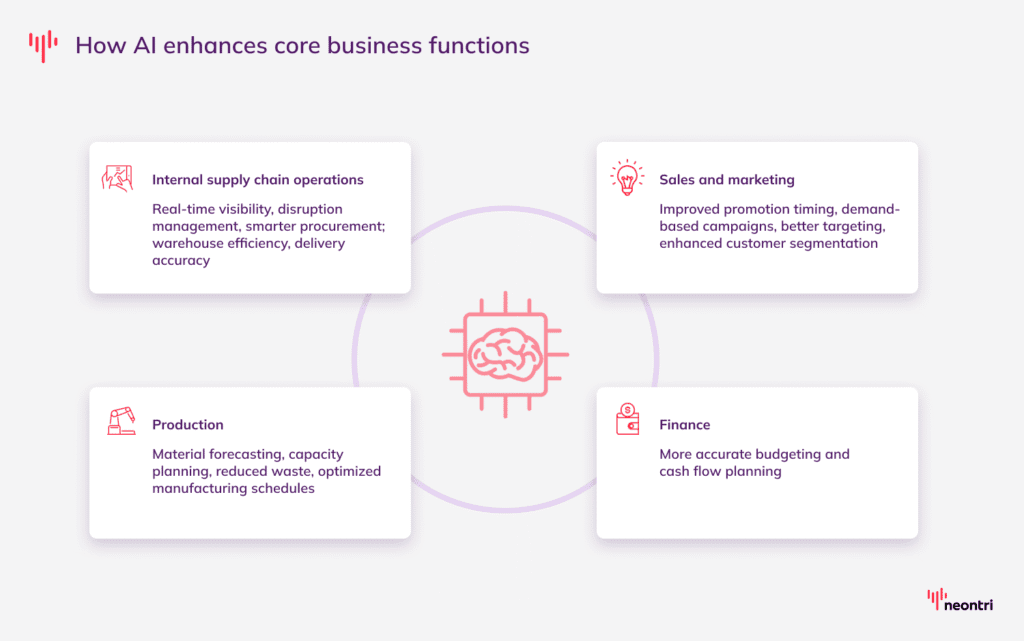
How does artificial intelligence enhance core business functions?
Companies using AI for demand forecasting
AI-powered forecasting is no longer limited to tech giants. Leading companies across industries are using it to improve planning, reduce waste, and respond faster to rapid market changes. Here’s how some of them are putting AI to work:

Walmart
Walmart uses AI to manage inventory more efficiently, especially during peak seasons. Its Centralized Forecasting Service and a tool called Eden play an important role in predicting produce freshness, reducing waste, and keeping shelves stocked both in-store and online.
Eden analyzes over 1.6 billion data points daily and has helped Walmart cut $86 million in food waste in just one year. It also improved forecasting accuracy by 20%, leading to smarter inventory decisions and better product availability.

Zara
Zara is a standout example of how AI in fashion retail drives smarter decisions and empowers the company to stay competitive. By analyzing real-time sales data, social media trends, and consumer buying patterns, the brand can forecast demand and adjust inventory quickly.
This allows Zara to respond to shifting trends without delay. As a result, 85% of its inventory sells at full price—far above the industry average and a key driver of its profitability.

Amazon
With millions of products to manage, Amazon integrates AI into its inventory planning to anticipate demand and ensure availability. Its machine learning models look at data from over 400 million items, helping cut excess stock by 15–20%. This has made deliveries faster, even same-day in many cases, and improved customer satisfaction.

Siemens
In the manufacturing space, Siemens uses AI to anticipate equipment failures before they happen. With its predictive analytics tools, it can reduce unplanned downtime, improve production planning, and keep operations running smoothly. By preventing disruptions, Siemens can deliver more consistent performance and reduce costly delays in its plants.

Mastercard
Mastercard leverages AI to spot changes in consumer spending habits. These insights help businesses adjust their financial strategies and stay ahead of shifting market conditions. Research shows that this approach can cut financial risk by up to 25%, giving companies more confidence in their decisions and a better chance at long-term growth.

Starbucks
Starbucks relies on an AI platform called Deep Brew to tailor the customer experience. It analyzes factors like purchase history, location, time of day, and weather to predict demand and suggest personalized offers.
This system considers more than 400 store-level inputs and has increased customer engagement by 15%, improved product recommendation accuracy by 50%, and delivered a 30% boost in ROI.

UPS
UPS applies AI in its ORION system (On-Road Integrated Optimization and Navigation) to forecast demand and optimize delivery routes. ORION processes data from over 250 million address points daily. The results? 100 million fewer miles driven annually and estimated yearly savings of $300–$400 million in fuel and labor costs, proving the value of smart forecasting at scale.
What are some popular next-day AI tools used in various industries?
Most companies don’t use standalone “next-day” products. Short-term forecasting is usually delivered through broader planning setups that combine data pipelines, forecasting models, and daily decision workflows. Popular examples include:
- Amazon Forecast helps retail and e-commerce teams generate short-term demand projections to support inventory and replenishment planning.
- Google Cloud forecasting capabilities enable near-term sales and stock predictions, particularly for organizations already working within Google’s analytics ecosystem.
- SAP Integrated Business Planning (IBP) supports manufacturers and supply chain teams by translating updated demand signals into production and replenishment adjustments.
- Azure Machine Learning allows logistics and distribution teams to build custom forecasting models that feed staffing, routing, and capacity planning.
- DataRobot simplifies model training and monitoring, making it easier to keep forecasts aligned with changing demand patterns.
- SAS forecasting tools provide large enterprises with scalable forecasting capabilities that integrate with existing planning and analytics processes.
In practice, the best fit depends on how quickly demand changes, how many products and locations are involved, and how tightly forecasts need to connect to daily planning.
How to implement AI for demand forecasting
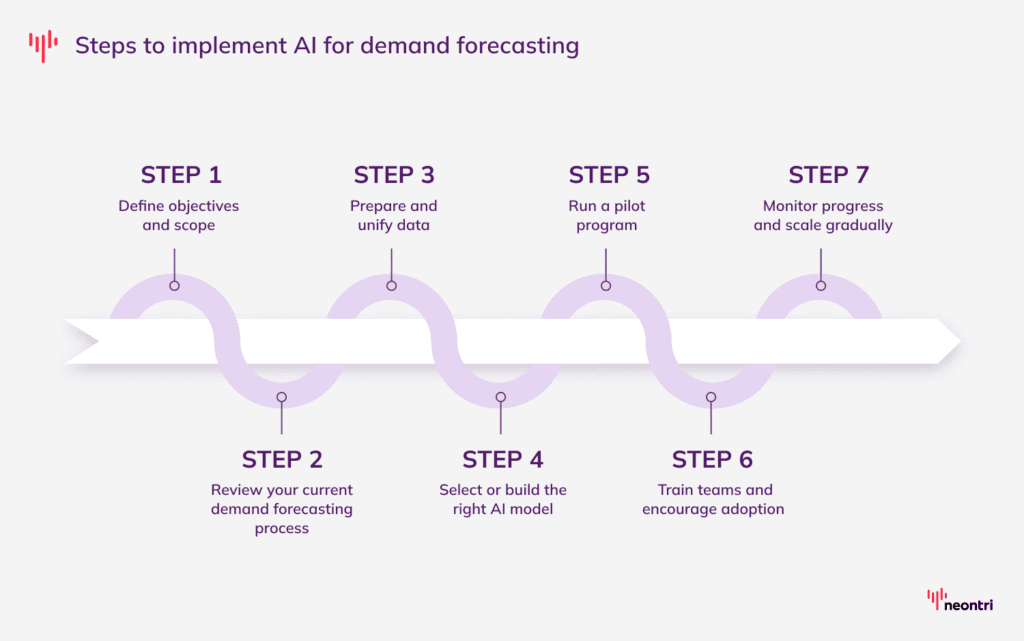
AI-powered forecasting might deliver impressive results, but getting there takes the right approach. The key is to start small, build on what’s already in place, and focus on the areas that bring the most value. Here are a few practical steps to help you get started and scale effectively over time.
Step #1: Define objectives and scope
Before implementing AI in demand planning, clarify what your business wants to achieve—whether the aim is to improve inventory control, streamline production, or support financial planning. Setting priorities like reducing stockouts, avoiding overstock, or forecasting product sales more precisely will help shape the right AI strategy.
Step #2: Review your current demand forecasting process
Evaluate the existing planning processes. Look at what tools and methods are in place, how accurate the results are, and how decisions are made. Also, check whether the data is complete, consistent, and accessible enough to support AI forecasting.
Step #3: Prepare and unify data
Identify all data sources: ERP, CRM, POS, and external feeds like weather, economic indicators, or even customer sentiment. Clean, standardize, and integrate this data into a single, accessible platform to provide a reliable foundation for AI models.
Step #4: Select or build the right AI model
Choose an AI model that fits your specific industry and operational needs. These models use different methods, like machine learning techniques such as regression, neural networks, and combined approaches. Each method has its strengths and helps identify complex patterns in data. Off-the-shelf solutions may work for some, but more complex environments may benefit from custom-built models that reflect how the business works and what makes it different.
Step #5: Run a pilot program
Rather than launching company-wide from day one, test the AI solution on a limited set of products, regions, or business units. This allows you to measure accuracy, gather insights, and make improvements before scaling up.
Step #6: Train teams and encourage adoption
Equip staff with the knowledge and tools to work with AI forecasts. Provide intuitive dashboards and offer training to build trust and confidence. Encourage collaboration between departments to streamline planning based on insights.
Step #7: Monitor progress and scale gradually
Once the pilot delivers good results, expand step by step across more areas of the business. Keep tracking performance, gather feedback from teams, and make regular adjustments to improve accuracy and efficiency over time.
How to use AI for demand forecasting for new products
When forecasting purchasing needs for new products, historical data may not be available. Yet, AI can still help. By using transfer learning, companies can apply insights from similar past product launches. Artificial intelligence models also tap into external data like market trends, competitor activity, and social media signals to estimate demand more accurately, even before a product hits the market.
Challenges and how to overcome them
As with any transformation, implementing AI technologies for demand forecasting comes with some challenges. However, each obstacle has a practical solution that allows businesses to make smarter, more scalable decisions and move forward with confidence.
#1: Poor data quality
To perform well, AI needs reliable, consistent data. In some companies, however, it might be incomplete, outdated or spread across different systems. All this can lower forecast accuracy and lead to wrong decisions.
Solution: The first step is to build a strong data foundation. Clean all the information, identify and address any biases, and organize it in a consistent way. Well-prepared data is essential for generating accurate and reliable forecasts.
#2: Potentially high implementation costs
Launching an AI solution can come with a big price tag. Between the tools, infrastructure, and skilled experts needed, the upfront investment can feel out of reach, especially for smaller businesses.
Solution: Start small. Run a pilot project in one part of the business to show it works. Cloud-based tools can also lower costs and make scaling easier down the road.
#3: Privacy and compliance risks
Using AI to forecast demand means working with sensitive information, like customer data or market behavior. That brings up questions around data privacy and security, and makes staying compliant with laws like GDPR and CCPA a must.
Solution: Make data protection part of your process. Be transparent about how AI models work, follow strict compliance rules, and run regular audits to stay aligned with ethical standards.
#4: Integration with legacy systems
Some companies still rely on older systems that weren’t built with AI in mind. Trying to connect new tools to outdated platforms can be tricky, time-consuming, and costly.
Solution: Focus on high-impact areas first and use APIs or middleware to connect systems without rebuilding everything from scratch. A phased rollout reduces disruption and helps teams adjust as you go.
#5: Model interpretability and trust
If teams don’t understand how an AI model makes its predictions, they’re less likely to trust it, or use it. This can stall adoption, even if the model is technically sound.
Solution: Use explainable AI techniques and clear dashboards that show how forecasts are generated. When users see what data is driving the output, it’s easier to build confidence and make informed decisions.
#6: Limited skilled resources
Sometimes, businesses don’t have enough specialists including data scientists, with the skills needed to develop, manage, or fully understand AI systems.
Solution: To avoid missed opportunities, invest in training programs to upskill teams. If hiring is challenging, consider working with external partners or AI strategy consultants who guide the setup and transfer knowledge.
Neontri: Your trusted expertise in AI-powered forecasting
With over a decade of experience in custom software development and digital transformation, Neontri guides businesses in incorporating AI into their forecasting and planning processes. We’ve supported clients across sectors like banking, fintech, and retail, helping them modernize legacy systems, streamline operations, and increase forecasting accuracy.
Our approach is always tailored. Whether it’s integrating data, developing the right AI models, or ensuring smooth implementation and long-term optimization, our team is with you from start to finish. If you’re looking to future-proof your supply chain with smarter forecasting, let’s talk.
Final thoughts
In a world shaped by global uncertainties and shifting market dynamics, relying on old forecasting methods just isn’t enough. AI-powered forecasting allows businesses to keep up with emerging trends, respond faster to changes, and meet demand more accurately—without guesswork. For companies looking to stay competitive and resilient, AI offers a clear path forward.
FAQ
How is generative AI used in demand forecasting?
GenAI helps improve forecasting by analyzing vast amounts of data and simulating different demand scenarios. It can generate insights, test “what-if” models, and support faster, more informed decision-making.
How can an enterprise use AI for demand forecasting?
Large organizations can use AI to process large volumes of data from sales, market trends, and external sources. It plays a key role in generating more accurate demand forecasting, optimizing inventory, and reacting faster to demand shifts.
How does AI improve demand forecasting in retail?
Artificial intelligence helps retailers predict what customers will buy and when. It analyzes real-time sales, demand trends, and external factors to reduce stockouts, avoid overstocking, and improve pricing and promotions.
What industries benefit the most from AI-driven demand forecasting?
Usually, sectors with complex supply chains or fast-changing customer behavior benefit most. For example, retail, manufacturing, automotive, logistics, and consumer goods.
Who offers the best AI-driven demand forecasting?
Unfortunately, there’s no one-size-fits-all answer as the best solution depends on your industry, data maturity, and specific needs. Companies like Neontri specialize in tailored AI forecasting tools that align with business goals.
What role does machine learning play in AI-based demand forecasting?
Machine learning is the engine behind AI forecasting. It identifies patterns in historical and present data, then updates predictions as new information comes in, making forecasts more accurate over time.