“We experienced a six-month deployment delay and a 40% budget overrun when our primary infrastructure provider couldn’t scale to meet our expansion needs.”
This kind of setback isn’t unusual. As digital demands grow, many companies turn to external IT vendors for solutions and expertise that in-house teams can’t fully provide.
In fact, 65% of organizations now work with three or more third-party providers to meet their IT needs, and allocate 35% of their IT budgets to them. That’s why effective IT vendor management has become a critical business priority.
However, cooperating with suppliers isn’t always straightforward. Challenges like choosing the right application development partners, overseeing multiple vendors, handling complex contracts, and ensuring compliance and security can lead to vendor lock-in, delays, higher costs, and slow digital transformation. When managed well, these partnerships improve performance, reduce risk, and keep organizations agile as needs evolve.
In this article, we’ll cover the core principles of managing IT providers, share best practices, and offer practical guidance drawn from Neontri’s hands-on expertise.
Key takeaways:
- IT vendor management involves choosing the right IT partners, overseeing their work, and making sure it contributes to business goals.
- Successful vendor management relies on a few core elements, such as careful provider selection, clear contracts, service performance tracking, third party vendor risk management, and strong relationships.
- Following proven best practices makes a difference. With a clear strategy, from onboarding to exit planning, organizations can avoid common pitfalls and build relations that support long-term goals.
What is IT vendor management?
Vendor management in IT is the process of selecting, managing, and coordinating relationships with third-party companies that provide various IT products and services. These might include:
- Software providers
- Cloud service platforms
- Hardware suppliers
- IT support services
The goal is not just to hire the right providers, but to make sure their services support an organization’s needs, deliver value, meet compliance requirements, and avoid unnecessary vendor risks. When done well, vendor management helps businesses get the most out of their IT partnerships and avoid costly problems.
Key aspects of IT vendor management
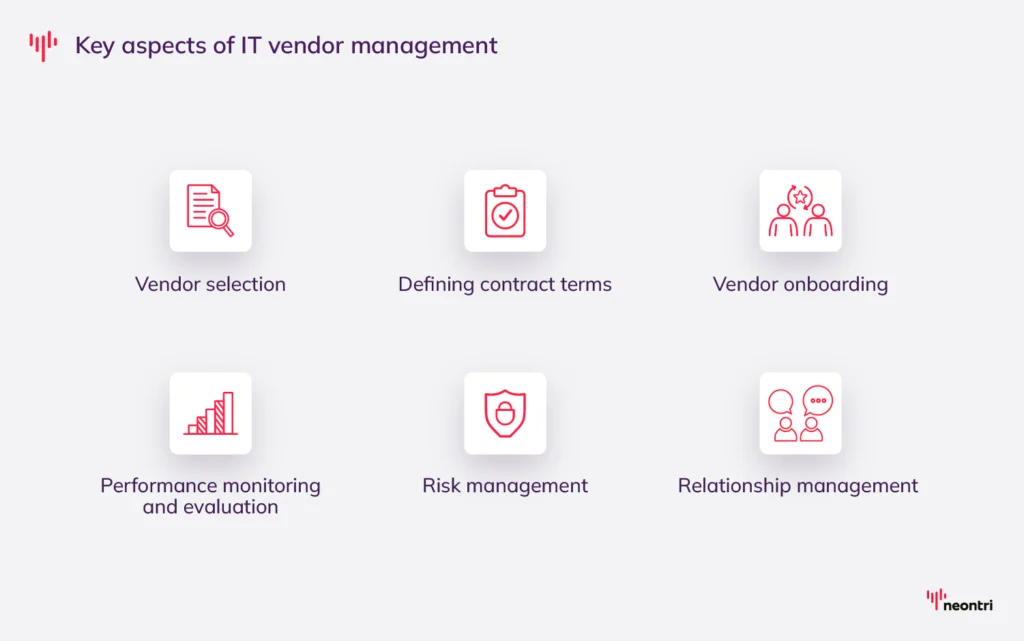
To successfully manage IT vendors, companies need to rely on a set of core practices that form the foundation of an effective strategy:
- Vendor selection: Choosing the right supplier starts with a clear understanding of business needs and technical requirements. Cost, quality, and security are important but so is cultural fit and the partner’s ability to scale. A thorough process prevents mismatches that can cause delays or extra costs down the line. That’s why businesses should invest time in evaluating potential vendors.
- Defining contract terms: Clear terms and conditions are key to setting expectations and avoiding misunderstandings. Pricing, service standards, deadlines, and compliance requirements should all be outlined in agreements. This will protect both parties and offer a framework for resolving problems when they emerge.
- Vendor onboarding: A smooth onboarding process establishes the groundwork for the rest of the relationship. New suppliers need the right tools, documentation, and contacts to start delivering value quickly. The more organized the onboarding is, the faster they can be productive.
- Performance monitoring and evaluation: Ongoing performance reviews are critical to quality and accountability. Companies should track vendors against key metrics such as uptime, response time or project milestones. Regular feedback makes it easier to ensure alignment and allows issues to be addressed early. It also opens the door for continuous improvement and stronger collaboration over time.
- Risk management: Every vendor relationship carries some level of risk, whether it’s data security issues, regulatory compliance or financial reliability. By identifying these risks early, during the evaluation and selection phase, businesses can put safeguards in place, including scheduled audits, contingency plans or limiting access to sensitive systems.
- Relationship management: Effective partnerships go beyond contracts and checklists. To build meaningful cooperation, companies need relationships grounded in trust, transparency, and consistent communication. This makes frequent check-ins and open dialogue more productive, helping teams to resolve vendor-related issues quickly and keep projects on track. When external providers are treated like true business partners, they’re more likely to stay engaged and committed to shared goals.
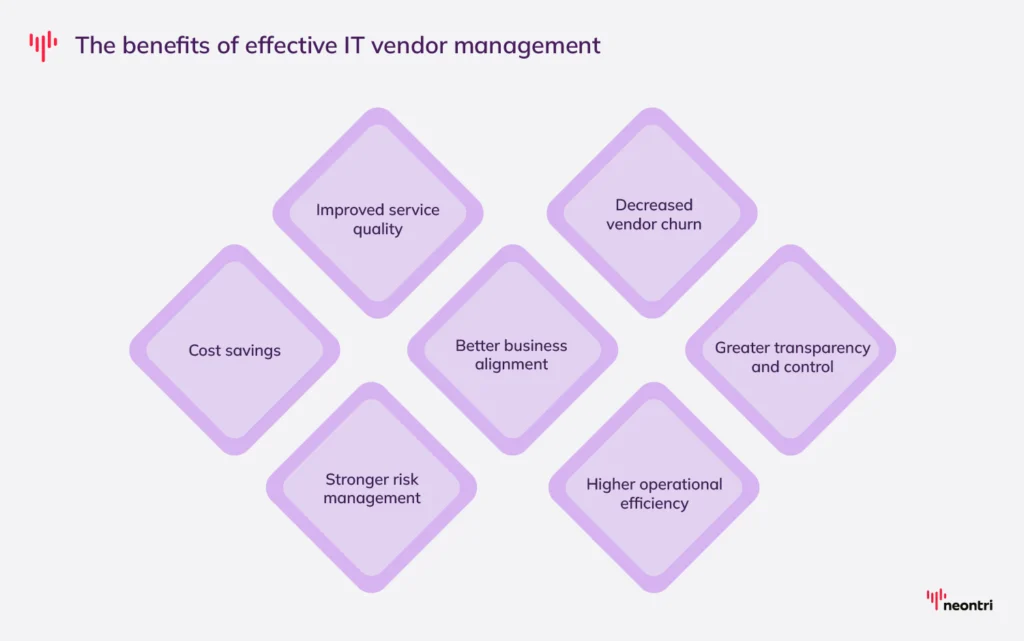
IT vendor management best practices
Managing IT vendors well is key to getting the most value from such partnerships. Here are a few best practices that companies can follow to reduce risks, avoid vendor lock-in, improve performance, and support long-term business objectives.

Strategically select IT vendors that fit business needs
Choosing the right vendor is one of the most important steps in managing IT partnerships. Focus on finding providers that align with your goals, offer industry-related expertise, and meet standards for reliability, compliance, and cost.
| Strategic steps | Tactical steps | |
| Define the scope of work and determine your focus | Align vendor capabilities with both short-term needs and long-term business goals. Consider how the provider fits into the digital roadmap now and in the future. | Create a detailed project specifications document with technical, security, and compliance requirements. This will help ensure vendors clearly understand expectations. |
| Evaluate vendor’s reputation and expertise | Prioritize those with proven industry expertise and innovation potential. | Check for how many years the outsourcing company has been providing its services. Also, read client references, case studies, and third-party reviews. |
| Assess financial stability | Make sure the IT provider can support long-term projects and adjust to growing business needs. | Review client retention rates, financial statements, and credit ratings. |
| Verify compliance | Define the security and legal requirements the vendor needs to meet, based on industry rules and standards. | Check relevant certifications, like ISO or SOC 2, and review how they handle data privacy and security. Make sure vendors follow regulations such as GDPR or CCPA. |
| Do a cost-benefit analysis | Balance vendor costs with expected return and effective risk mitigation. Look beyond the initial price and consider the full value the service brings to the business. | Compare pricing models, hidden fees, and total cost of ownership (TCO). |
| Score and compare vendors | Evaluate partners based on reputation, experience, compliance, and cost. Focus on the option that brings the most benefit and reliability over time. | Create a scoring system with clear criteria and assign values to each. Compare the results to build a shortlist of top candidates for final selection. |
Neontri’s recommendation: To avoid vendor lock-in, prioritize partners who use open standards, support system integration, and offer flexible engagement models. At Neontri, we help businesses build strategies that leave room to adapt and scale—without being tied to a single vendor.
Centralize vendor agreements and documentation
By storing all contracts and supplier’s details in a single, secure platform, such as a vendor management system (VMS) or contract lifecycle management (CLM) tool, organizations can facilitate easy access, compliance tracking, and performance reviews.
| Strategic steps | Tactical steps | |
| Build a single place to manage vendor information | Choose a system that can store all contracts and vendor details. Ideally, the system should also connect with finance and procurement tools to streamline processes. | Create a central VMS or CLM and upload all vendor profiles and important documents. Keep everything organized in one location so teams can find what they need quickly. |
| Make documents consistent and easy to use | Establish clear standards for how documents should be written and stored. Use the same format across all agreements and appoint a team member to manage document updates. | Use templates for common documents like SLAs, NDAs, and MSAs to save time and keep things consistent. Schedule regular reviews to make sure everything is current and accurate. |
| Ensure secure access control | Set rules for who can view or edit vendor files based on their role or department. | Assign user roles in the system and monitor who accesses which files. Set up automatic email reminders for contract renewals, upcoming deadlines, or compliance checks. |
| Backup and disaster recovery | Have a plan in place to protect the supplier’s information in case of a technical issue, system crash, or cyberattack. | Schedule regular backups of vendor data and test the system occasionally to make sure recovery works well. |
Address regional compliance differences
Working with IT vendors across different regions brings regulatory challenges that can’t be ignored. Each area may have its own rules, such as GDPR in the EU, HIPAA in the U.S., or data localization laws in parts of Asia. Failing to meet these requirements can lead to fines, legal trouble, and damage to the company’s reputation.
How to implement:
- Step #1: Identify which regulations apply to each third-party provider based on their operating regions.
- Step #2: Add compliance terms to vendor contracts that match the legal rules in each region.
- Step #3: Use software tools to keep track of whether providers are following the rules.
- Step #4: Set up regular checks to review compliance and catch any issues early.
- Step #5: Train your team on the key legal differences between regions so they know what to look out for.
- Step #6: Assess legal risks during the selection process to avoid surprises later.
Use vendor management automation tools
Automation is changing the way companies deal with external providers. From negotiating to keeping contracts organized, automating vendor management helps with accuracy, cost savings, risk monitoring and compliance. For example, 77% of organizations now use software with vendor management features to streamline risk management.
How to implement:
- Step #1: Use a centralized vendor management system (VMS) or contract lifecycle management (CLM) platform to automate onboarding, contract management, and renewals processes.
- Step #2: Look for platforms with built-in features such as contract tracking, renewal alerts, and performance dashboards.
- Step #3: Pick tools that have risk assessment modules and workflows that align with your procurement processes and business requirements.
Neontri’s recommendation: Make sure that the automation platform integrates with the current IT systems. This will give you a full picture of all the activities and success metrics of each supplier, improving decision-making.
Regularly monitor risk and compliance
Vendor risk doesn’t stop at onboarding. Businesses need ongoing visibility into providers’ financial stability, system security, and regulatory compliance. Continuous monitoring reduces the chance of surprise failures or data breaches. In fact, 61% of companies experienced a third-party data breach or cybersecurity incident in the past year, which highlights how critical ongoing oversight really is.
How to implement:
- Step #1: Use a vendor risk management (VRM) solution to track cybersecurity and financial health over time.
- Step #2: Schedule automated compliance checks and map vendor practices against frameworks like GDPR, HIPAA, or ISO standards.
- Step #3: Set up real-time alerts to flag risk events, such as missed obligations or changes in financial status.
Create a structured vendor performance evaluation framework
Managing third-party vendors without a clear process often leads to inconsistent oversight and slow responses to problems. A structured evaluation framework helps teams stay organized, set clear expectations, and make faster, better decisions. It also ensures suppliers continue to deliver value, meet performance standards, and align with business goals.
How to implement:
- Step #1: Define roles and responsibilities for managing vendor relationships across departments.
- Step #2: Set up a governance committee to review the provider’s performance, update policies, and handle escalations.
- Step #3: Look beyond contractual terms to check on actual day-to-day service delivery.
- Step #4: Establish clear key performance indicators (KPIs) to identify areas where external providers excel or fall short.
Neontri’s recommendation: Make performance evaluations a two-way process. Invite vendors to give feedback on collaboration, too. This builds stronger relationships and resolves issues faster.
Plan and test exit strategies
Oftentimes, companies don’t think about exit strategies until it’s too late. But preparing in advance helps protect business operations in case a vendor relationship ends unexpectedly or underperforms. So, whatever the reason, a solid plan allows organizations to act quickly and limit disruption.
How to implement:
- Step #1: Involve the people in your organization who understand the legal, technical, and operational impact of ending a vendor relationship.
- Step #2: Include clear exit clauses in contracts that define data handover processes, service transitions, and alternative options.
- Step #3: Think through both a slow transition and an emergency exit plan that can be activated fast.
- Step #4: Identify and document trigger events that would require a transition or switch.
- Step #5: Conduct simulated exercises or failovers each year to ensure internal teams are prepared to shift services with minimal disruption.
Neontri’s recommendation: Vendor lock-in is one of the most common risks in long-term partnerships, and companies often realize it when their options are already limited. Building a clear exit strategy early helps avoid this situation. At Neontri, we recommend structuring contracts to allow flexibility and choosing solutions built on open standards, modular architecture, and easy third-party integrations. These steps make it easier to switch providers when needed and ensure your business stays in control, not locked in.
Foster collaborative vendor relationships
Good vendor relationships are built on trust and clear communication. When both sides stay connected and aligned, it’s easier to solve problems, stay on track, and work toward shared goals.
How to implement:
- Step #1: Treat external partners as strategic allies, not just service providers.
- Step #2: Conduct regular joint planning sessions to align on goals, roadmaps, and feedback.
- Step #3: Keep vendor communication open and regular.
- Step #4: Set quarterly business reviews (QBRs) to review performance and improve cooperation.
Neontri: Your partner in smarter IT vendor management

If managing IT providers feels complex, especially in multi-vendor environments, that’s because it often is. Neontri guides companies to simplify vendor coordination and stay in control by providing expert software engineering for banking and fintech, dedicated development teams, custom software development services, and the technical support needed to remain flexible as business needs evolve.
Final thoughts
IT vendor management is a core part of running a successful, resilient business. With the right strategy, companies can mitigate risk, improve collaboration, and ensure their technology partners are delivering real value. Whether you’re working with one provider or many, the goal is the same: to stay in control, move faster, and build partnerships that support long-term growth.
FAQ
What role does communication play in effective IT vendor management?
It’s important for companies and their IT providers to communicate clearly and consistently so that everyone is on the same page about goals, expectations, and deadlines. Regular check-ins also help find problems early and solve them before they escalate. Over time, this builds trust, which leads to better collaboration and results.