In today’s rapidly evolving technological landscape, artificial intelligence has transformed from speculative technology into an essential business tool driving competitive advantage across sectors. This report synthesizes insights from exclusive interviews with six thought leaders from diverse industries around the world who have successfully navigated AI implementation. Their collective experiences reveal that effective AI adoption requires balancing technological capability with strategic business objectives, data quality management, and thoughtful workforce transformation.
Organizations that implement AI through incremental, focused applications while maintaining a long-term strategic vision are best positioned to capture its benefits while avoiding costly missteps. As AI increasingly becomes an ambient technology, the competitive edge will shift from mere adoption to implementation sophistication, with human expertise redirected toward high-value activities that machines cannot easily replicate.
Our distinguished interviewees
This research is based on in-depth interviews with six industry leaders who bring diverse perspectives from their respective fields:

Ronen Chen is the Chief Technology Officer at a leading financial technology firm based in Tel Aviv, Israel. With over 20 years of experience implementing advanced technologies in banking and financial services, he brings critical insights about AI adoption in highly regulated industries where security and compliance concerns influence implementation strategies.

Aurélie Cabezas is the Merchant Solutions Manager at Purse, a payment orchestration platform based in Paris, France. With a background in fintech innovation, she provides perspective on how growing companies can balance immediate AI applications with long-term strategic integration while navigating resource constraints.

Cees Werff is the CEO of a multinational insurance company headquartered in Amsterdam, Netherlands. He has spearheaded successful AI implementation for document processing and claims management, demonstrating how traditional industries can effectively transition to AI-enhanced operations through methodical, incremental approaches.

Maksym Sofer is the VP R&D of a cybersecurity firm specializing in vendor risk assessment based in Singapore. His company has pioneered multi-model AI approaches for information security applications, offering valuable insights about maintaining accuracy and reliability when AI processes sensitive security information.

Orr Fabian is the Chief Technology Officer at Skyline Robotics, with the company’s headquarters and R&D center in Yakum, Israel, and additional offices in New York City. He has successfully implemented AI and machine learning in physical-world applications, specifically for revolutionary window-cleaning robots for skyscrapers, highlighting the unique challenges of combining AI with robotics.

Gilad Braunschvig is the Executive Vice President of R&D at a healthcare technology company focused on long-term care insurance solutions, based in Boston, USA. With a background spanning both healthcare and technology sectors, he brings insights into AI’s transformative potential in creative processes, talent development, and skills evolution in rapidly changing industries, meet compliance requirements, and avoid unnecessary vendor risks. When done well, vendor management helps businesses get the most out of their IT partnerships and avoid costly problems.
The current AI landscape
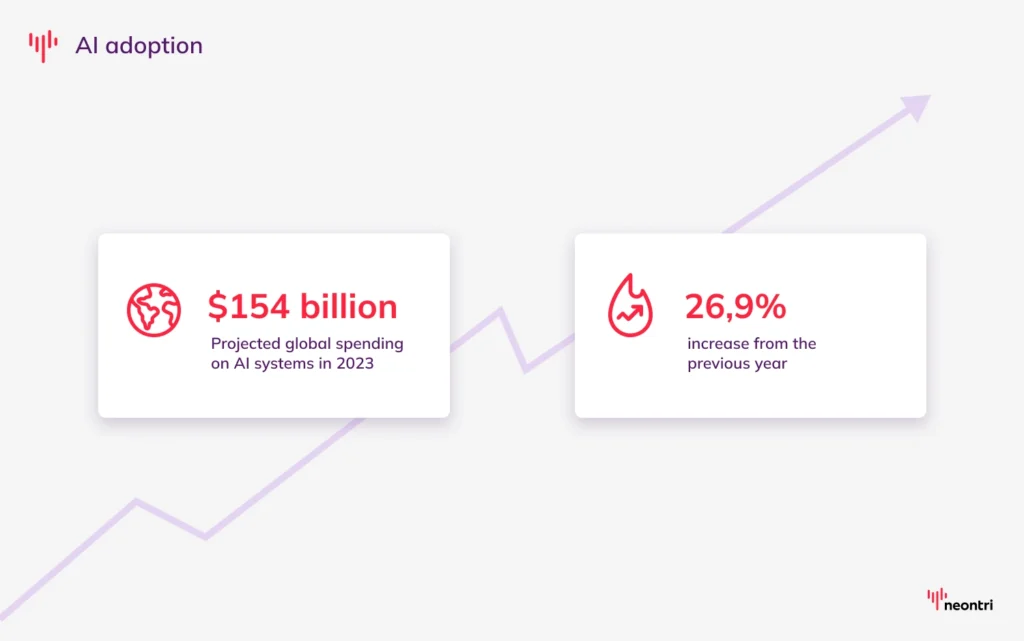
The business world is experiencing an unprecedented wave of AI adoption, with global spending on AI systems projected to reach $154 billion in 2023, a 26.9% increase from the previous year. This surge crosses industries, with particularly strong growth in financial services, healthcare, retail, and manufacturing. The driving technologies include large language models (LLMs), computer vision, predictive analytics, and robotic process automation, all increasingly accessible through cloud-based platforms requiring minimal technical expertise.
Despite this accessibility, implementation success varies dramatically. McKinsey research indicates that only 20% of companies adopting AI report significant bottom-line impact, while the majority struggle with integration challenges, return on investment concerns, and workforce adaptation issues.
This divide between potential and realized value underscores the importance of strategic implementation approaches. This is precisely why real-world insights from industry pioneers offer a clearer path to unlocking AI’s transformative potential.
Strategic approaches to AI implementation
Rather than rushing to adopt the latest tools, organizations must think strategically about how AI fits into their goals, operations, and long-term plans.
Critical thinking vs. blind enthusiasm
In the current AI-driven environment, technology solutions proliferate “like mushrooms after the rain,” creating pressure for rapid adoption. However, successful implementation begins with disciplined evaluation rather than reflexive execution.
“We need to think very closely before we implement this solution or those solutions, to think twice about what is the benefit and what is the disadvantage,“
advises Ronen Chen, cautioning against the common pattern where executives have “stopped thinking” when it comes to AI, assuming technologies like ChatGPT will automatically solve their problems.
This critical evaluation should focus particularly on differentiation. Generic AI solutions rarely provide a sustainable competitive advantage. Instead, Chen recommends creating “a technical barrier… that this startup or this enterprise has a unique value proposition against the industry that nobody has, or they need to take time to create it.” This approach ensures that AI implementation serves strategic goals rather than merely following industry trends.
Incremental implementation and continuous learning
Small, well-defined projects create laboratories for developing AI implementation expertise. Cees Werff, whose insurance company successfully automated document processing, champions this incremental approach:
“Take a small project… prepare it well enough, have a good team understanding, and then take it step by step and implement it. Learn from it, improve it before you move further.”
His company began with a focused application in a single office, allowing them to refine their approach before expanding. This methodical scaling enabled the team to address challenges incrementally rather than facing them simultaneously across the organization. Their system continues to improve through ongoing learning: “There are still a number of cases that are being sent to a default folder, where AI said, ‘Okay, I don’t know what it is.’ And with that, of course, you’re learning every day.”
This continuous improvement model contrasts sharply with “big bang” implementations that attempt to transform entire operations simultaneously, often resulting in disruption and disappointing results.
Balancing long-term vision with short-term gains
Organizations that successfully navigate AI implementation typically maintain parallel strategies addressing both immediate needs and long-term vision. As Chen observes, “The smart companies, or the smart CTO C-level guys… working in two ways, in the short term and the long term.” This balanced approach allows businesses to capture quick wins that build momentum while positioning themselves for more transformative opportunities.
Aurélie Cabezas of Purse, exemplifies this dual focus. While preparing for comprehensive AI integration by hiring dedicated specialists “to help us on that internally and to first assess how we are working in the company,” they’ve simultaneously identified immediate applications in documentation assistance, data analysis, and developer support tools.
This approach creates a virtuous cycle where short-term successes generate organizational support for more ambitious initiatives while providing valuable implementation experience that reduces risk for larger projects.
Real-world applications across industries
The cross-industry application of AI demonstrates both its versatility and the importance of tailoring implementation to specific operational contexts. Successful organizations identify high-value use cases where AI addresses concrete business challenges rather than embracing technology for its own sake.
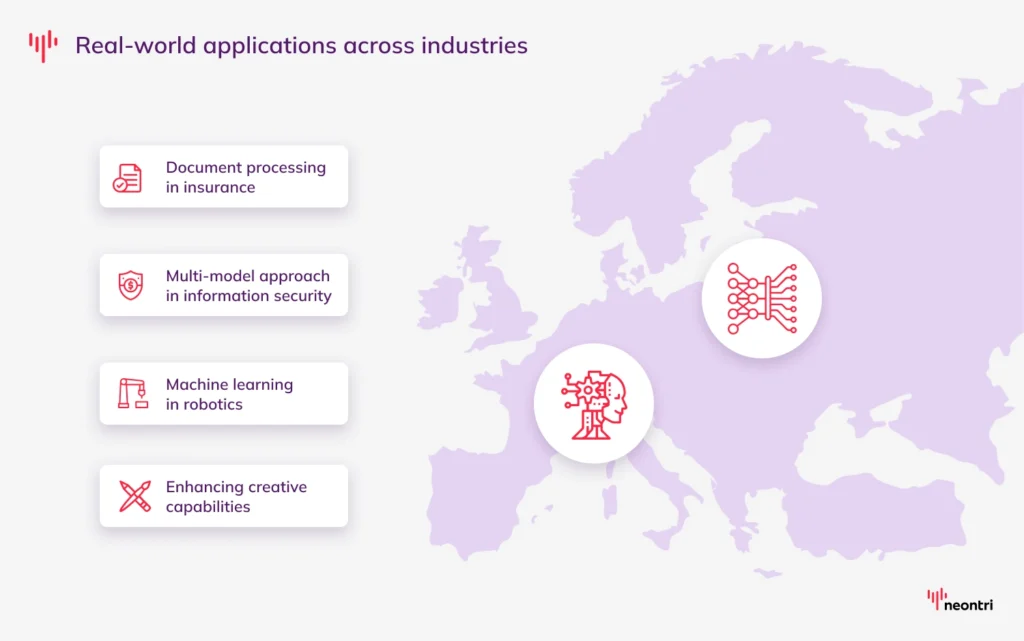
Document processing in insurance
The insurance industry’s document-intensive operations present particularly fertile ground for AI automation. Cees Werff’s company provides a clear success story in implementing an AI system that automates the previously manual task of sorting incoming emails and documents into claim folders.
With a specific KPI—95% of incoming documents correctly processed—the company maintains a clear benchmark for measuring success while acknowledging that perfect automation remains aspirational. This focused application demonstrates how AI can deliver tangible benefits by addressing specific operational pain points rather than attempting wholesale transformation.
The results have been dramatic, with processing time reduced by 60% and staff redirected to higher-value activities involving customer interaction and complex decision-making. The clear ROI from this implementation has built organizational confidence for expanding AI into additional processes.
Multi-model approach in information security
Information security presents unique challenges for AI implementation due to the critical nature of accuracy and the severe consequences of errors. Maksym Sofer’s company has developed a sophisticated “cross-reference” approach to address these concerns when processing vendor security data.
“We use what is called a cross-reference between the models. We use a few different service providers in parallel. We estimate costs, response time, validate the results, etc. We do recalculation on a weekly basis,” Sofer explains. This approach directly addresses a critical challenge in AI implementation: hallucinations or fabricated information.
“Hallucinations are still one of the most challenging things we see in our data as customer feedback,” Sofer acknowledges. By comparing outputs across multiple providers, including OpenAI, Google’s Vertex AI, Perplexity, and Anthropic, they identify discrepancies that signal potential inaccuracies while prioritizing results from the most reliable source for each task.
This multi-model approach demonstrates how organizations can implement redundancy and validation protocols to ensure AI reliability in critical applications—a consideration often overlooked in the rush to implementation.
Machine learning in robotics
Physical-world AI applications face implementation challenges that purely digital applications avoid. Orr Fabian, CTO of Skyline Robotics, offers firsthand insights into these complex real-world implementations. His company has achieved a significant milestone as “the first one ever to clean a skyscraper using a system in New York City,” demonstrating the real-world viability of their window-cleaning robots.
Fabian’s company employs machine learning for specific tasks like “understanding the orientation of the window and detecting seals and obstructions”, while recognizing that traditional algorithms sometimes outperform ML approaches: “Machine learning is either a better way, a quicker way, or sometimes the worst way to do things. It’s not always the best way.”
This pragmatic assessment cuts through the hype often surrounding AI, acknowledging that context determines the most effective approach. For complex real-world applications, Fabian notes:
“I don’t think that the current machine learning and AI models can truly react applicatively to the real world as it is now. But I do think that there is a lot of potential in creating more and more situations to train the models in order to become better and better as we go.”
This methodical, task-specific implementation of AI within a broader tech framework represents a blueprint for organizations seeking to apply artificial intelligence to physical operations. Rather than forcing this technology into every process, Skyline Robotics selectively applies it where it outperforms traditional approaches.
Enhancing creative capabilities
Creative processes present distinctive opportunities for AI augmentation rather than automation. Gilad Braunschvig, EVP of R&D at a company focused on long-term care insurance, highlights how AI dramatically improves creative productivity: “The entire area of creating media is really a huge lift. We can create a number of versions of advertisements, videos, landing pages, and whatever through prompts, which really increases the pace in terms of finding the right thing and reducing costs.”
His team uses AI tools across various functions, including research, document creation, prototyping, design, and video production. These applications demonstrate how AI can serve as a productivity multiplier, enabling teams to explore more options while reducing resource requirements.
This approach to implementation focuses on amplifying human capabilities rather than substituting for them, resulting in both productivity gains and improved creative outcomes. By redirecting professionals toward conceptual work rather than execution, the organization has increased both efficiency and employee satisfaction.
Key implementation challenges
AI implementation presents multifaceted challenges that vary by industry and application type. Understanding and anticipating these challenges is crucial for realistic planning and successful execution.
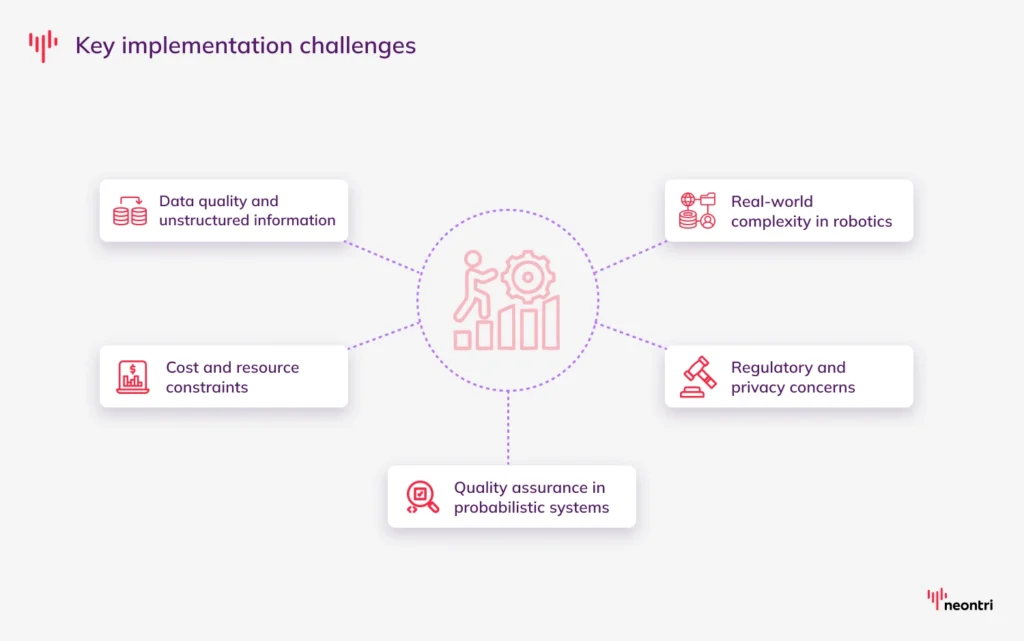
Data quality and unstructured information
Data quality presents the most fundamental implementation challenge across all industries. As Ronen Chen succinctly states, “If you put garbage in, you’re going to get garbage out,” highlighting the importance of proper database architecture as a prerequisite for AI implementation.
The challenge becomes particularly acute when dealing with unstructured information from external sources. Maksym Sofer elaborates on the difficulties of extracting structure from inconsistent vendor documentation: “Vendors don’t follow the same approach of format in this document… the challenge is not only to process them, but to actually extract what we need without designating for each document the structure beforehand.”
Their solution involves multi-stage processing that combines preliminary structure analysis with LLM-based extraction—a sophisticated approach that requires both technical expertise and domain knowledge. This highlights how successful implementation often depends on capabilities beyond the AI technology itself, including data engineering and domain expertise.
Organizations that underestimate the data preparation requirements typically face disappointing results and implementation delays. This problem is pervasive, with many organizations struggling to quantify the true impact of poor data on AI project success; comprehensive AI implementation statistics often reveal the scale of these underlying issues.
Successful adopters typically allocate 60-70% of their AI project resources to data acquisition, cleaning, and preparation rather than to the technology itself.
Cost and resource constraints
The expense of implementing advanced AI solutions creates significant barriers, particularly for small and medium-sized organizations. Maksym Sofer describes the prohibitive costs of running sophisticated AI models: “GPU instance, which is capable of running any reasonably strong model, will cost something like between $10 and $20 per hour. For some companies, it might be considered as a decent amount of money, and it’s not as efficient, like using LLM of ChatGPT for one day.”
Similarly, AI orchestration platforms often exceed many organizations’ budgets: “They provide pricing starting from around a few thousand per month and up to tens of thousands… this is only for orchestration.” These economics force difficult decisions about building custom solutions versus using commercial platforms.
Cost considerations extend beyond technology to talent, with experienced AI specialists commanding premium salaries. Organizations must balance the potential returns against these substantial investments, often leading to a focus on high-value, targeted applications rather than broad implementation.
Quality assurance in probabilistic systems
Traditional software development practices poorly serve AI implementation due to the fundamental shift from deterministic to probabilistic systems. “Most software developers are used to deterministic systems or almost deterministic systems,” Gilad Braunschvig notes. “And now the LLMs bring in a commodity that is less predictable, then you need to put in guardrails to make sure that what you get is good enough.”
This shift requires new quality assurance approaches. Braunschvig describes emerging methodologies: “You can use an LLM as a judge for some criteria… one LLM creates the content, another one is checking.” Alternatively, “you could create a set of manually tested good answers, and then you can ask the bot to compare it to the validated results and see if it’s close enough in different aspects.”
Organizations that attempt to apply traditional testing methodologies to AI systems typically experience both excessive false positives that reject acceptable outputs and dangerous false negatives that allow problematic outputs to reach production. Developing appropriate quality assurance frameworks remains an evolving discipline that requires specialized expertise.
Real-world complexity in robotics
Physical-world AI applications face implementation challenges that are orders of magnitude more complex than their digital counterparts. Orr Fabian articulates this vividly:
“When you create a system, an actual hardware system that you need to send to the world, to the real world, it’s not only about the code… there are, like, a billion different things that can go wrong.”
These complications include electromagnetic interference, wind effects, sensor noise from sunlight, reflections from transparent surfaces, and physical movements of robotic platforms. “The real world contains so much infinite data and things that can go wrong and weird… it’s countless,” Fabian explains, highlighting why physical AI applications often progress more cautiously than their digital counterparts.
This complexity requires implementation approaches that combine extensive simulation, controlled testing, and gradual deployment with strong human oversight. The gap between laboratory performance and real-world reliability often proves wider than anticipated, demanding substantial adaptation of both AI systems and implementation timelines.
Regulatory and privacy concerns
Organizations working with sensitive data face additional implementation challenges. Braunschvig addresses HIPAA compliance in healthcare applications: “We have some systems that are privacy regulated, some systems that are HIPAA regulated… we need to be cautious about how we manage data that goes to LLMs.”
Solutions include implementing private instances of smaller models or carefully managing data sent to external services: “It could be done either by installing our own LLM deployments, the small version, if stuff like Llama can solve them, or to make sure that data management wise, we mitigate what goes into the LLM.”
Ronen Chen highlights how regulatory concerns slow AI adoption in financial services: “Banks have an additional layer of regulations from the GDPR, from SOC 2, from US regulatory and European regulatory. “ This explains why many financial institutions prefer to see successful implementations elsewhere before committing: “They’re not jumping into the pool because they’re afraid… They want to see another bank doing it, and then I will join it.”
These regulatory considerations often dictate implementation architecture, sometimes requiring on-premises deployment rather than cloud solutions or creating data segregation requirements that add complexity and cost. Organizations in regulated industries must factor these constraints into their implementation planning from the outset.
AI’s impact on the workforce and skills
AI implementation inevitably transforms workforce requirements, though in more nuanced ways than often assumed. Understanding these implications is crucial for both organizational planning and individual career development.
Transforming rather than eliminating jobs
Our experts consistently emphasize that AI transforms roles rather than simply eliminating them. Orr Fabian describes how his window-cleaning robots elevate worker roles: “The actual users become robot operators. Instead of cleaning windows, they can sit in a control room watching the robot work. They’re in a safer environment… we’re enhancing people’s lives.”
He elaborates on this worker-friendly approach: “We’re not working against the window cleaners. We’re working with them.” Cleaning companies can now “clean several buildings at the same time for a shorter period of time” instead of having employees work on a single building for months, with workers transitioning to safer, more skilled positions.
Aurélie Cabezas similarly argues that “we will always need someone to be able to build and to maintain and to make sure that it does what it’s supposed to do… we will always need the human somewhere to check or to verify.” She draws parallels to previous technological revolutions: “Like computers. When it started, a lot of people were like, ‘The computers will take our places.’ And now, no, it did not; it created new jobs, basically.”
This transformation pattern appears consistently across industries—routine cognitive and manual tasks increasingly shift to AI systems while humans focus on exception handling, relationship management, creative direction, and system oversight. Organizations that frame AI implementation as augmentation rather than replacement typically encounter less resistance and achieve faster adoption.
The adaptation imperative
While optimistic about AI creating new opportunities, our experts emphasize that adaptation is essential. Gilad Braunschvig observes a fundamental shift in skill valuation:
“The gap between a junior and someone who is senior but is not adopting is shrinking very quickly, because writing code fast is not an asset anymore… defining the problem well and controlling the context becomes the asset.”
He challenges the conventional wisdom that AI primarily threatens junior positions: “For the first couple of years of ChatGPT, [the thinking was] that juniors are going to lose their jobs. I think that more and more people now understand that seniors that do not adapt will lose their jobs.” This observation stems from examples where “people coming right out of the university… produce better quality products and code than people that are 10 years in the industry, because they won’t adapt to the new capabilities.”
Ronen Chen shares this perspective, noting AI’s impact on creative industries: “I’m going to say something that may sound bad, but now, in order to use a graphical or user interface, or create a new JPEG, or element, or a dashboard, I don’t need the designer. I need good storytelling that I can tell to the GenAI to create this dashboard.” He observes that certain positions “are being moved, being eliminated” as AI tools perform creative tasks at a fraction of the cost.
This adaptation imperative applies at both the organizational and individual levels. Companies must invest in retraining programs and create structures that encourage experimentation and learning. Individuals must continuously evolve their skills, focusing on areas where human judgment, creativity, and interpersonal abilities provide distinctive value beyond what AI can deliver.
Future directions and predictions
Understanding emerging AI trends provides crucial context for implementation planning and strategic positioning. Our experts identify several key developments likely to shape the competitive landscape.
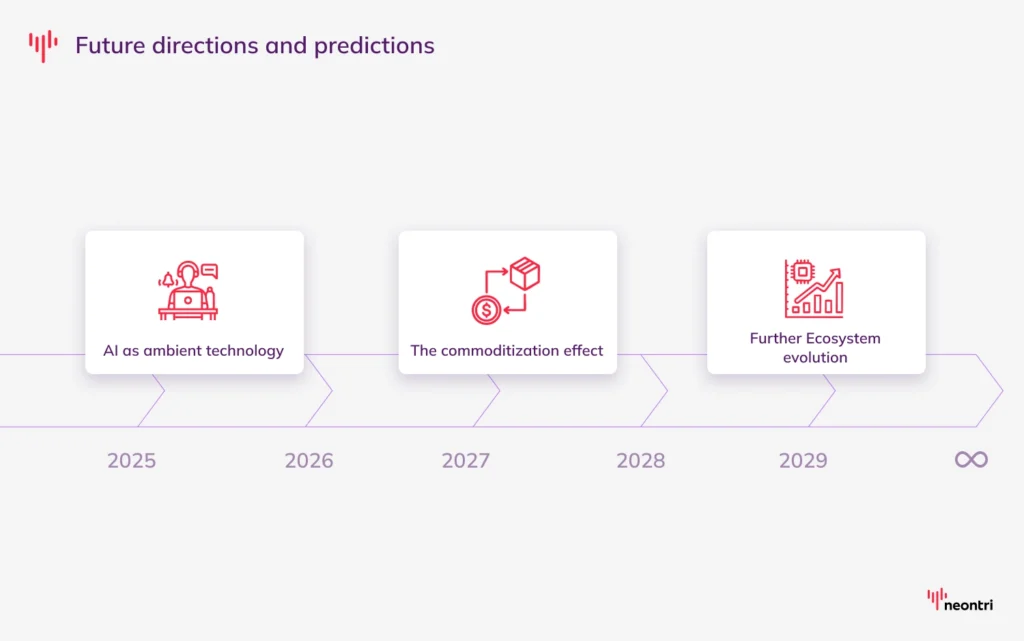
AI as ambient technology
Multiple experts predict AI will evolve into an ambient technology that seamlessly integrates into daily operations without special attention or initiative. Cabezas believes AI “will be just something that we all use, and we won’t even think about it,” comparing it to video conferencing post-COVID: “Before COVID, there were a lot of people that didn’t understand it. And today, it’s for everybody.”
“Take a small project… prepare it well enough, have a good team understanding, and then take it step by step and implement it. Learn from it, improve it before you move further.”
This normalization suggests that organizations should prepare for AI to become an expected capability rather than a differentiator, with the focus shifting to how effectively it’s implemented rather than whether it’s used at all. The competitive advantage will derive from implementation sophistication and integration quality rather than from adoption itself.
This evolution mirrors previous technological transitions, from electricity to computers to internet connectivity, where initial adopters gained significant advantages before the technology became ubiquitous infrastructure. Organizations should anticipate this progression when planning their implementation strategy, capturing early advantages while preparing for a future where AI becomes simply part of the business environment.
The commoditization effect
AI is already rapidly standardizing certain products and services that previously commanded premium pricing. “What you saw immediately is that some products became commodities because the LLM is the application,” Gilad Braunschvig explains, citing examples like video subtitling, where simple AI tools are replacing sophisticated paid services.
This commoditization creates both threats and opportunities. For startups, it represents “an arbitrage there that will be closed probably in the next few years”, where first movers can capture value before standardization drives prices down. For established businesses, it requires an honest assessment of which service offerings face a commoditization threat and which retain distinctive value beyond what AI can easily replicate.
More broadly, Braunschvig anticipates rising productivity expectations across all industries: “The requirements from talking about software engineers before, but I think also in every other job title, the expectation of productivity is just going to be higher.” These changing expectations will transform service offerings: “Many things that used to cost a lot of money, like a lawyer writing the will for you, will become cheap, and then you will just have to provide better service to get your attention.”
Organizations should proactively identify which aspects of their value proposition face commoditization pressure and reorient toward services and capabilities that AI cannot easily replicate. This often involves shifting from information provision to insight generation, from content creation to strategic direction, and from routine cognitive tasks to judgment-intensive activities.
Ecosystem evolution
The AI implementation landscape is rapidly evolving, with Maksym Sofer predicting three key areas of development:
- Orchestration platforms: Systems that coordinate various AI tools will become more accessible and affordable, though currently they remain too expensive for most startups. These platforms will reduce implementation complexity and enable more sophisticated applications.
- Specialized applications: Domain-specific implementations of AI for particular tasks and industries will proliferate, reducing the need for custom development and accelerating adoption in specialized fields.
- Hardware improvements: The shift toward more efficient hardware like Tensor Processing Units (TPUs), specifically designed for AI workloads, will dramatically reduce implementation costs, democratizing access to sophisticated AI capabilities.
Sofer anticipates these developments will disrupt current market leaders: “I foresee that for the coming year or years, we will have a rise in the ability to actually deploy, maintain, run, execute LLM-capable, similar stuff using TPU, which is drastically cheaper, and this will create probably pretty nasty results for guys like Nvidia.”
These ecosystem changes will substantially reduce implementation barriers, particularly for small and medium-sized organizations. Those planning their AI strategy should monitor these developments closely, as they may enable previously unaffordable applications and potentially disrupt current vendor relationships.
The human advantage
Despite AI’s advancing capabilities, several experts highlight how human interaction will become more valuable. Braunschvig anticipates “more human interaction applications like voice or video or things like that,” suggesting that as routine tasks become automated, human elements will become important differentiators.
This perspective suggests that successful AI implementation isn’t about removing humans from processes but channeling their capabilities toward higher-value activities that machines cannot easily replicate—creativity, judgment, empathy, and contextual understanding.
Organizations that view AI primarily as a cost-reduction tool through headcount elimination often miss the more significant opportunity. The most successful implementations typically combine AI efficiency with enhanced human effectiveness rather than simply substituting technology for people.
Industry-specific implementation guidance
Different sectors face distinctive AI implementation challenges and opportunities based on their operational contexts, regulatory environments, and competitive dynamics. The following guidance draws on our experts’ experiences across multiple industries.
Financial services and banking
Financial institutions face unique implementation barriers due to regulatory requirements and security concerns. As Ronen Chen explains, banks operate under strict frameworks like GDPR, SOC 2, and both U.S. and European regulations, which often delay adoption. This results in a cautious, wait-and-see approach—many prefer to observe successful implementations by other institutions before taking similar steps themselves.
Key recommendations:
- Begin with internal, non-customer-facing applications to build implementation expertise while minimizing regulatory concerns.
- Develop robust model explainability capabilities to satisfy regulatory requirements for algorithmic transparency.
- Implement multi-layered security protocols, particularly for applications involving customer financial data.
- Consider on-premises deployment for sensitive applications rather than cloud-based solutions.
- Establish clear audit trails for AI-assisted decisions to satisfy compliance requirements.
Insurance
Insurance operations involve substantial document processing and standardized decision-making, creating natural opportunities for AI implementation. Cees Werff’s successful document processing system demonstrates the potential for targeted automation that enhances rather than replaces human capabilities.
Key recommendations:
- Focus initial implementations on well-defined, high-volume processes with clear success metrics.
- Develop robust exception handling processes for cases where AI confidence falls below acceptable thresholds.
- Gradually expand from document processing to more complex underwriting and claims assessment applications.
- Maintain human oversight for customer-facing decisions to ensure both regulatory compliance and customer satisfaction.
- Use AI to enhance both efficiency and risk assessment accuracy rather than focusing exclusively on cost reduction.
Healthcare and life sciences
Healthcare applications face distinctive challenges involving protected health information, life-critical accuracy requirements, and complex regulatory frameworks. As Braunschvig notes, systems governed by privacy and HIPAA regulations require especially careful handling of any data shared with large language models, underscoring the need for strict compliance in AI implementation.
Key recommendations:
- Implement private instances of AI models where possible to maintain data control.
- Develop rigorous validation protocols for any patient-affecting applications.
- Focus initial implementations on administrative rather than clinical applications.
- Ensure implementation complies with relevant regulatory frameworks, including HIPAA and FDA requirements.
- Develop clear protocols for human oversight and intervention, particularly for clinical applications
Manufacturing and robotics
Physical-world AI applications face unique implementation challenges compared to purely digital applications. Fabian points out that deploying hardware systems introduces layers of complexity beyond software—real-world conditions add countless variables that can derail even well-designed code.
Key recommendations:
- Begin with an extensive simulation before physical deployment to identify potential failure modes.
- Implement phased deployment with strong human oversight during initial operation.
- Develop robust exception handling protocols for environmental variations.
- Combine machine learning with traditional algorithmic approaches where appropriate, rather than forcing ML into all processes.
- Create clear communication protocols for human-machine collaboration rather than attempting full automation.
Technology and software development
Technology organizations face distinctive implementation opportunities in augmenting developer productivity and enhancing product capabilities. Braunschvig emphasizes how AI accelerates creative work by enabling rapid generation of media assets, such as ad variations and landing pages, through simple prompts, significantly speeding up experimentation while lowering costs.
Key recommendations:
- Integrate AI assistance directly into development workflows rather than as separate tools.
- Develop clear quality standards for AI-generated content and code.
- Create paired programming approaches that combine AI generation with human review.
- Focus on enhancing developer productivity while maintaining code quality and security.
- Evaluate which product capabilities could benefit from embedded AI functionality.
Conclusion: A balanced path forward
The collective wisdom of these six industry leaders suggests a nuanced approach to AI implementation:
- Think critically about specific applications rather than adopting AI indiscriminately. The most successful implementations target concrete business challenges with clear value potential rather than implementing technology for its own sake.
- Start small with well-defined projects and clear success metrics. Incremental implementation creates learning opportunities while limiting risk and building organizational confidence.
- Address data quality before attempting sophisticated implementations. Poor data quality inevitably produces disappointing results regardless of model sophistication.
- Consider multiple approaches for critical applications, including AI and traditional algorithms. The most robust implementations often combine AI with traditional approaches rather than relying exclusively on either.
- Prepare for commoditization by focusing on unique value propositions. As AI capabilities become increasingly accessible, competitive advantage will derive from distinctive applications rather than from the technology itself.
- Foster adaptation across all organizational levels. Both leadership and frontline staff must continuously evolve their skills and mental models to effectively integrate AI into operations.
- Envision transformation rather than elimination of human roles. Successful implementation typically redirects human capabilities toward higher-value activities rather than simply eliminating positions.
While AI undoubtedly offers transformative potential, its most successful implementations balance technological capability with business strategy, data quality, ethical considerations, and human expertise. Organizations that navigate these complexities thoughtfully will be best positioned to capture AI’s benefits while avoiding pitfalls.
By learning from the experiences of these diverse industry leaders—in insurance, information security, payment processing, healthcare, robotics, and financial services—decision-makers can develop implementation strategies suited to their specific contexts while benefiting from the broader patterns of successful AI adoption.